BirdNerd Study Deck · Queensland · Australia

Birds of Queensland

Blind-ID flash cards — annotated plates on the front, full field accounts on the back


Birds of QLD
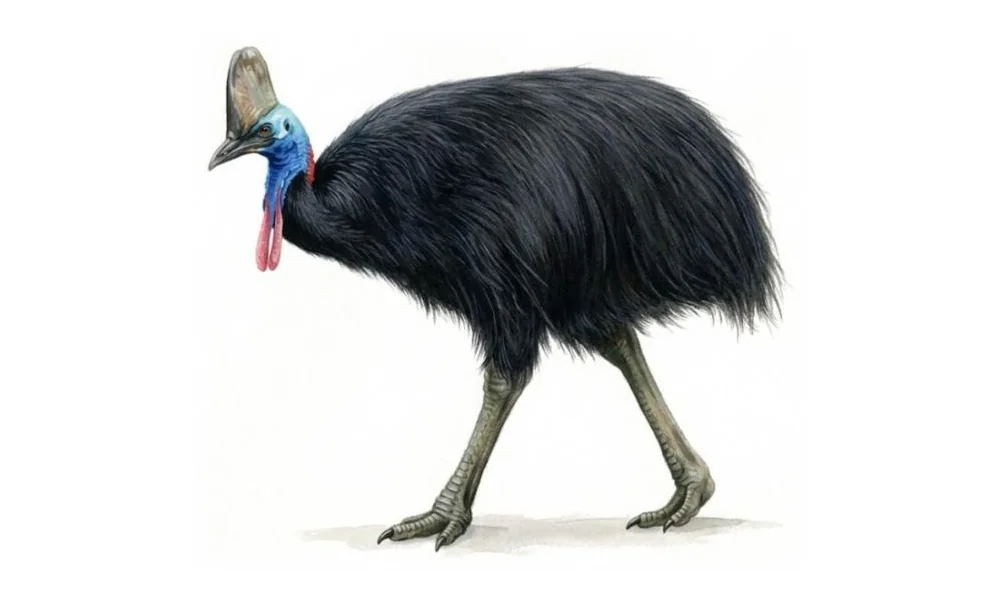
Mystery bird plate I
Casquetall blade-like keratin helmet
Neckbare vivid blue skin, red nape
Wattlestwo pendulous red lobes
Plumagecoarse glossy black, hair-like
Feet3 toes; 12 cm dagger claw
  1. 1Casque tall blade-like keratin helmet
  2. 2Neck bare vivid blue skin, red nape
  3. 3Wattles two pendulous red lobes
  4. 4Plumage coarse glossy black, hair-like
  5. 5Feet 3 toes; 12 cm dagger claw
Adult — sexes alike; ♀ larger No. I

Southern Cassowary

Casuarius casuarius johnsonii

Casuariidae · Cassowaries

No. I130–170 cm; females to ~60 kg — Australia's heaviest birdEPBC Endangered

Description

  • Casque — tall grey-brown blade-like keratin helmet
  • Neck — bare vivid blue skin, red on the nape
  • Wattles — two pendulous red wattles on the foreneck
  • Plumage — coarse, glossy black hair-like feathers
  • Feet — three toes; inner claw a 12 cm dagger
Male glossy black, hair-like plumage; bare blue neck, red nape and twin wattles; tall horny casque. Female larger (to 1.8 m, 60+ kg), taller casque, brighter bare skin. Juvenile brown with dull head, rudimentary casque; chicks striped black and cream.

Behaviour

Strides the rainforest floor alone, gleaning fallen fruit; the key rainforest seed-disperser. Solitary, sedentary in a fixed home range; deep booms and rumbles often heard before seen. Wary; sparse.

Cairns Brisbane

Wet Tropics + Cape York ranges

Distribution

Confined to tropical NE Queensland: Wet Tropics rainforests from Cooktown to the Paluma Range (strongholds at the Daintree and Mission Beach), plus disjunct Cape York populations in the Iron and McIlwraith Ranges. Mostly below 1,100 m.

Habitat

Tropical rainforest, especially lowland and foothill forest with year-round fleshy fruit; also gallery forest, melaleuca swamp, mangroves and wooded corridors between forest patches.

Breeding

Jun–Oct. Clutch 3–5, usually 4, olive-green. Ground scrape lined with leaf litter; male alone incubates ~50 days and rears chicks.
BirdNerd study deck · QLD Seriesssp. johnsonii in Australia; EPBC Endangered.
Mystery bird plate II
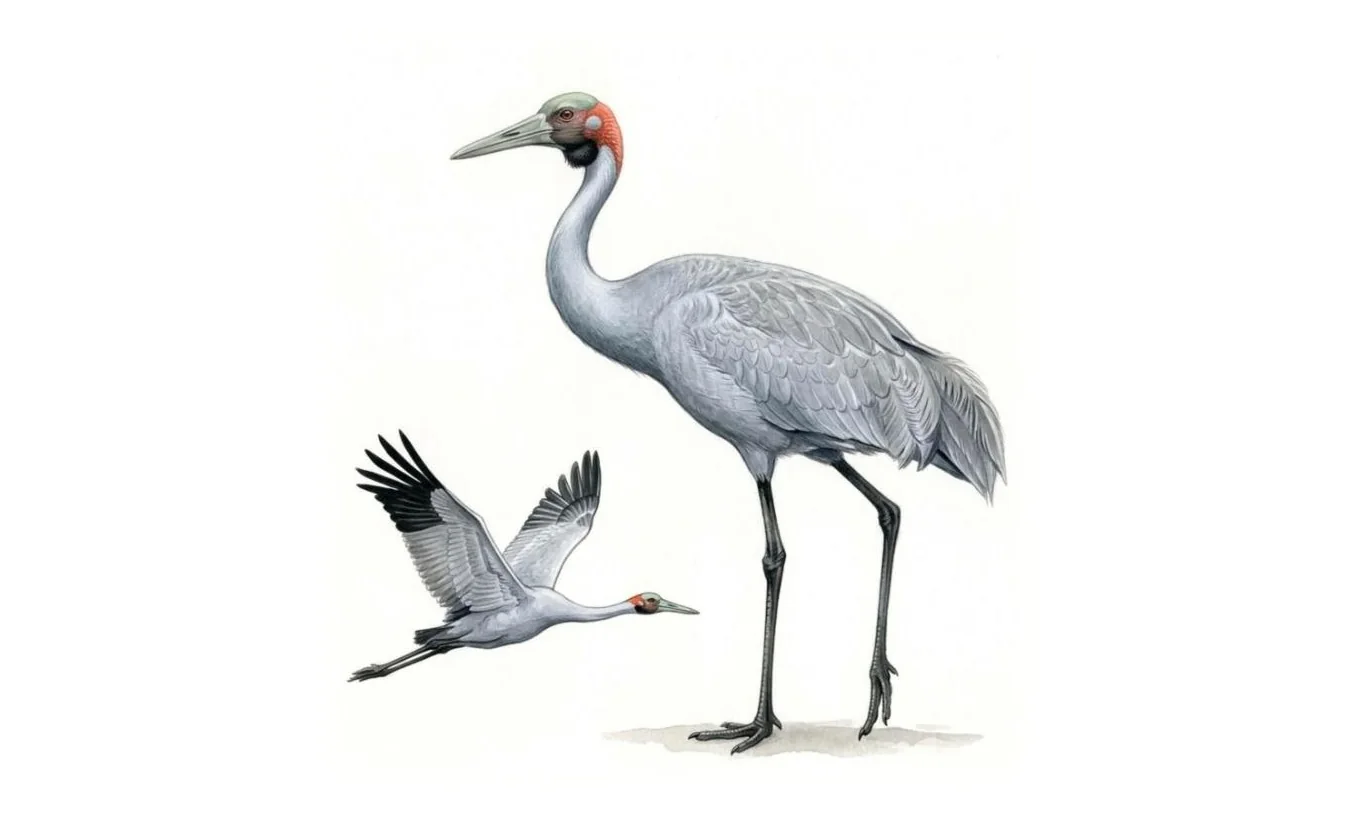
Headcoral-red band, grey-green crown
Dewlapblack bristled pouch under the chin
Plumageuniform silvery-grey body
Wingtipsblack primaries show in flight
Legslong, dark grey-black
  1. 1Head coral-red band, grey-green crown
  2. 2Dewlap black bristled pouch under the chin
  3. 3Plumage uniform silvery-grey body
  4. 4Wingtips black primaries show in flight
  5. 5Legs long, dark grey-black
Adult — sexes alike; ♀ smaller No. II

Brolga

Antigone rubicunda

Gruidae · Cranes

No. II100–130 cm tall; wingspan to 2.4 mLeast Concern (QLD)

Description

  • Head — bare coral-red band behind grey-green crown
  • Dewlap — black bristled pouch under the chin
  • Plumage — uniform silvery-grey body
  • Wingtips — black primaries show in flight
  • Legs — long, dark grey-black
Male tall silver-grey crane; bare red head-band, grey-green crown, black dewlap; dark legs. Female identical but noticeably smaller. Immature fully feathered grey head, lacking red skin; bare adult head develops over the first year.

Behaviour

Digs sedge and bulkuru tubers from shallow wetlands with the heavy bill; also insects, molluscs and crops. Famed bowing, leaping dance displays. Territorial pairs when breeding; dry-season flocks of 100+. Common in the north, scarcer south.

Cairns Brisbane

Statewide (suitable habitat)

Distribution

Widespread across Queensland, which holds Australia's largest populations — Gulf of Carpentaria floodplains and Cape York south through central and western QLD to the SEQ coast. Dry-season flocks on Gulf wetlands can exceed 1,000 birds.

Habitat

Freshwater and brackish wetlands — marshes, shallow lakes, floodplains and wet grasslands; forages in cropland, irrigated pasture and saltmarsh in the dry season.

Breeding

Mainly Feb–May in N QLD (wet season); Sep–Dec in the south. Clutch usually 2. Large vegetation mound islanded in shallow swamp.

BirdNerd study deck · QLD SeriesMonotypic; formerly in Grus, now Antigone.
Mystery bird plate III
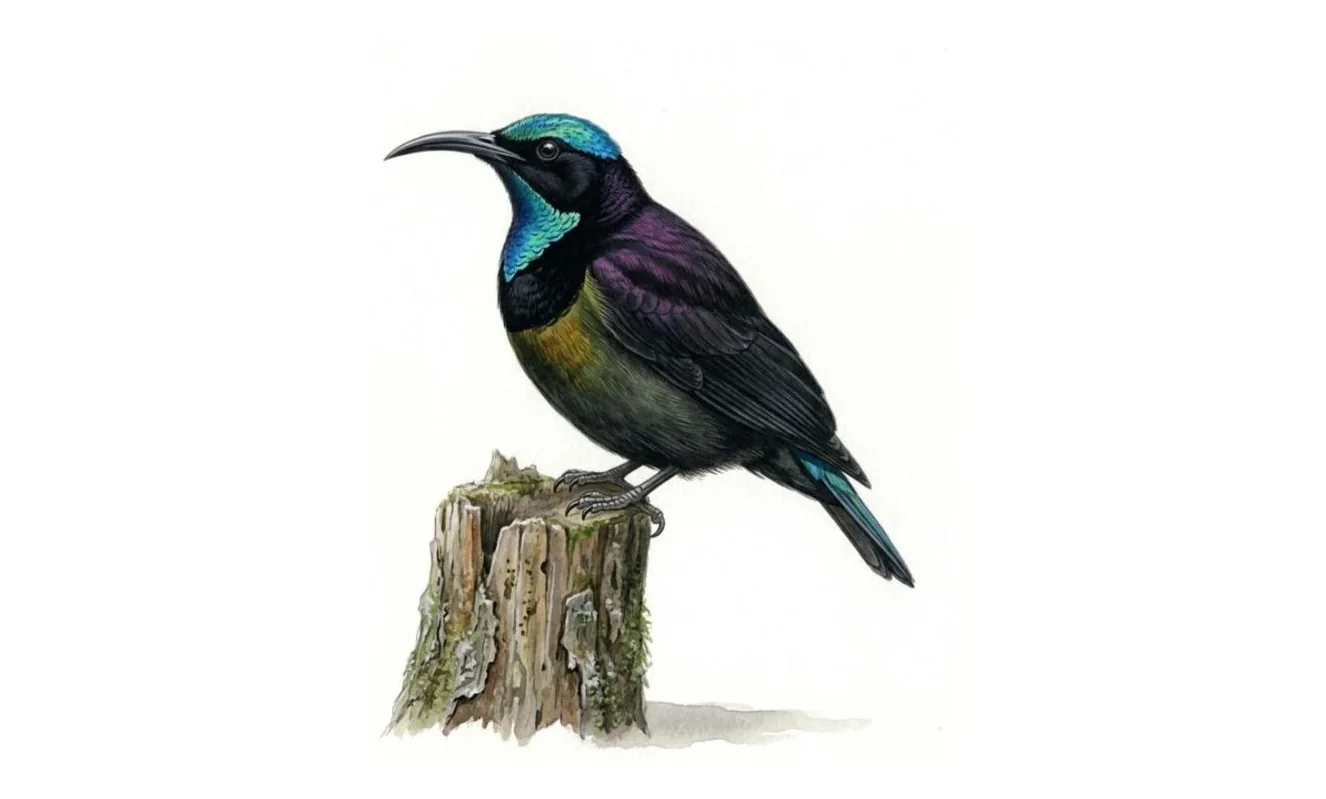
Crowniridescent metallic blue-green cap
Gorgettriangular metallic throat shield
Bodyvelvet black with oily purple sheen
Billlong, slender, gently decurved
Breast bandbronze-olive wash below the gorget
  1. 1Crown iridescent metallic blue-green cap
  2. 2Gorget triangular metallic throat shield
  3. 3Body velvet black with oily purple sheen
  4. 4Bill long, slender, gently decurved
  5. 5Breast band bronze-olive wash below the gorget
Adult ♂ No. III

Victoria's Riflebird

Ptiloris victoriae

Paradisaeidae · Birds-of-paradise

No. III23–25 cm — the smallest riflebirdIUCN Vulnerable

Description

  • Crown — iridescent metallic blue-green cap
  • Gorget — triangular metallic throat shield
  • Body — velvet black with oily purple sheen
  • Bill — long, slender, gently decurved
  • Breast band — bronze-olive wash below the gorget
Male velvet-black with purple sheen; iridescent blue-green crown, throat-shield and central tail; olive-washed belly. Female grey-brown above with whitish eyebrow; cinnamon-buff below, marked with dark chevrons. Immature female-like; young male gains full plumage over several years.

Behaviour

Hops up trunks, probing and tearing bark and dead wood for arthropods; also canopy fruit. Polygynous — the male displays from a traditional perch with fanned wings and a rasping "yaa-ss". Solitary; common within the Wet Tropics.

Cairns Brisbane

Wet Tropics

Distribution

Endemic to the Wet Tropics — Cooktown south to the Seaview Range and Mt Elliot, south of Townsville, including the Atherton Tablelands. Sea level to ~1,200 m; most numerous in upland rainforest.

Habitat

Tropical rainforest at all elevations, plus adjacent wet sclerophyll, swamp woodland and forest edges; visits Tablelands gardens and remnants.

Breeding

Aug–Feb; eggs late Aug–early Jan. Clutch 1–3, usually 2. Leafy cup in vine tangle or tree-fern crown; female alone builds and tends.

BirdNerd study deck · QLD SeriesMonotypic; endemic to the Wet Tropics (Cooktown–Mt Elliot). The smallest riflebird.
Mystery bird plate IV
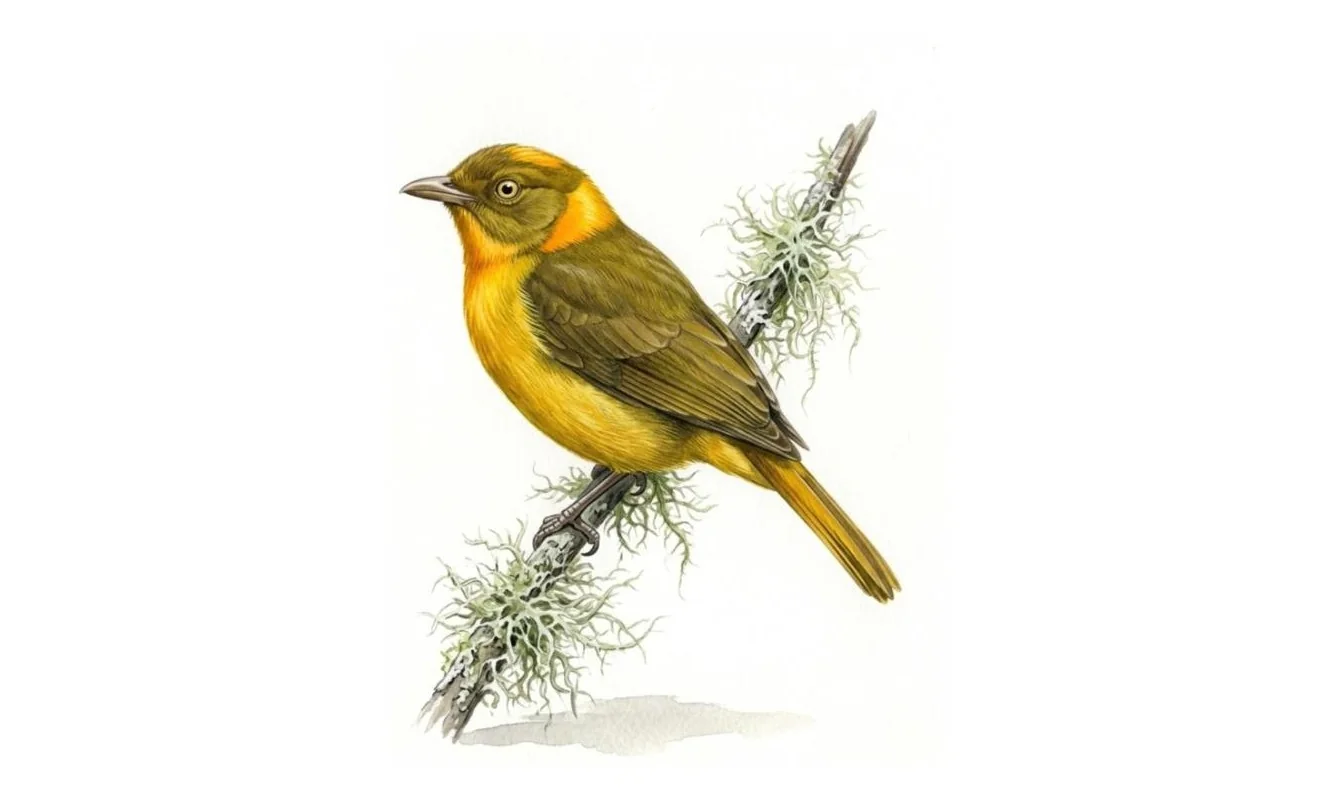
Crown & napeglistening golden patch, silky sheen
Underpartsgolden-yellow, throat to undertail
Upperpartscontrasting olive-brown
Taillargely golden
Eyepale straw eye
  1. 1Crown & nape glistening golden patch, silky sheen
  2. 2Underparts golden-yellow, throat to undertail
  3. 3Upperparts contrasting olive-brown
  4. 4Tail largely golden
  5. 5Eye pale straw eye
Adult ♂ No. IV

Golden Bowerbird

Prionodura newtoniana

Ptilonorhynchidae · Bowerbirds

No. IV23–25 cm — the smallest bowerbirdIUCN Near Threatened

Description

  • Crown & nape — glistening golden patch, silky sheen
  • Underparts — golden-yellow, throat to undertail
  • Upperparts — contrasting olive-brown
  • Tail — largely golden — striking in flight
  • Build — small, compact; ~24 cm
Male olive-brown above with glistening golden-yellow crown-patch and nape; golden-yellow underparts and tail. Female plain olive-brown above, ash-grey below, no yellow. Immature female-like with brown (not pale) eye; male takes 5–6 years to full plumage.

Behaviour

Quietly plucks fruit in the canopy; some insects and spiders taken in sallies. Male tends a twin-towered maypole bower of sticks decorated with lichen and pale flowers, rattling and calling nearby. Solitary, sedentary; sparse, upland rainforest only.

Cairns Brisbane

Wet Tropics

Distribution

Endemic to upland Wet Tropics rainforest — patchily from Mt Windsor and Thornton Peak through the Atherton Tablelands to the Seaview Range near Paluma. Almost entirely above ~900 m.

Habitat

Cool, cloudy upland tropical rainforest with dense canopy, favouring gentle slopes and ridge flanks; avoids heavily cleared forest.

Breeding

Sep–Jan; eggs mainly Nov–Jan. Clutch 1–2. Bulky deep cup wedged in a sheltered trunk crevice, usually below 3 m; female alone.

BirdNerd study deck · QLD SeriesMonotypic; sole member of Prionodura. Endemic to Wet Tropics uplands.
Mystery bird plate V
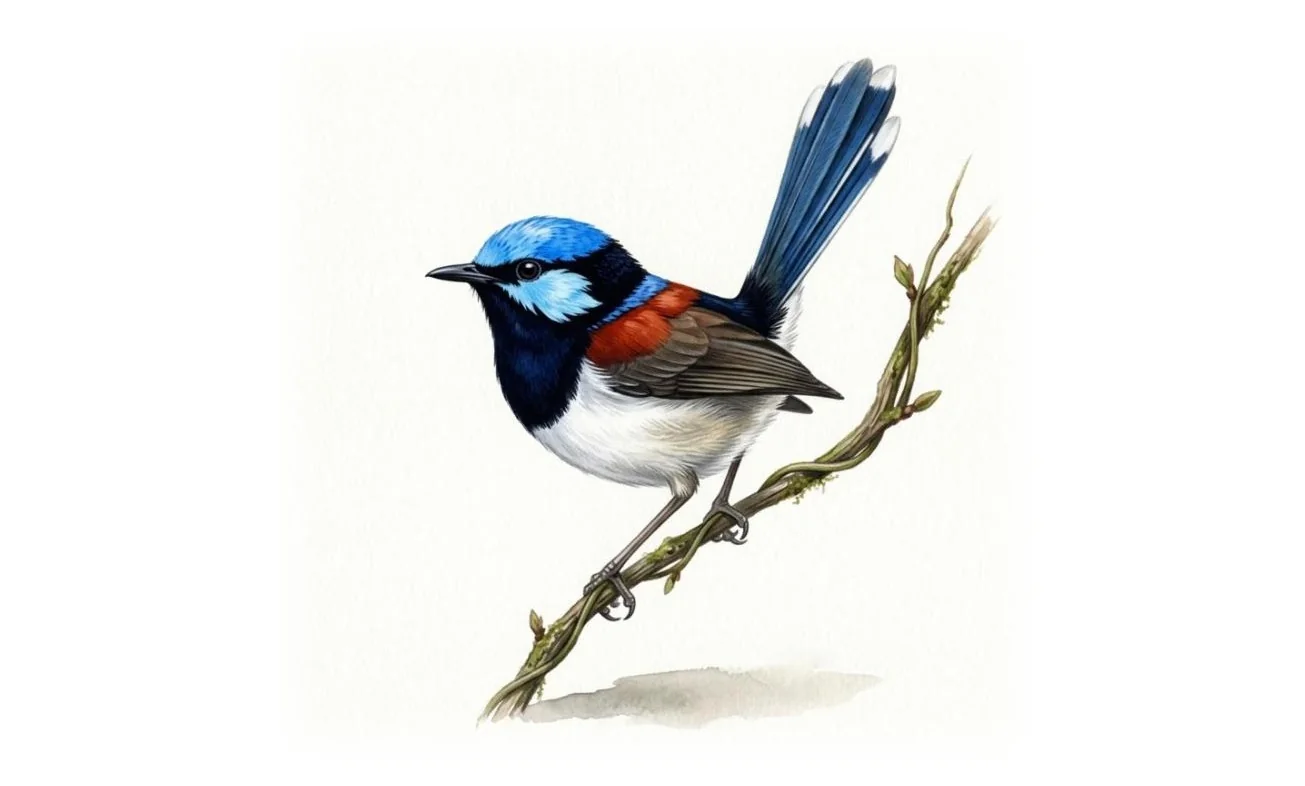
Crownazure, flared pale-blue ear tufts
Throatblack throat and nape band
Shoulderschestnut patches on blue upper back
Tailshort, broad, blue
Bellyclean white against blackish wings
  1. 1Crown azure, flared pale-blue ear tufts
  2. 2Throat black throat and nape band
  3. 3Shoulders chestnut patches on blue upper back
  4. 4Tail short, broad, blue
  5. 5Belly clean white against blackish wings
Adult ♂ No. V

Lovely Fairywren

Malurus amabilis

Maluridae · Australasian wrens

No. V12–14 cm; ~10 gLeast Concern

Description

  • Crown — azure-blue with flared pale-blue ear tufts
  • Throat — black throat and nape band
  • Shoulders — chestnut patches on blue upper back
  • Tail — short, broad, blue — boldest white tips of any fairywren
  • Belly — clean white against blackish wings
Male azure-blue crown, ear-tufts and mantle; black throat and breast; chestnut shoulders; white belly; white-tipped blue tail. Female smoky-blue above with turquoise ear-tufts, white lores and eye-ring, creamy-white below — the brightest female fairywren. Immature female-like, duller.

Behaviour

Gleans insects, especially caterpillars, along rainforest edge and vine scrub; forages higher than most fairywrens, tail fanned and cocked. Pairs and small cooperative groups with helpers; sedentary. Locally common, Cape York to the Townsville region.

Cairns Brisbane

Cape York & NE coast

Distribution

Endemic to far north Queensland — Cape York Peninsula on both coasts, extending down the east coast through the Wet Tropics lowlands to about Cardwell–Townsville. The only fairywren in rainforest-edge habitat across most of this range.

Habitat

Rainforest and monsoon-forest edges, vine thickets, dense regrowth, mangrove fringes and shrubby riparian tangles — wetter, denser habitat than other fairywrens.

Breeding

Most months, mainly Jul–Apr; multiple broods. Clutch 2–3, usually 3. Domed side-entrance nest slung low in dense foliage.

BirdNerd study deck · QLD SeriesMonotypic; chestnut-shouldered group, sister to the Purple-backed Fairywren (M. assimilis).
Mystery bird plate VI
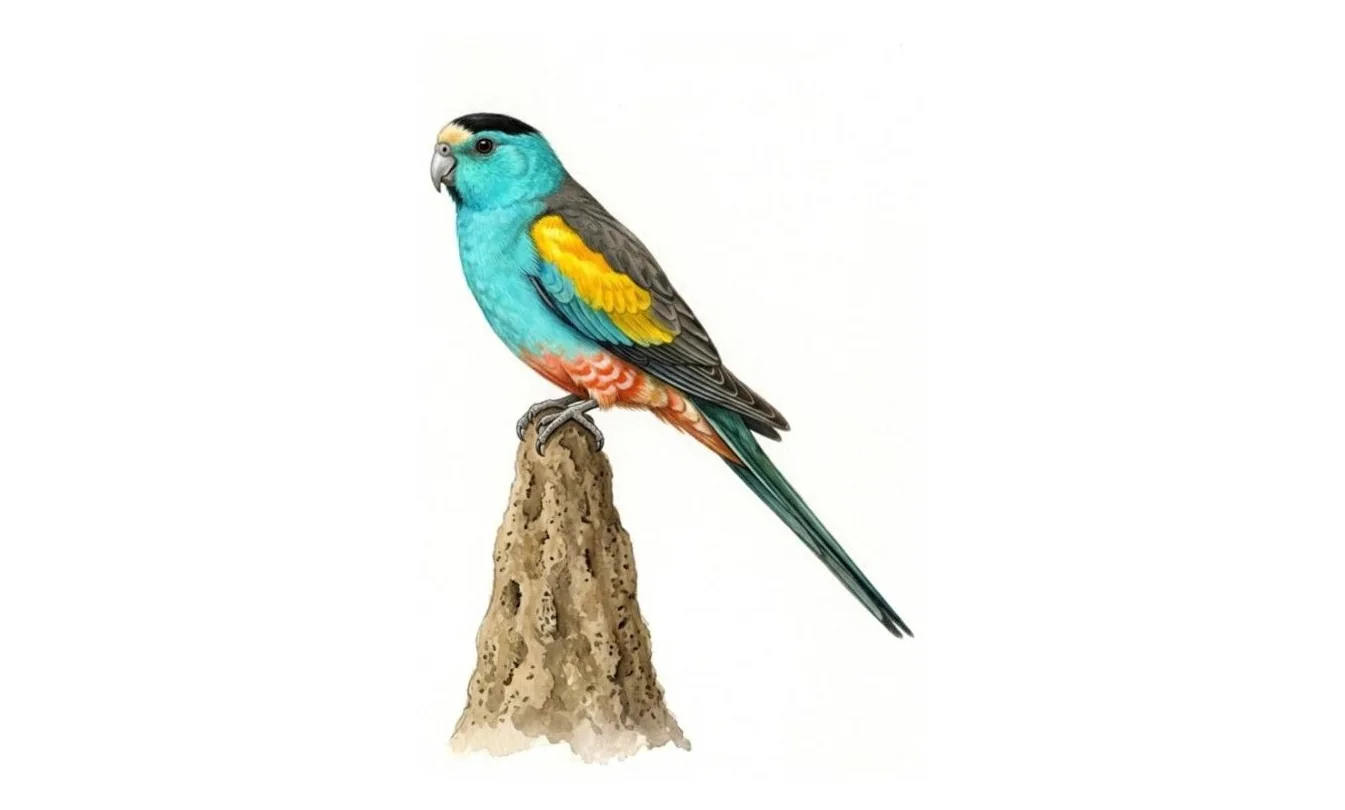
Capblack cap, pale-yellow forehead
Bodyturquoise face and underparts
Shouldergolden-yellow wing-covert patch
Bellysalmon-pink lower belly to undertail
Taillong, dark blue-black
  1. 1Cap black cap, pale-yellow forehead
  2. 2Body turquoise face and underparts
  3. 3Shoulder golden-yellow wing-covert patch
  4. 4Belly salmon-pink lower belly to undertail
  5. 5Tail long, dark blue-black
Adult ♂ No. VI

Golden-shouldered Parrot

Psephotellus chrysopterygius

Psittaculidae · Old World parrots

No. VI25–27 cm; ~55 g; long dark tailEPBC Endangered

Description

  • Cap — black crown behind a pale-yellow brow band
  • Body — turquoise-blue face, breast and underparts
  • Shoulder — golden-yellow patch across wing coverts
  • Belly — salmon-pink lower belly to undertail
  • Mantle — grey-brown back and wings
Male turquoise-blue with black cap, pale-yellow frontal band, golden shoulder patch, salmon-pink belly to undertail; grey-brown back. Female dull greenish-yellow with broad cream underwing-bar; older birds grey-capped. Immature like female; young male shows a brighter blue cheek.

Behaviour

Forages quietly on the ground for grass seed, chiefly fire-grass before the wet season; perches on mounds and low shrubs. Flight swift, slightly undulating. Pairs or small parties; ~700–1,100 wild birds remain, southern Cape York only.

Cairns Brisbane

S-central Cape York

Distribution

Endemic to south-central Cape York Peninsula — now just two small strongholds, around the Morehead River (Artemis Station, near Musgrave) and the middle Staaten River. Lowland savanna only.

Habitat

Open eucalypt and paperbark savanna with sparse grassy understorey and abundant terrestrial termite mounds; favours seasonally inundated grassy flats kept open by fire.

Breeding

Mainly Apr–Jul, soon after the wet (records Mar–Aug). Clutch 3–6, usually 4–6. Unlined chamber at the end of a tunnel dug into a termite mound.

BirdNerd study deck · QLD SeriesMonotypic. Formerly Psephotus; sister to the Hooded Parrot and the extinct Paradise Parrot.
Mystery bird plate VII
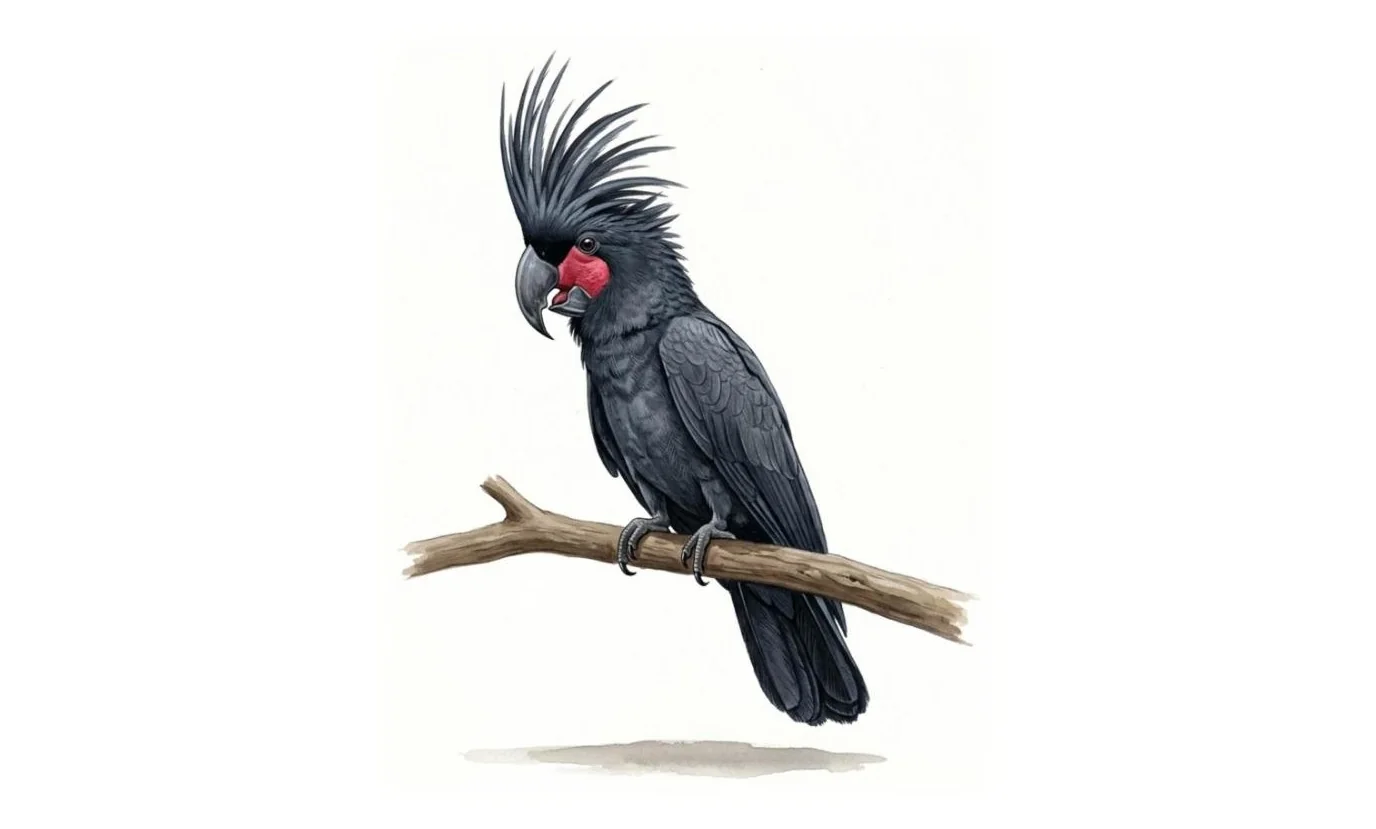
Cresttall, spiky, swept-back crest
Cheekbare crimson patch
Billmassive grey-black hook
Plumageuniform smoky grey-black
Tailbroad, all black
  1. 1Crest tall, spiky, swept-back crest
  2. 2Cheek bare crimson patch
  3. 3Bill massive grey-black hook
  4. 4Plumage uniform smoky grey-black
  5. 5Tail broad, all black
Adult — sexes alike; ♀ smaller bill No. VII

Palm Cockatoo

Probosciger aterrimus macgillivrayi

Cacatuidae · Cockatoos

No. VII55–60 cm; to 1.2 kg — Australia's largest parrotEPBC Endangered · QLD Endangered

Description

  • Crest — tall, spiky, backswept erectile crest
  • Cheek — bare crimson patch — flushes scarlet when excited
  • Bill — massive grey-black hook, largest of any cockatoo
  • Plumage — uniform smoky grey-black
  • Tail — broad, all black — no coloured panels
Male huge, sooty grey-black; massive erectile crest, bare crimson cheek-patch flushing scarlet when excited, enormous grey-black bill. Female similar with a smaller bill. Immature shows pale-yellow scalloping below, whitish bill-tip and pale eye-ring.

Behaviour

Feeds on nuts, hard seeds (pandanus, Parinari), fruit and larvae in canopy and on the ground; the male drums a hollow rim with a fashioned stick or seed pod. Flight slow and buoyant on deep, floppy wingbeats. Singles, pairs, trios; calls at dawn from dead emergents. Sparse; Cape York only.

Cairns Brisbane

Northern Cape York

Distribution

In Australia, only northern Cape York Peninsula — north of Princess Charlotte Bay in the east and the Archer–Watson Rivers in the west, including the Iron and McIlwraith Ranges. Also New Guinea.

Habitat

Rainforest edges and gallery forest plus adjacent tall eucalypt–paperbark woodland; depends on large hollow-bearing savanna trees near rainforest for nesting.

Breeding

Mainly Aug–Jan (recorded to Mar). Clutch 1. Egg on a platform of splintered twigs inside a deep vertical hollow; pairs may fledge one young only every few years.

BirdNerd study deck · QLD SeriesAustralian race macgillivrayi (shared with Trans-Fly New Guinea); sole member of Probosciger.
Mystery bird plate VIII
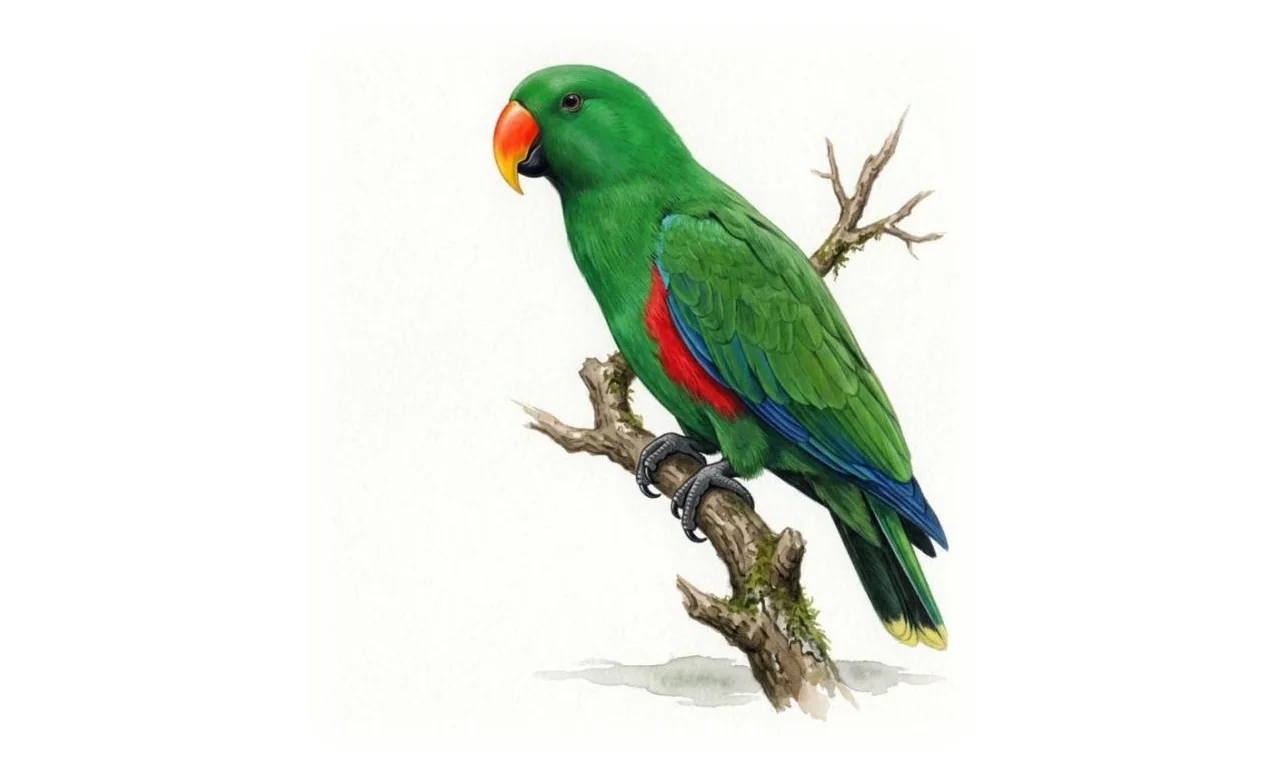
Bodybrilliant emerald green (male)
Flanksscarlet flanks and underwing
Billcandy-orange, yellow tip
Wing edgeblue outer flight feathers
Tailshort, dark green, pale yellow tip
  1. 1Body brilliant emerald green (male)
  2. 2Flanks scarlet flanks and underwing
  3. 3Bill candy-orange, yellow tip
  4. 4Wing edge blue outer flight feathers
  5. 5Tail short, dark green, pale yellow tip
Adult ♂ (♀ crimson & blue) No. VIII

Eclectus Parrot

Eclectus polychloros macgillivrayi

Psittaculidae · Old World parrots

No. VIII42–45 cm — the largest eclectus taxonQLD Endangered

Description

  • Body — brilliant emerald green (male)
  • Flanks — scarlet flanks and underwing, flashing in flight
  • Bill — candy-orange upper mandible, yellow tip
  • Wing edge — blue outer flight feathers
  • Tail — short, dark green, pale yellow tip
Male emerald-green; scarlet flanks and underwing-coverts, blue primaries; upper mandible coral-orange tipped yellow, lower black; orange eye. Female vivid crimson with violet-blue belly-band and collar; all-black bill, pale yellow eye. Immature resembles its sex but duller, bill brownish at first.

Behaviour

Noisy, conspicuous canopy frugivore — fruits, nuts, seeds and blossom; pairs and small groups disperse from communal roosts at dawn. Flight direct with shallow wingbeats and raucous screeches. Complex cooperative breeder, several males provisioning one female. Locally common, eastern Cape York rainforest only.

Cairns Brisbane

Northern Cape York

Distribution

In Australia, only the lowland rainforests of eastern Cape York between the Pascoe and Massy Creek–Rocky River catchments — essentially Iron Range (Kutini-Payamu) and the McIlwraith foothills. Widespread in New Guinea.

Habitat

Lowland tropical rainforest and tall gallery forest; nests only in big hollows high in emergent rainforest trees; visits fruiting forest edges.

Breeding

Jul–Jan; the female may attend the hollow much of the year. Clutch 2. Deep hollow high in an emergent rainforest tree, eggs on decayed wood dust.

BirdNerd study deck · QLD SeriesAustralian race macgillivrayi, the largest form; now within Papuan Eclectus E. polychloros after the split of the E. roratus complex.
Mystery bird plate IX
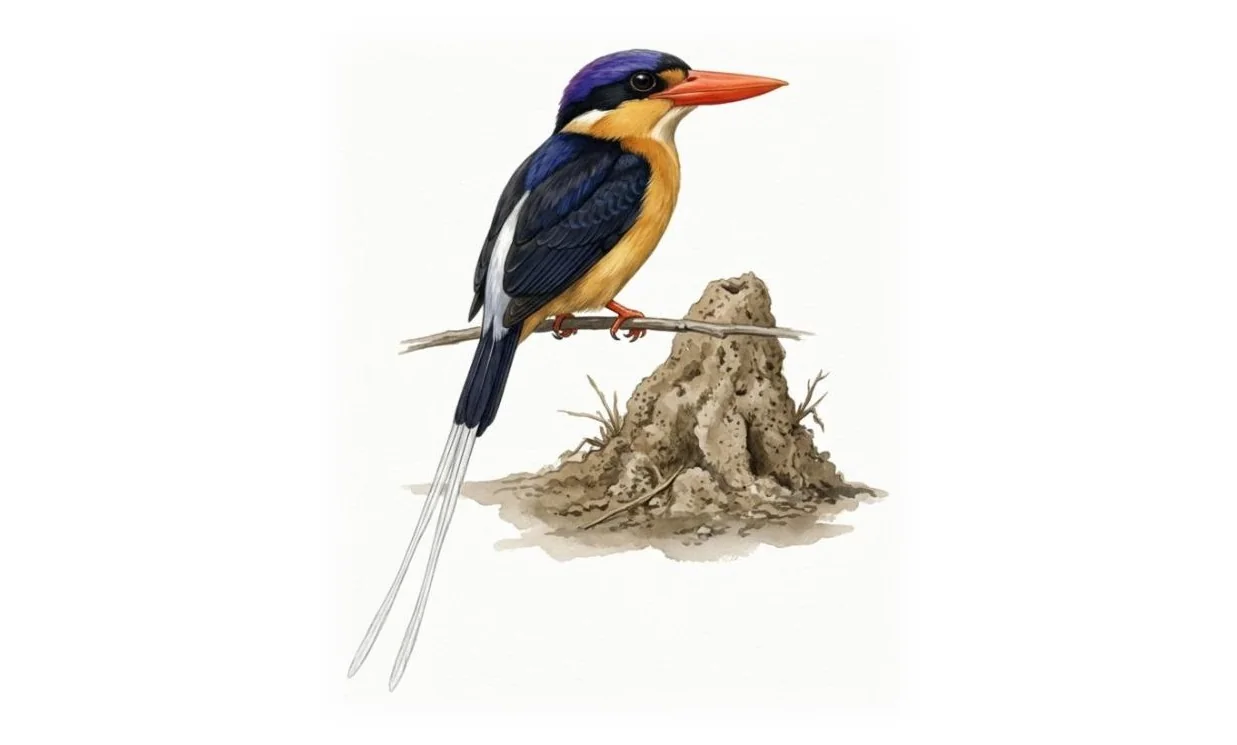
Billbright orange-red
Crownviolet-blue cap over a black mask
Rumpsilky white patch
Streamerstwo long white central feathers
Underpartswarm rufous-buff
  1. 1Bill bright orange-red
  2. 2Crown violet-blue cap over a black mask
  3. 3Rump silky white patch
  4. 4Streamers two long white central feathers
  5. 5Underparts warm rufous-buff
Adult — sexes similar No. IX

Buff-breasted Paradise-Kingfisher

Tanysiptera sylvia

Alcedinidae · Kingfishers

No. IX~35 cm incl. 13 cm tail streamersLeast Concern

Description

  • Bill — bright orange-red, large for the bird
  • Crown — violet-blue cap over a black mask
  • Rump — silky white patch, glowing in dim forest
  • Streamers — two greatly elongated white central tail feathers
  • Underparts — warm rufous-buff
Male orange-buff below with blue cap and wings, blackish back with silky white rump-stripe; scarlet bill; white tail-streamers to 13 cm beyond the tail. Female similar with shorter streamers, often abraded when nesting. Immature duller with brownish bill, buffy scalloping, no streamers.

Behaviour

Still-hunts from a low perch in dim understorey, pouncing on earthworms, beetles, phasmids, skinks and small frogs; located by an incessant chattering trill. Flight swift and darting, the white rump flashing. Solitary or pairs; a wet-season breeding migrant from New Guinea, locally common on the NE QLD coast.

Cairns Brisbane

Wet Tropics

Distribution

Wet-season breeding migrant from New Guinea; core population in the Wet Tropics lowlands between Cooktown and Townsville, mostly below 500 m, with scattered records north through eastern Cape York and south to Byfield.

Habitat

Lowland tropical rainforest, monsoon forest and gallery strips — especially flat, poorly drained forest floor studded with terrestrial termite mounds; keeps to shaded low and mid levels.

Breeding

Arrives early Nov, departs Mar–early Apr; breeds Nov–Mar. Clutch 3–4. Short tunnel and chamber dug into an active terrestrial termite mound.

BirdNerd study deck · QLD SeriesNominate sylvia breeds NE QLD and winters in New Guinea; race salvadoriana resident SE New Guinea.
Mystery bird plate X
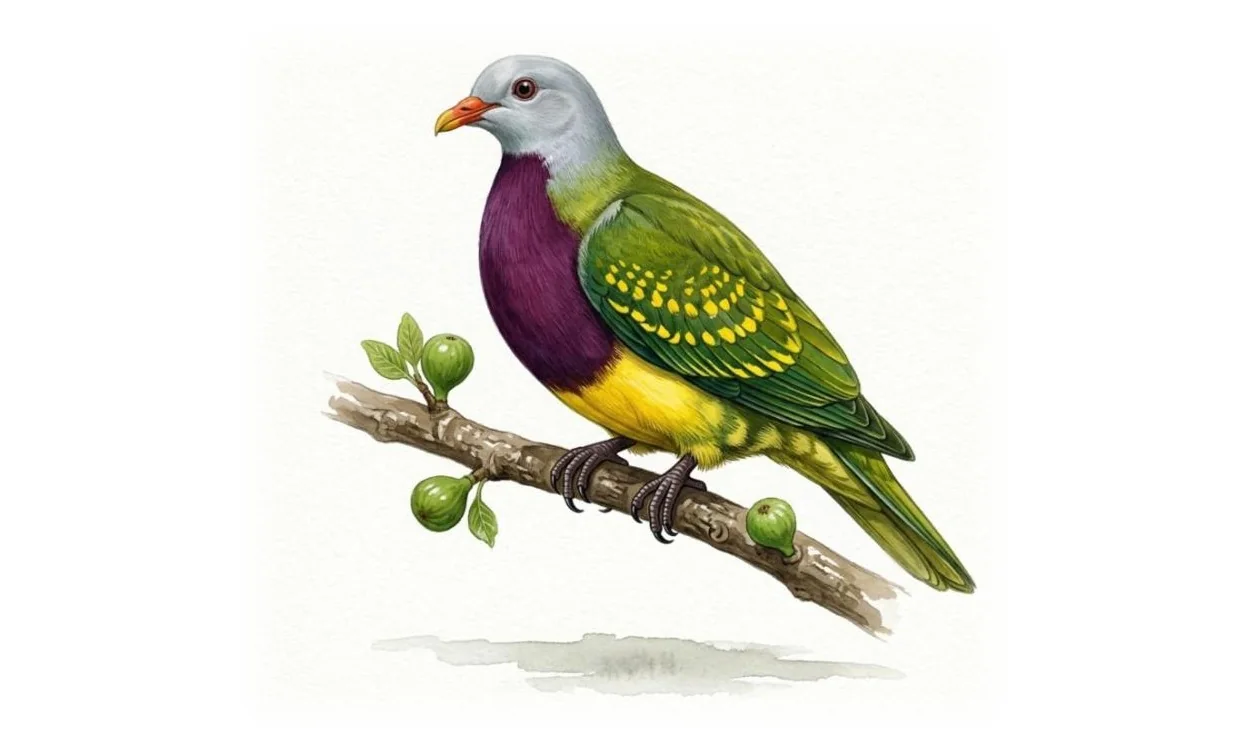
Headpale ash-grey head and neck
Breastrich glossy plum-purple bib
Bellybright yellow below the bib
Wing baryellow spots across green coverts
Upperpartsiridescent golden-green, long tail
  1. 1Head pale ash-grey head and neck
  2. 2Breast rich glossy plum-purple bib
  3. 3Belly bright yellow below the bib
  4. 4Wing bar yellow spots across green coverts
  5. 5Upperparts iridescent golden-green, long tail
Adult — sexes alike No. X

Wompoo Fruit-Dove

Ptilinopus magnificus

Columbidae · Pigeons & doves

No. X35–45 cm — Australia's largest fruit-doveLeast Concern

Description

  • Head — pale ash-grey head and neck
  • Breast — rich glossy plum-purple bib
  • Belly — bright yellow below the bib
  • Wing bar — bold yellow spotting across green coverts
  • Upperparts — iridescent golden-green, long tail
Sexes alike: rich purple throat to upper belly, yellow lower belly, green upperparts, pale grey head, bold yellow wing-bar; orange-red bill tipped yellow. Immature duller and greener, purple reduced or absent. Northern birds markedly smaller.

Behaviour

Sluggish canopy frugivore, swallowing large fruits (figs, laurels) whole; clambers and hangs acrobatically among vines. Easily overlooked — betrayed by falling fruit and the deep "wollack-a-woo". Flight strong, direct. Singly or in pairs; flocks at fruiting trees. Sedentary; locally common north, scarcer south.

Cairns Brisbane

Eastern seaboard

Distribution

East-coast rainforests from eastern Cape York (Iron–McIlwraith Ranges) south through the Wet Tropics and central coast to SEQ and into NSW; lowland to upland rainforest.

Habitat

Tropical and subtropical rainforest, gallery forest and well-developed regrowth with fruiting canopy trees — figs above all. A canopy dweller tracking fruit crops locally.

Breeding

Mainly Aug–Jan, variable with fruit crops in the north. Clutch 1. Flimsy twig platform in a fork of small tree, vine or sapling, often low; both sexes build and incubate.

BirdNerd study deck · QLD SeriesAustralian races: small keri (Wet Tropics) and assimilis (Cape York) v. the large southern nominate; variation partly clinal.
Mystery bird plate XI
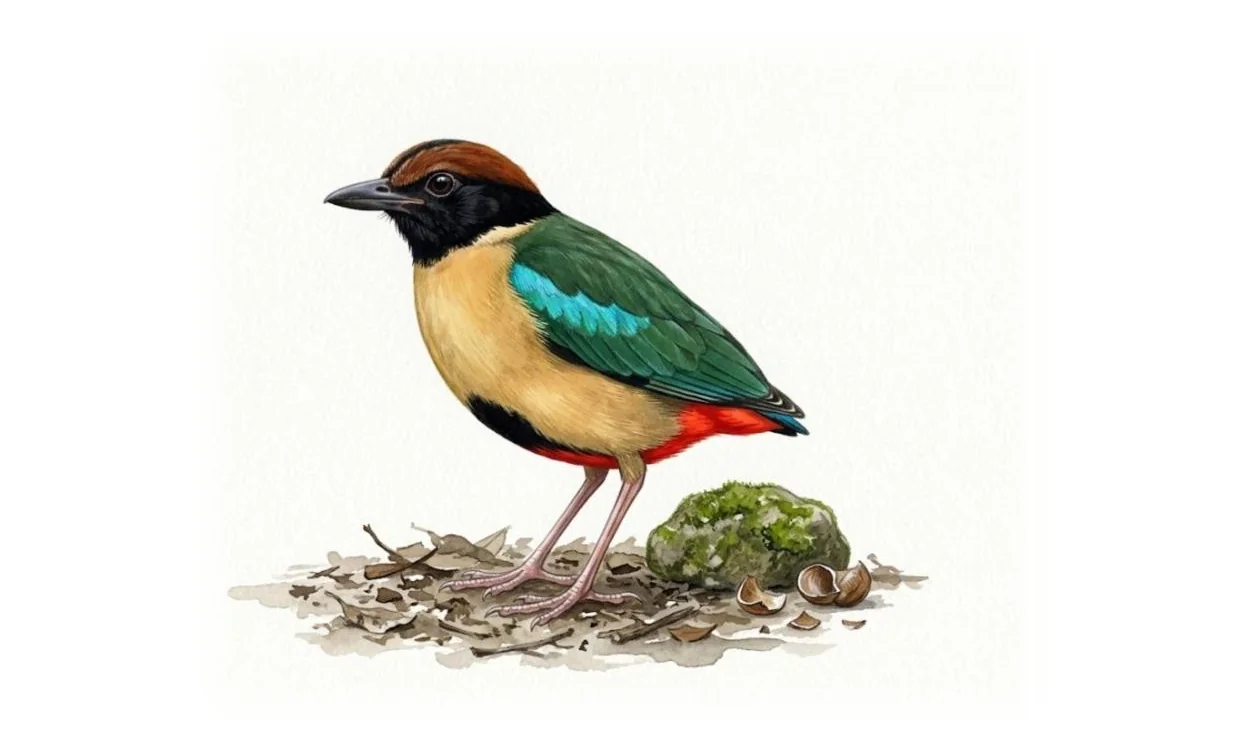
Crownchestnut, black centre stripe
Hoodjet-black face through eye to nape
Breastbuff-yellow
Wingsgreen, turquoise shoulder flash
Legslong, pinkish
  1. 1Crown chestnut, black centre stripe
  2. 2Hood jet-black face through eye to nape
  3. 3Breast buff-yellow
  4. 4Wings green, turquoise shoulder flash
  5. 5Legs long, pinkish
Adult — sexes alike No. XI

Noisy Pitta

Pitta versicolor

Pittidae · Pittas

No. XI19–21 cm; plump, near-taillessLeast Concern

Description

  • Crown — chestnut with a narrow black centre stripe
  • Hood — jet-black face through eye to nape
  • Breast — buff-yellow; black belly patch, scarlet vent
  • Wings — bright green, turquoise shoulder flash
  • Build — plump ground bird on long pinkish legs
Male stocky, short-tailed; chestnut crown with black median stripe, black face; green back, blue shoulder; buff-yellow below with black belly-patch and scarlet vent. Female near-identical, fractionally duller. Immature duller, washed-out, with grey-black orange-based bill and reduced red vent.

Behaviour

Hops on the rainforest floor flicking leaf-litter; hammers snails open on stone or log anvils. Flight low, whirring, direct; mostly terrestrial. Solitary or pairs; common but shy in coastal QLD rainforests, with some altitudinal movement in winter. The far-carrying "walk-to-work" betrays it.

Cairns Brisbane

Eastern seaboard

Distribution

Coastal and subcoastal eastern QLD from Torres Strait and Cape York through the Wet Tropics to SEQ. In the Wet Tropics an altitudinal migrant — breeding upland in summer, wintering in the lowlands.

Habitat

Rainforest floor and adjacent wet sclerophyll, vine scrub and dense gullies; some winter movement into drier woodland and mangrove edges.

Breeding

Mainly Oct–Jan in QLD (Nov–Feb on Cape York). Clutch 3–4. Bulky domed stick-and-leaf nest with side entrance, on the ground at a tree base, buttress or log.

BirdNerd study deck · QLD SeriesTwo: versicolor (Cairns district to NSW) and simillima (Torres Strait and Cape York; partial migrant to New Guinea) — intermedia no longer recognised, the variation clinal.
Mystery bird plate XII
Eye stripebroad dark band through the eye
Billmassive
Shouldersmall sky-blue spotted patch
Underpartsoff-white, faintly barred
Tailrufous, barred dark, white-tipped
  1. 1Eye stripe broad dark band through the eye
  2. 2Bill massive
  3. 3Shoulder small sky-blue spotted patch
  4. 4Underparts off-white, faintly barred
  5. 5Tail rufous, barred dark, white-tipped
Adult — sexes alike; ♀ larger No. XII

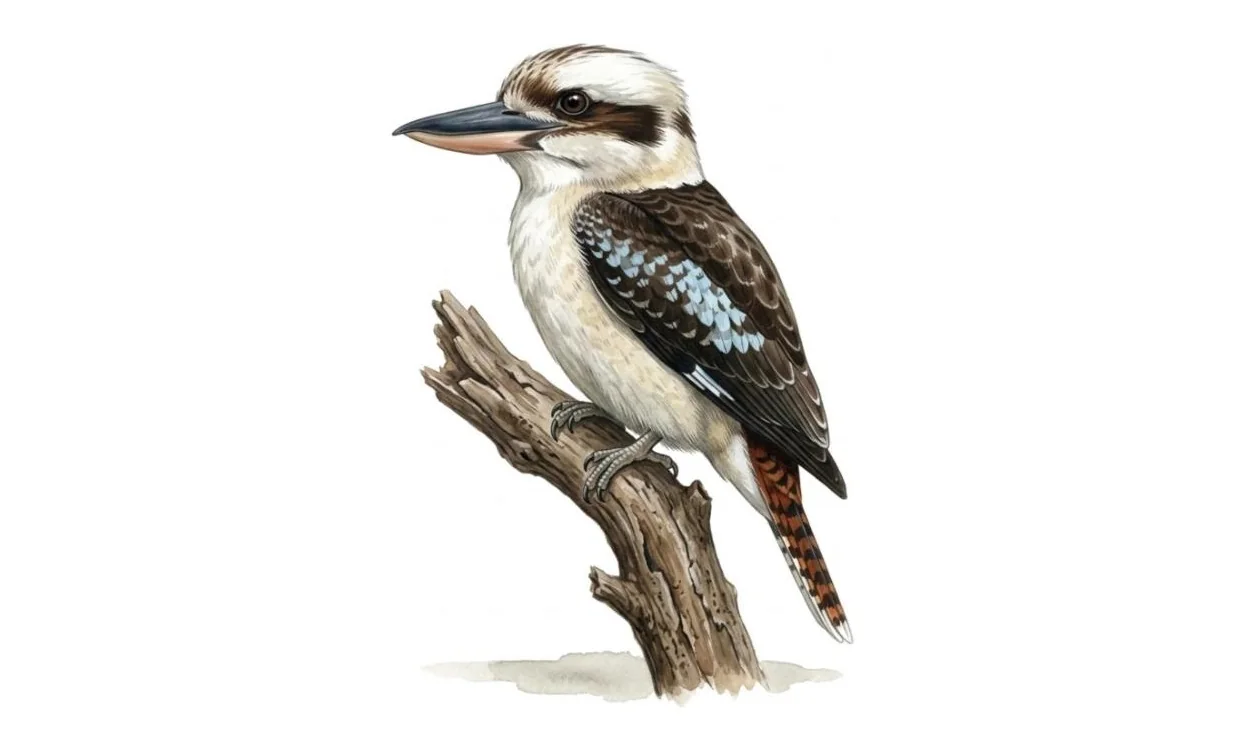
Laughing Kookaburra

Dacelo novaeguineae

Alcedinidae · Kingfishers

No. XII41–47 cm — the world's heaviest kingfisherLeast Concern

Description

  • Eye stripe — broad dark brown band through a whitish head
  • Bill — massive; black above, horn below
  • Shoulder — small sky-blue spotted patch
  • Underparts — off-white, faintly barred
  • Tail — rufous, barred dark, white-tipped
Male whitish head and underparts with dark brown eye-stripe; brown back; blue-flecked wing coverts, blue wash on rump; rufous tail barred black. Female alike, slightly larger, with little or no blue on the rump. Immature duller and mottled, with dark scalloping and shorter bill.

Behaviour

Perch-and-pounce hunter — drops onto insects, reptiles and small vertebrates, bashing large prey on a branch. Flight direct and heavy on shallow wingbeats. Sedentary, in territorial family groups with helpers from previous broods; famous dawn and dusk chorus. Common and conspicuous throughout eastern QLD.

Cairns Brisbane

Eastern Queensland

Distribution

Throughout eastern Queensland from Cape York to the NSW border, well inland along wooded watercourses; absent from the treeless arid west. Smaller subspecies minor on Cape York. Common in Brisbane.

Habitat

Open sclerophyll forest and woodland with sparse understorey, farmland with scattered trees, and urban parks and gardens.

Breeding

Aug–Jan, peak Sep–Dec. Clutch usually 3 (2–4). Unlined chamber in a tree hollow or excavated arboreal termitarium; the group shares incubation and feeding.

BirdNerd study deck · QLD SeriesTwo: nominate over most of the range; minor of Cape York smaller. Despite the epithet, absent from New Guinea.
Mystery bird plate XIII
Headviolet-blue, fine pale streaks
Collargreenish-yellow nape band
Breastorange-red, unbarred
Bellydeep blue-violet
Billorange-red (dark in juveniles)
  1. 1Head violet-blue, fine pale streaks
  2. 2Collar greenish-yellow nape band
  3. 3Breast orange-red, unbarred
  4. 4Belly deep blue-violet
  5. 5Bill orange-red (dark in juveniles)
Adult — sexes alike No. XIII

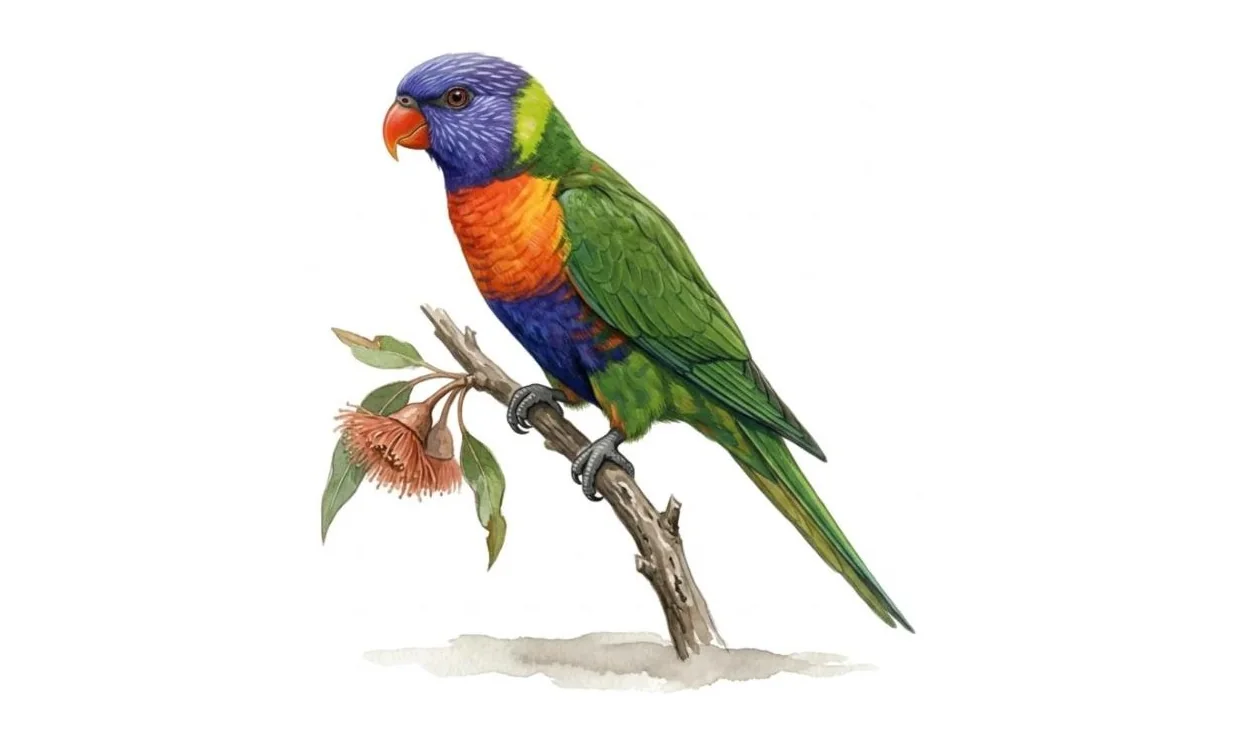
Rainbow Lorikeet

Trichoglossus moluccanus

Psittaculidae · Lorikeets

No. XIII25–30 cm; ~130 gLeast Concern

Description

  • Head — violet-blue with fine pale shaft streaks
  • Collar — greenish-yellow nape band
  • Breast — orange-red, unbarred
  • Belly — deep blue-violet
  • Bill — bright orange-red (dark in juveniles)
Sexes alike: violet-blue head and belly, orange-red breast, yellow-green nuchal collar, green upperparts; scarlet bill, red eye. Immature duller with brown-black bill, brown eye and shorter tail.

Behaviour

Swift, direct, screeching flight on whirring wings. Clambers acrobatically through blossom; the brush tongue takes nectar and pollen, plus fruit, seeds and insects. Noisy pairs and flocks; large communal dusk roosts. Abundant, tracking flowering; thrives in QLD towns and gardens.

Cairns Brisbane

Eastern seaboard

Distribution

Eastern seaboard from Cape York to the NSW border, on and near the coast and adjacent ranges; abundant in coastal SEQ cities. Australia's most commonly recorded bird.

Habitat

Rainforest edge, eucalypt forest and woodland, coastal heath and mangroves; thrives in flowering street trees and gardens.

Breeding

Mainly Jun–Jan in QLD; can breed most months in the north. Clutch usually 2 (1–3). Eggs on decayed wood-dust in a high eucalypt hollow; female alone incubates.

BirdNerd study deck · QLD SeriesSplit from the Coconut Lorikeet (T. haematodus) complex; nominate moluccanus in E Australia, smaller septentrionalis on Cape York.
Mystery bird plate XIV
Camouflagesilver-grey, streaked black
Billwide, hooked, bristle-fringed
Eyelarge, yellow, side-facing
Posturebolt-upright broken-branch pose
Underpartspale grey, finely dark-streaked
  1. 1Camouflage silver-grey, streaked black
  2. 2Bill wide, hooked, bristle-fringed
  3. 3Eye large, yellow, side-facing
  4. 4Posture bolt-upright broken-branch pose
  5. 5Underparts pale grey, finely dark-streaked
Adult ♂, grey morph No. XIV

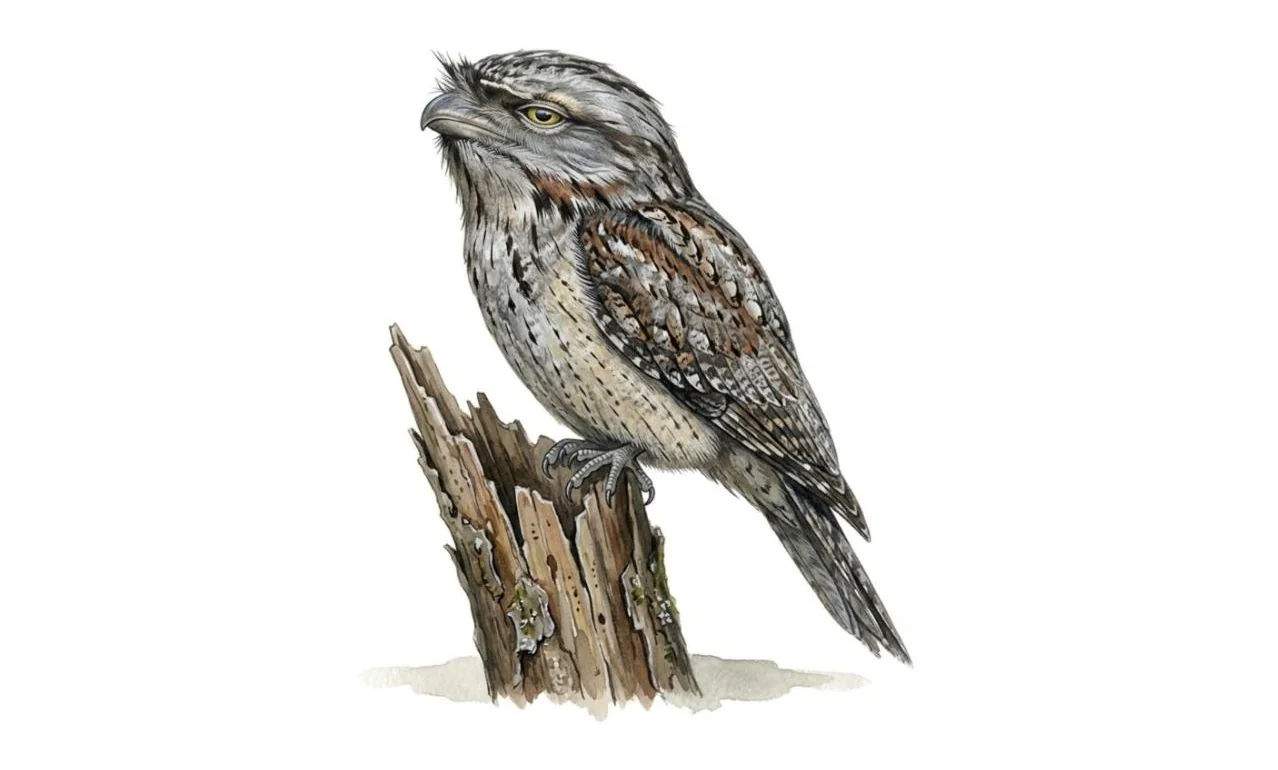
Tawny Frogmouth

Podargus strigoides

Podargidae · Frogmouths

No. XIV34–53 cmLeast Concern

Description

  • Camouflage — silvery-grey, mottled and streaked black
  • Bill — wide, hooked 'frog mouth' with bristle tufts
  • Eye — large, yellow, side-facing — no facial disc
  • Posture — bolt-upright broken-branch pose by day
  • Underparts — pale grey, finely dark-streaked
Male silver-grey, finely streaked and mottled black and rufous; massive flattened olive-grey bill, yellow eye. Female often browner or rufous-washed with finer markings; a chestnut-red morph is mostly female. Immature paler and fluffier with diffuse markings.

Behaviour

Nocturnal; pounces from a low perch onto insects, worms and small vertebrates, some prey hawked in flight. Flight silent, mothlike. By day freezes upright in the cryptic broken-stick pose; pairs sedentary, roosting together. Common but overlooked throughout QLD; soft resonant "oom-oom" at night.

Cairns Brisbane

Statewide (suitable habitat)

Distribution

Virtually statewide wherever there are trees — coast, ranges and inland woodland; the smaller, paler subspecies phalaenoides across the Gulf and north. Absent only from treeless desert; avoids dense rainforest interior.

Habitat

Eucalypt forest, woodland, scrub, heath and savanna with perching trees; common in urban parks and gardens.

Breeding

Aug–Dec, opportunistic after rain inland. Clutch 2–3, often 2. Flimsy stick platform on a horizontal fork; male incubates by day, pair shares at night.

BirdNerd study deck · QLD SeriesThree Australian races: nominate (E Australia incl. S QLD), smaller paler phalaenoides (tropical north), brachypterus (west).
Mystery bird plate XV
Head & neckbare bright-red skin
Wattleyellow throat wattle (male)
Plumagesooty black, loose and coarse
Taillarge fan, flattened vertically
Feetpowerful
  1. 1Head & neck bare bright-red skin
  2. 2Wattle yellow throat wattle (male)
  3. 3Plumage sooty black, loose and coarse
  4. 4Tail large fan, flattened vertically
  5. 5Feet powerful
Breeding ♂ detail
Breeding ♂
Adult ♂ No. XV

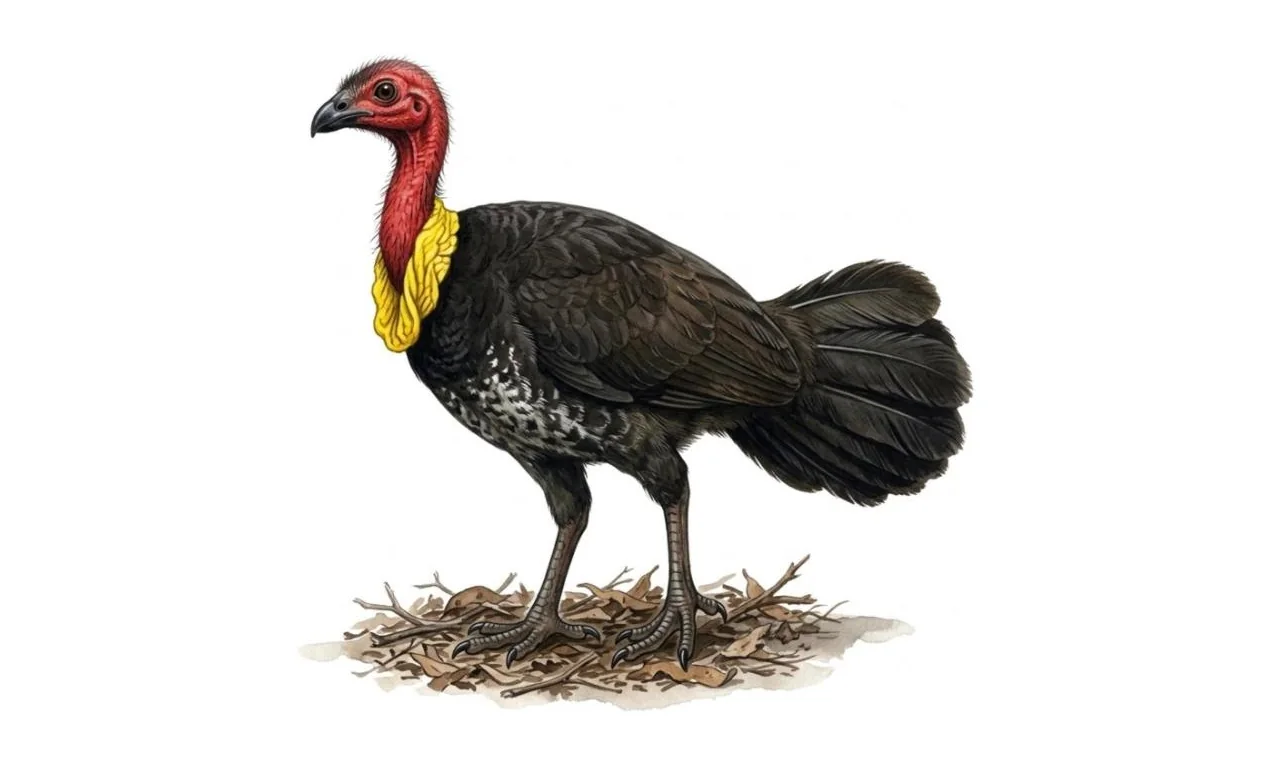
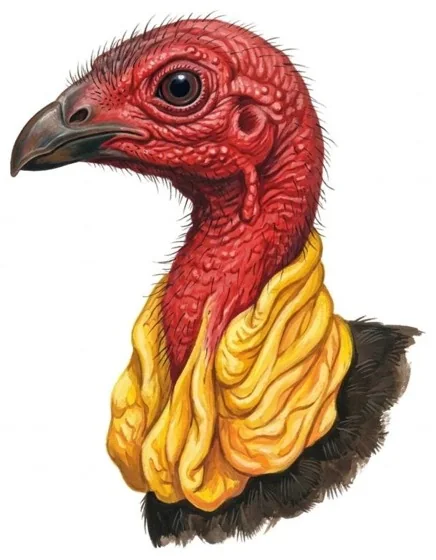
Australian Brush-turkey

Alectura lathami

Megapodiidae · Mound-builders

No. XV60–75 cm; ~2.3 kgLeast Concern

Description

  • Head & neck — bare bright-red skin, sparse bristles
  • Wattle — pendulous yellow throat wattle (male)
  • Plumage — sooty black, loose and coarse
  • Tail — large fan, flattened vertically — unique
  • Feet — powerful; rakes litter backwards
Male large, black-plumaged; bare red head, pendulous yellow wattle enlarging and brightening when breeding; laterally flattened fan tail; white-flecked underparts. Female smaller with a paler, reduced collar. Immature brown and mottled with feathered head and neck; no wattle.

Behaviour

Rakes leaf-litter powerfully for invertebrates, seeds and fallen fruit; a bold raider of gardens and compost. Flight clumsy and brief; flutters up to roost in trees. Usually solitary or in loose groups; mound-owning males territorial. Common in SE and NE QLD rainforest, scrub and suburbs.

Cairns Brisbane

Eastern seaboard

Distribution

Eastern QLD from the tip of Cape York through the Wet Tropics and coastal ranges to SEQ. Purple-wattled subspecies purpureicollis on northern Cape York; yellow-wattled nominate elsewhere. Abundant in suburban Brisbane.

Habitat

Rainforest and wet sclerophyll, extending into drier vine scrub and gardens; rakes mulch and litter in urban bushland.

Breeding

Eggs Aug–Mar, peak Sep–Dec. Each female lays ~18–24 eggs singly, several females per mound (up to 50 eggs); male-tended mound of raked litter and soil held at 33–35 °C. Chicks independent at hatching.

BirdNerd study deck · QLD SeriesTwo: nominate lathami (yellow wattle); purpureicollis of N Cape York smaller, with purple-white wattle.
Mystery bird plate XVI
Necksnake-like S-kink, white stripe
Billstraight, finely pointed dagger
Bodybrown-black, chestnut breast (male)
Wingsilvery-white streaking
Taillong, broad, stiff fan
  1. 1Neck snake-like S-kink, white stripe
  2. 2Bill straight, finely pointed dagger
  3. 3Body brown-black, chestnut breast (male)
  4. 4Wing silvery-white streaking
  5. 5Tail long, broad, stiff fan
Adult ♂ (♀ pale below) No. XVI

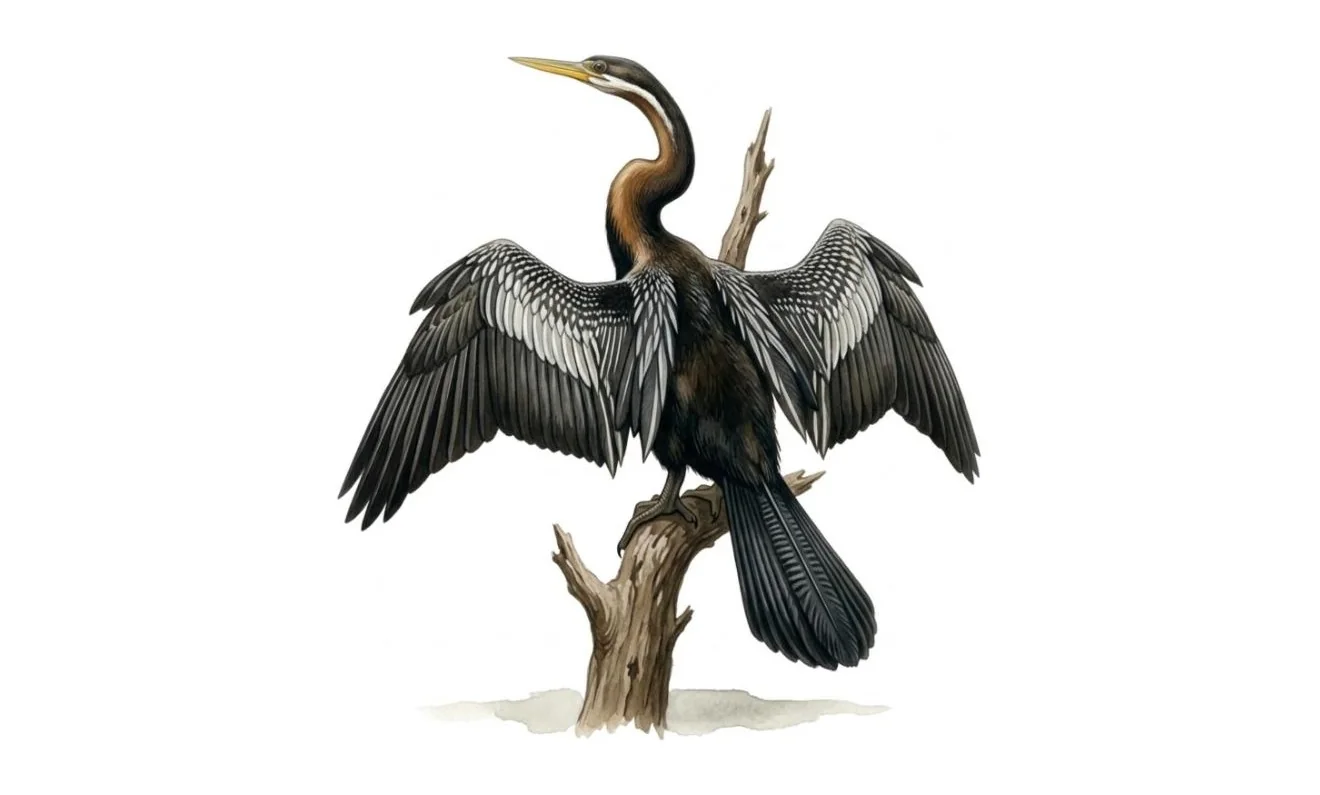
Australasian Darter

Anhinga novaehollandiae

Anhingidae · Darters

No. XVI85–97 cm; wingspan ~120 cmLeast Concern

Description

  • Neck — long, snake-like, with S-kink and white cheek stripe
  • Bill — straight, finely pointed dagger — never hooked
  • Body — glossy brown-black, chestnut breast wash (male)
  • Wing — bold silvery-white streaking on coverts
  • Tail — long, broad, stiff fan — far longer than a cormorant's
Male glossy black with chestnut foreneck, white cheek-stripe and silver-white wing streaking. Female grey-brown above, white to pale grey below, with the white neck-stripe. Immature like a dull female, stripe indistinct. Facial skin brightens when breeding.

Behaviour

Swims body-submerged, only the snaking neck visible; dives and spears fish, surfacing to flick and swallow them head-first. Soars high on thermals in a cross-shaped silhouette; perches with wings spread to dry. Usually solitary or pairs; common on still inland and coastal waters.

Cairns Brisbane

Statewide (suitable habitat)

Distribution

Throughout Queensland wherever there is smooth open water at least ~0.5 m deep — rivers, lakes, dams, lagoons and sheltered estuaries, coast to far inland; absent only from waterless arid country.

Habitat

Freshwater wetlands, rivers, reservoirs and sheltered coastal waters with open water for hunting and exposed snags or posts for perching and wing-drying; nests in trees standing in water.

Breeding

Any month, tied to water levels — chiefly Aug–Oct in SE QLD, Jan–Apr in the north. Clutch 3–5, usually 4. Large stick platform in a fork over water, often among cormorant colonies.

BirdNerd study deck · QLD SeriesFormerly a race of the Oriental Darter; now a full species, Australian birds A. n. novaehollandiae.
Mystery bird plate XVII
Gapedark gape line past the eye
Neckvery long, with a sharp kink
Billyellow when not breeding
Plumageall white; no plumes (non-br.)
Legsvery long, blackish
  1. 1Gape dark gape line past the eye
  2. 2Neck very long, with a sharp kink
  3. 3Bill yellow when not breeding
  4. 4Plumage all white; no plumes (non-br.)
  5. 5Legs very long, blackish
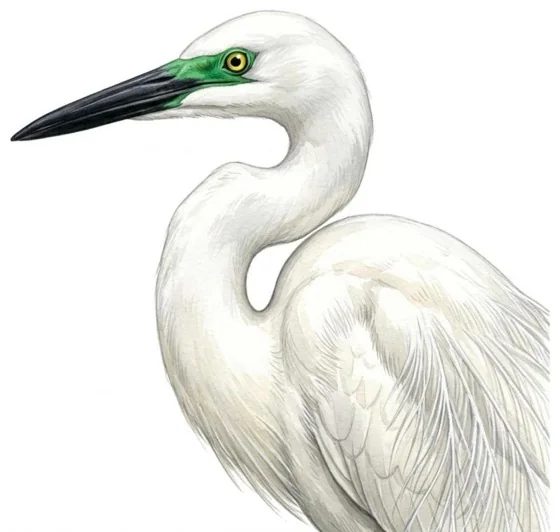
Breeding detail
Breeding
Adult non-breeding — sexes alike No. XVII

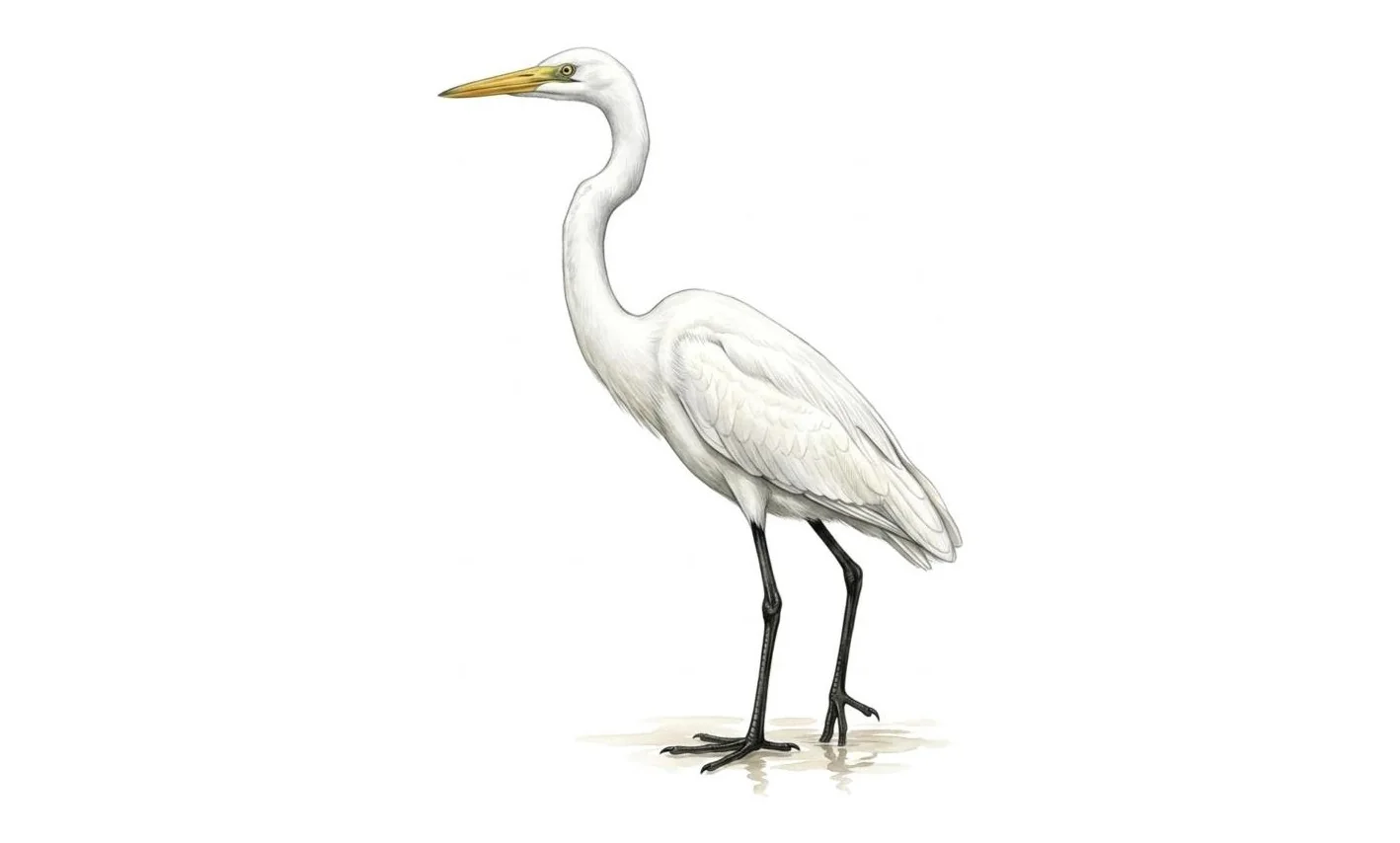
Great Egret

Ardea alba modesta

Ardeidae · Herons & egrets

No. XVII83–103 cm; wingspan to 1.7 mLeast Concern

Description

  • Gape — dark gape line extends clearly behind the eye
  • Neck — extremely long (~1.5× body), carried with a sharp kink
  • Breeding — bill black, facial skin emerald-green, back aigrettes
  • Non-breeding — bill and facial skin yellow, no plumes
  • Legs — very long, blackish; upper legs flush reddish when breeding
Sexes alike: all white, the largest egret; neck longer than the body, dark gape-line extending behind the eye. Non-breeding bill and face yellow, legs blackish. Breeding bill black, facial skin green, upper legs reddish; filamentous plumes over the back only — no head plumes. Juvenile as non-breeding.

Behaviour

Stalks slowly or stands motionless in shallows, neck kinked, spearing fish with a rapid lunge. Flight ponderous, neck folded, legs trailing. Usually feeds alone but roosts and nests colonially; common and widespread on wetlands statewide.

Cairns Brisbane

Statewide (suitable habitat)

Distribution

Across virtually all of Queensland, from coastal estuaries and mudflats to inland floodplains; the flooded Channel Country supports some of Australia's largest breeding colonies.

Habitat

Any shallow water: freshwater swamps, floodplain wetlands, river margins, farm dams, irrigated pasture, estuaries, mangroves and tidal mudflats.

Breeding

Mainly Oct–Dec in the south, Mar–May in the north; dependent on water levels. Clutch 2–6, usually 3–4. Flat stick platform in a tree over water; colonial with ibis, cormorants and other egrets.

BirdNerd study deck · QLD SeriesEastern Great Egret A. a. modesta (Asia–Australasia); treated by some authorities as the full species Ardea modesta.
Mystery bird plate XVIII
Billslender and black in all seasons
Loresyellow to grey-yellow facial skin
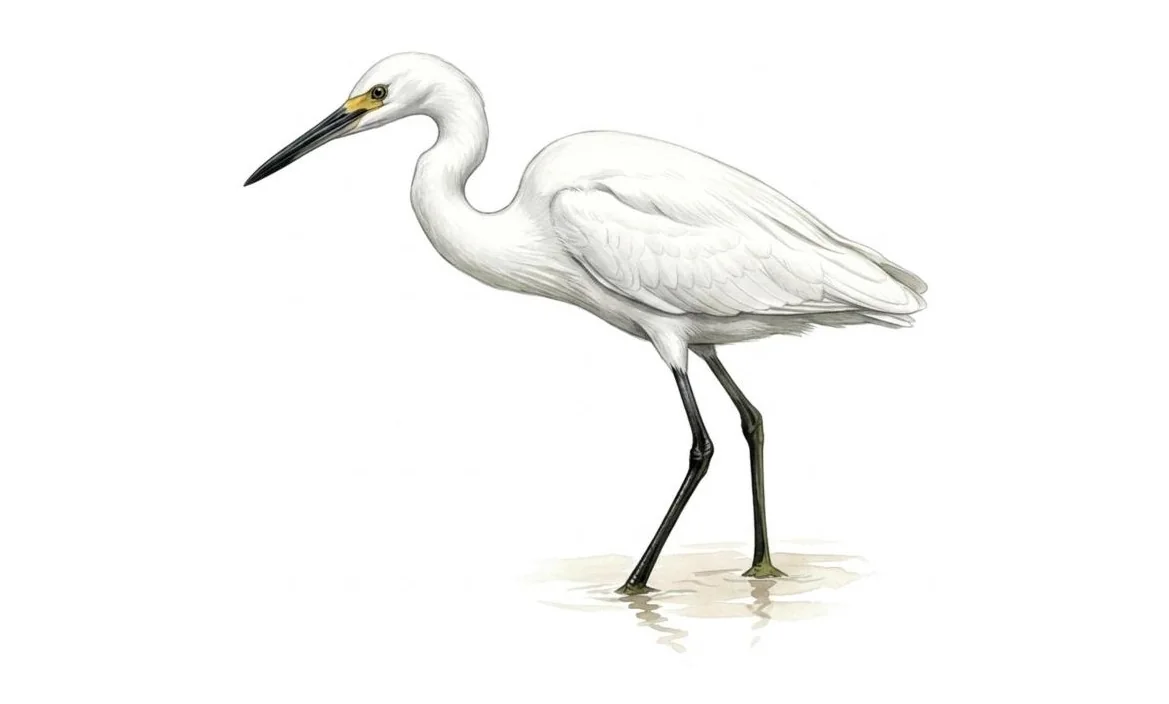
Buildsmall, slim, dainty all-white egret
Legsblack
Feetdark toes in Australian ssp.
  1. 1Bill slender and black in all seasons
  2. 2Lores yellow to grey-yellow facial skin
  3. 3Build small, slim, dainty all-white egret
  4. 4Legs black
  5. 5Feet dark toes in Australian ssp.
Breeding detail
Breeding
Adult non-breeding — sexes alike No. XVIII

Little Egret

Egretta garzetta nigripes

Ardeidae · Herons & egrets

No. XVIII55–65 cm; 350–550 gLeast Concern

Description

  • Build — small, slim, dainty all-white egret
  • Bill — slender and black in all seasons
  • Lores — yellow to grey-yellow facial skin
  • Legs & feet — black; toes mostly blackish in Australian birds
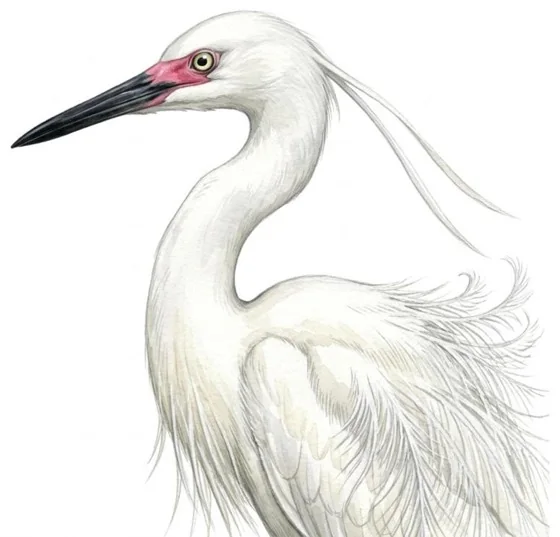
  • Breeding — two long ribbon nape plumes, lacy back plumes
Sexes alike: small, slender, all white; bill fine and black; facial skin yellow; legs and feet black with yellowish soles. Breeding: two long ribbon nape plumes and lacy back and breast plumes; facial skin flushes pink-red at courtship peak. Juvenile lacks plumes.

Behaviour

The most active egret — dashes, jinks and sprints in the shallows, foot-stirring and raking to flush prey, sometimes shading the water with raised wings. Flight buoyant and quick. Singly or in loose groups; moderately common on coastal and inland wetlands.

Cairns Brisbane

Eastern Queensland

Distribution

Widespread in coastal and subcoastal Queensland — Gulf of Carpentaria, Cape York and the entire east coast — extending inland along major rivers and floodplain wetlands; scarce in the arid southwest.

Habitat

Tidal mudflats, mangroves, saltmarsh and shallow fresh wetlands — swamp margins, lagoons and drying floodplain pools; equally at home in salt and fresh water.

Breeding

Oct–Feb in southern QLD, Mar–Apr in the north; linked to water levels. Clutch 3–5, usually 4. Scanty stick platform in tree or mangrove over water; colonial.

BirdNerd study deck · QLD SeriesAustralasian race nigripes: yellow facial skin and black toes, unlike the yellow-toed Eurasian nominate.
Mystery bird plate XIX
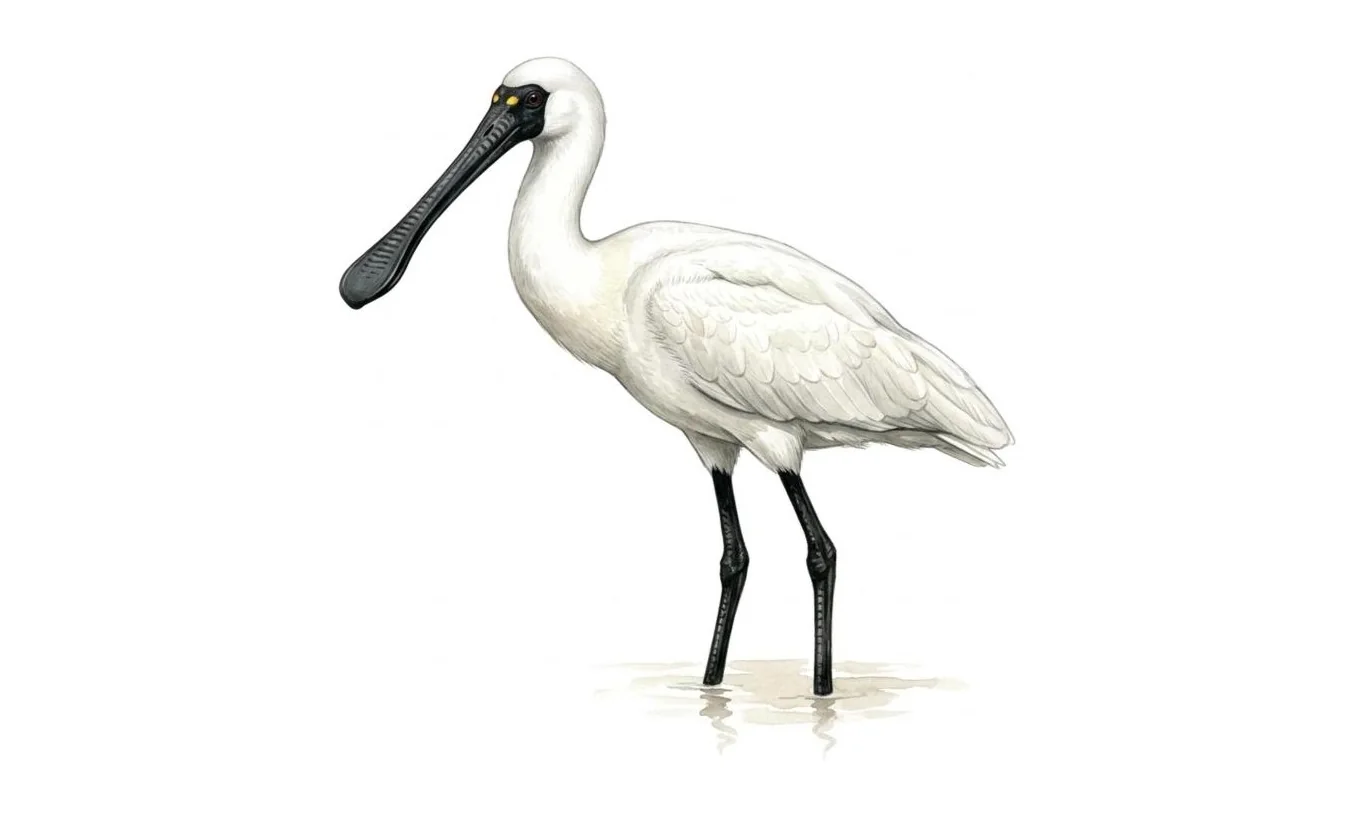
Billlong, black, spatulate
Facebare black skin
Plumageentirely white body
Neckcarried extended in flight
Legslong and black
  1. 1Bill long, black, spatulate
  2. 2Face bare black skin
  3. 3Plumage entirely white body
  4. 4Neck carried extended in flight
  5. 5Legs long and black
Breeding detail
Breeding
Adult non-breeding — sexes alike No. XIX

Royal Spoonbill

Platalea regia

Threskiornithidae · Ibises & spoonbills

No. XIX74–81 cm; wingspan ~120 cmLeast Concern

Description

  • Bill — long, black, spatulate — broad spoon tip
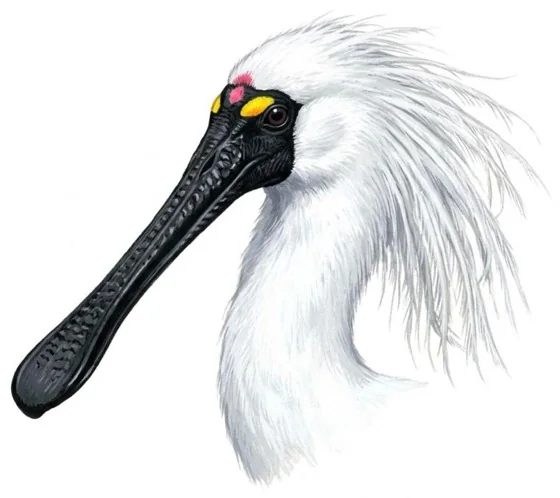
  • Face — bare black skin; yellow patch above each eye, red forehead spot
  • Plumage — entirely white body
  • Breeding — shaggy white nuchal crest to ~20 cm, buff breast wash
  • Flight — neck fully extended — not tucked like a heron
Sexes alike: white, with black spatulate bill, black facial skin and black legs. Breeding: nuchal crest of long white plumes (to 20 cm, longer in the male), yellow patch above the eye, red forehead spot, creamy breast wash. Female slightly smaller, shorter-billed. Juvenile duller, crestless, dark-tipped flight feathers.

Behaviour

Wades steadily in the shallows sweeping the submerged bill side to side in wide arcs, detecting prey by touch; feeds day or night. Flight direct, neck extended, with steady wingbeats and glides. Singly to small parties; common on fresh and sheltered marine wetlands.

Cairns Brisbane

Eastern Queensland

Distribution

Widespread across eastern, northern and central Queensland in coastal and inland wetlands, pushing into Channel Country wetlands after flooding; scarcest in the driest southwest.

Habitat

Shallow fresh and saline waters: swamps, lagoons, floodplain wetlands, farm dams, tidal mudflats and mangrove fringes — usually wading in water under ~40 cm.

Breeding

Oct–Mar in QLD, eggs mainly Nov–Feb; timing and success tied to water levels. Clutch 2–4, usually 3. Solid stick bowl lined with leaves, in a tree crown over water or tall reeds; mixed colonies.

BirdNerd study deck · QLD SeriesMonotypic. One of two Australian spoonbills — Yellow-billed has a pale bill and legs and no crest.
Mystery bird plate XX
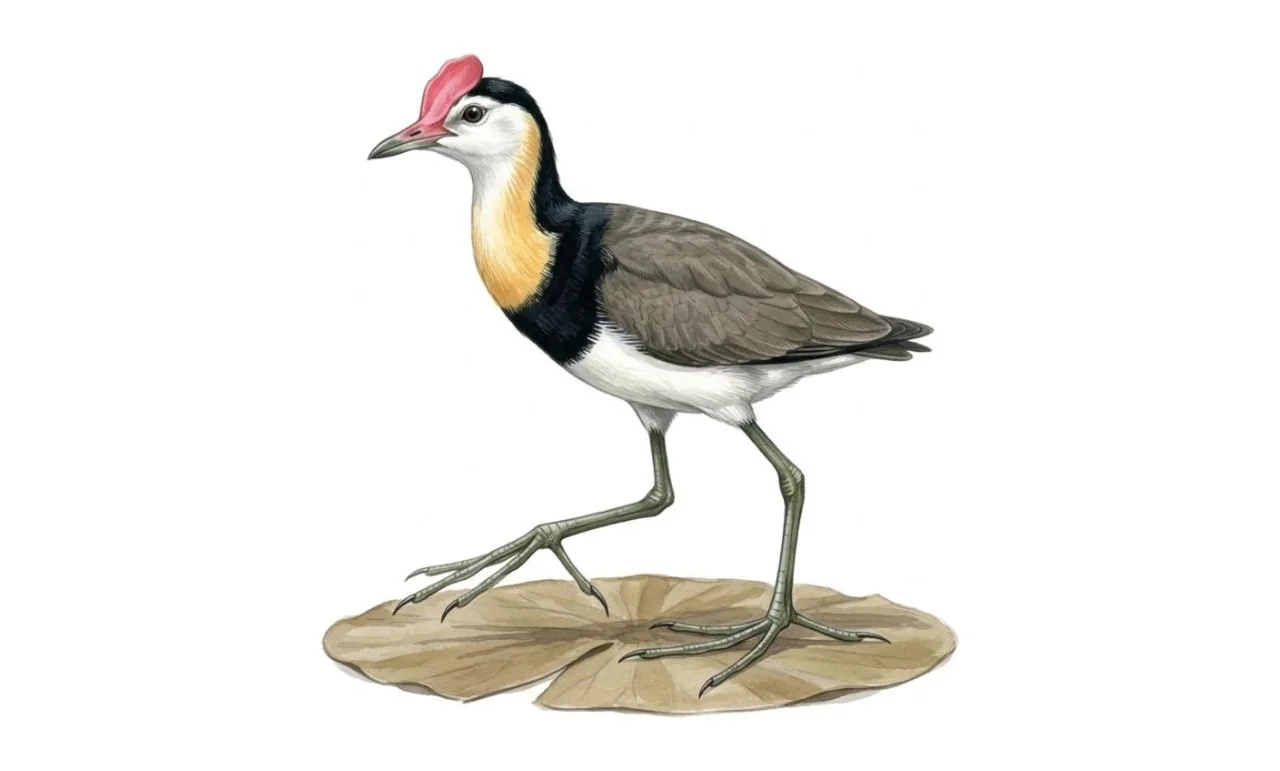
Combfleshy red-pink forehead wattle
Neckgolden wash on foreneck
Breast bandbroad black band, white belly
Upperpartsplain grey-brown
Feetvery long spider-like toes
  1. 1Comb fleshy red-pink forehead wattle
  2. 2Neck golden wash on foreneck
  3. 3Breast band broad black band, white belly
  4. 4Upperparts plain grey-brown
  5. 5Feet very long spider-like toes
Adult — ♀ larger No. XX

Comb-crested Jacana

Irediparra gallinacea

Jacanidae · Jacanas

No. XX20–27 cm; female much larger than maleLeast Concern

Description

  • Comb — fleshy red-pink wattle on the forehead
  • Head & neck — white face, golden-yellow foreneck, black crown and hindneck
  • Breast band — broad black band above a clean white belly
  • Upperparts — plain grey-brown; black flight feathers
  • Feet — extraordinarily long spider-like toes and claws
Sexes alike in plumage: fleshy red-pink comb; black crown, hindneck and breast-band; golden-yellow wash on the face-sides; white throat and belly; brown back; enormous toes. Female distinctly larger and brighter. Juvenile chestnut-crowned with white breast (no band) and rudimentary comb.

Behaviour

Trots over lily pads on huge spidery toes, gleaning insects and seeds; constantly flicks the tail and bobs the head. Flight low and fluttering, legs and toes trailing. Singly, pairs or loose groups on tropical lagoons; swims and dives if alarmed.

Cairns Brisbane

Northern & eastern coastal wetlands

Distribution

Coastal and subcoastal freshwater wetlands from Cape York and the Gulf Country down the entire east coast to the NSW border; greatest numbers in the tropical north, absent from the dry interior.

Habitat

Permanent tropical and subtropical freshwater lagoons, billabongs, swamps and dams with abundant floating vegetation — waterlilies above all; rarely comes ashore.

Breeding

Sep–May in QLD, mainly the wet season in the north; re-nests as water levels shift. Clutch usually 4, glossy and heavily scrawled. Flimsy damp pad on floating leaves; polyandrous — the male alone incubates, carrying chicks to safety under his wings.

BirdNerd study deck · QLD SeriesAustralian birds I. g. novaehollandiae; the only jacana in Australia.
Mystery bird plate XXI
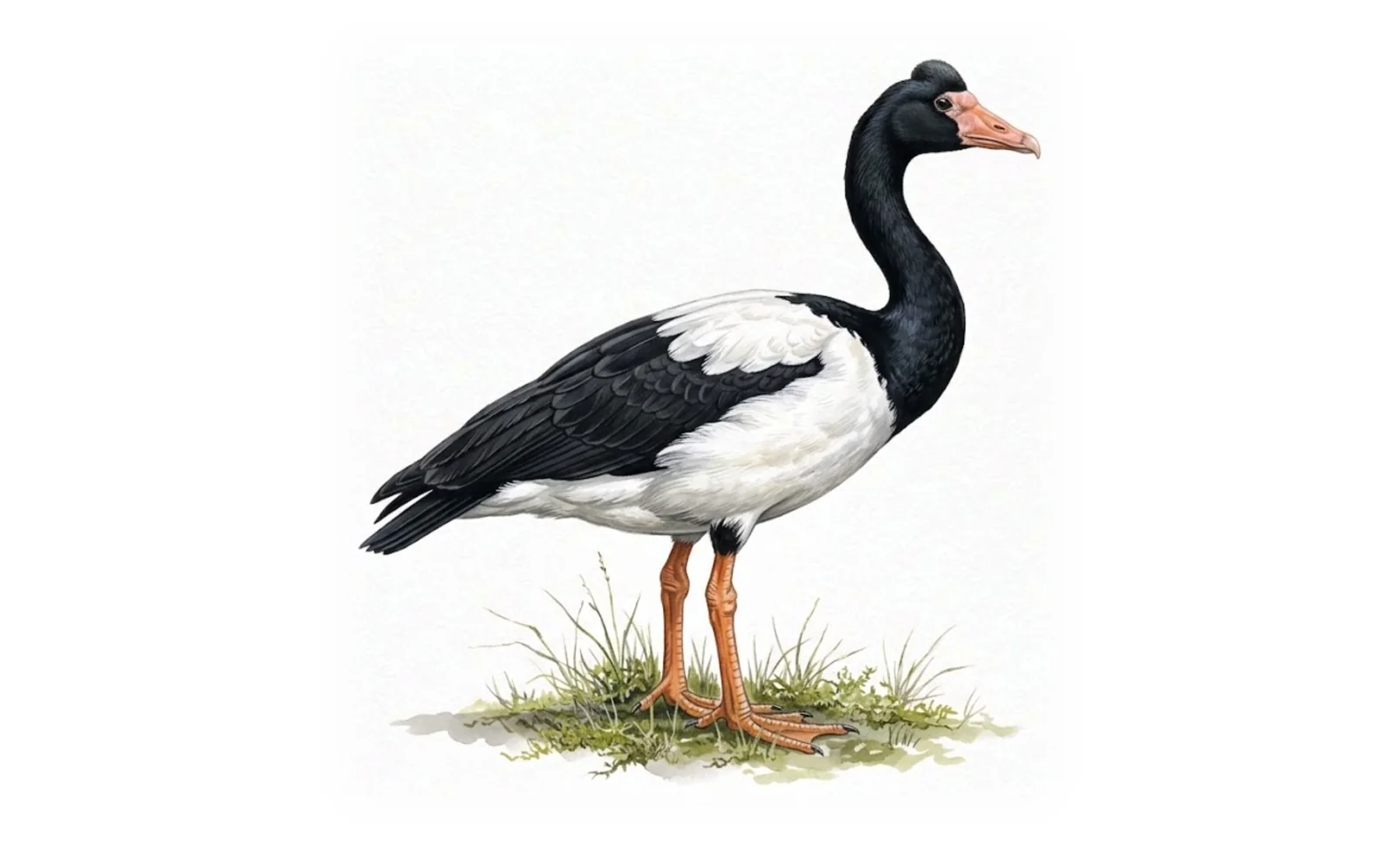
Headdomed knob on the black crown
Billhooked, orange-pink
Necklong, slender and all black
Bodywhite underparts and saddle
Legsorange
  1. 1Head domed knob on the black crown
  2. 2Bill hooked, orange-pink
  3. 3Neck long, slender and all black
  4. 4Body white underparts and saddle
  5. 5Legs orange
Adult — sexes alike; ♂ larger No. XXI

Magpie Goose

Anseranas semipalmata

Anseranatidae · Magpie Goose

No. XXI71–92 cm; male largerLeast Concern

Description

  • Head — domed knob on the black crown
  • Bill — hooked, orange-pink; bare pinkish face
  • Neck — long, slender and all black
  • Body — white underparts and saddle; black wings
  • Legs — orange; toes only half-webbed
Sexes alike in pattern: black head, neck, wings and tail; white body and saddle; orange legs; bare pinkish face. Male larger, with a taller crown knob that grows with age. Juvenile has white areas mottled grey-brown and only a small or no knob.

Behaviour

Grazes grasses and digs for spike-rush bulbs and wild rice in shallow swamps; dry-season flocks of thousands on remaining wetlands. Often in trios of one male and two females. Common in the north; recovering in the south.

Cairns Brisbane

Northern & eastern coastal wetlands

Distribution

Coastal floodplains of northern and eastern Queensland — Gulf and Cape York wetlands, the Burdekin delta and Townsville Town Common south to SEQ, where it has recolonised; flocks wander inland after rain.

Habitat

Seasonal freshwater floodplains and swamps with dense sedges and wild rice; also wet grassland, dams, lakes, irrigated crops, sugarcane and urban parkland.

Breeding

Wet season, mainly Feb–Jun. Clutch usually ~8 (up to 16 when two females share). Floating platform of trampled sedge in deep swamp; male builds; all adults incubate.

BirdNerd study deck · QLD SeriesMonotypic; the only species in Anseranas and family Anseranatidae.
Mystery bird plate XXII
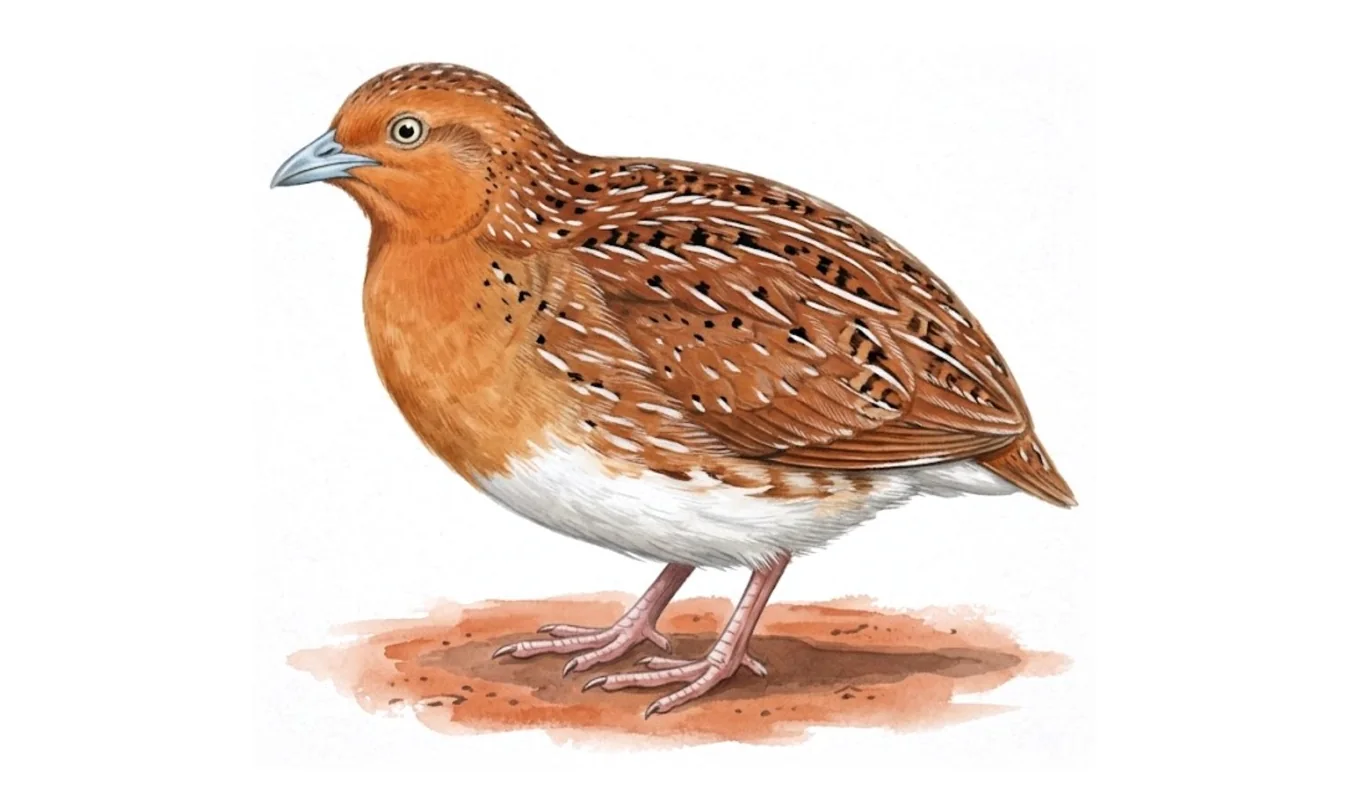
Breast♀ plain rufous-orange
Eyepale whitish-cream iris
Billstout, pale blue-grey bill
Upperpartsrufous, streaked white
Bellywhite belly and flanks, unbarred
  1. 1Breast ♀ plain rufous-orange
  2. 2Eye pale whitish-cream iris
  3. 3Bill stout, pale blue-grey bill
  4. 4Upperparts rufous, streaked white
  5. 5Belly white belly and flanks, unbarred
Adult ♀ (♂ smaller, duller) No. XXII

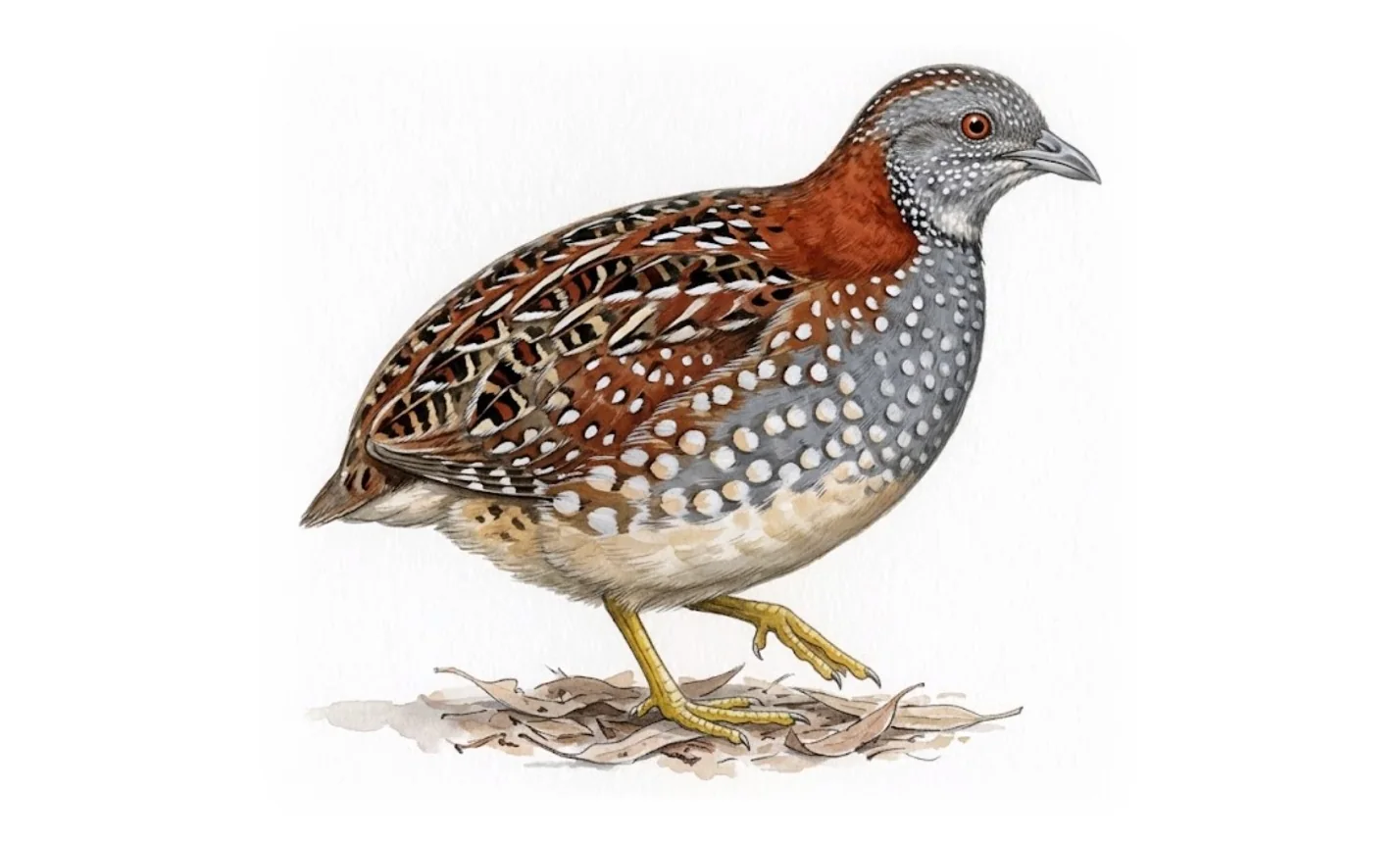
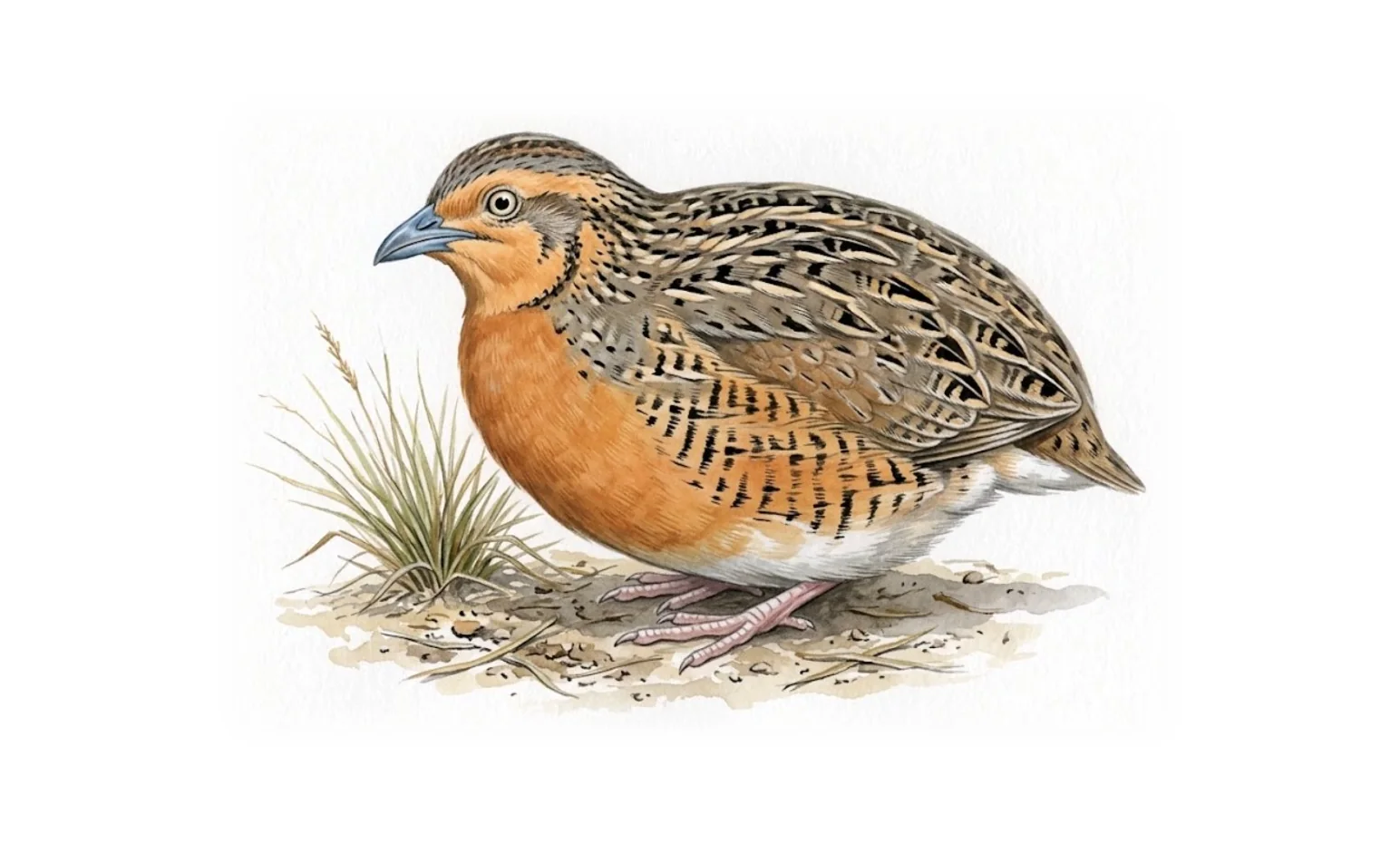
Little Button-quail

Turnix velox

Turnicidae · Buttonquails

No. XXII12–16 cm; ♀ largerLeast Concern

Description

  • Breast — ♀ plain rufous-orange; face, throat, breast
  • Eye — pale whitish-cream iris
  • Bill — stout, pale blue-grey bill
  • Upperparts — rufous, streaked white; flecked black
  • Belly — white belly and flanks, unbarred
Reversed dimorphism. Female larger: unmarked rufous-orange face, throat and breast, rufous upperparts streaked white. Male smaller, paler and duller, breast buff with darker scalloping. Juvenile like male but spotted and scalloped below.

Behaviour

Eats grass seeds, green shoots and insects, scratching on the ground mainly at night and dusk. Solitary, in pairs or small groups; nomadic and abundant after good seasons. Runs through grass and is seldom seen unless flushed.

Cairns Brisbane

Western & central-west inland

Distribution

Mainly western and central QLD south of about 19°S: Mitchell-grass downs, Channel Country and the Winton–Longreach district; nomadic, occasionally reaching the Darling Downs and eastern plains in dry years.

Habitat

Arid and semi-arid tussock grassland, spinifex, saltbush and open grassy woodland; also stubble and cereal crops. Mostly active at night.

Breeding

After rain in any month; mainly Sep–Mar in the south-east. Grass-lined scrape under a tussock, sometimes hooded. Clutch 3–4; male incubates.

BirdNerd study deck · QLD SeriesMonotypic; endemic to mainland Australia.
Mystery bird plate XXIII
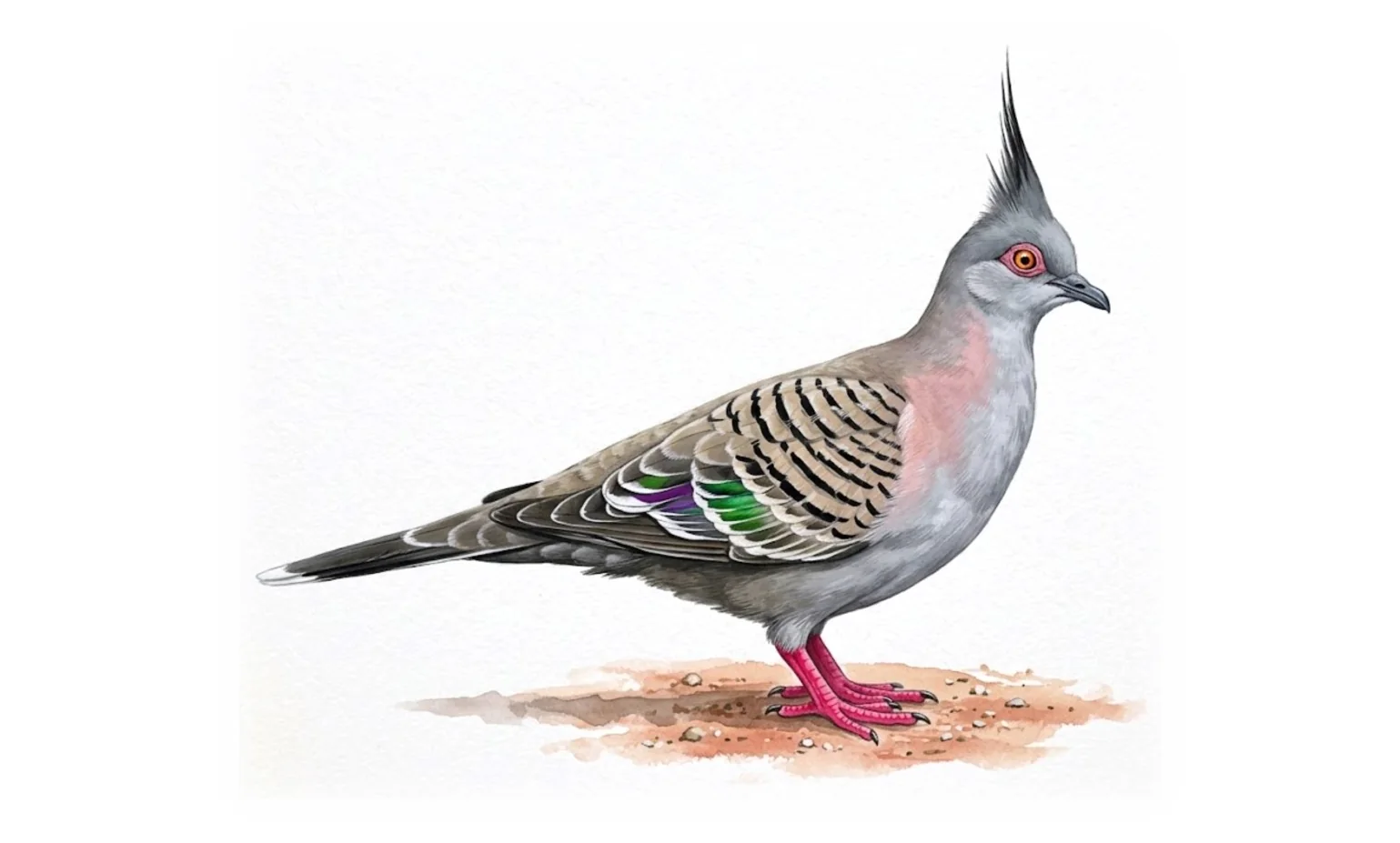
Cresttall, thin black crest held erect
Eyeorange eye
Wingbuff-grey, boldly barred black
Underpartssoft grey
Legsshort, bright pinkish-red legs
  1. 1Crest tall, thin black crest held erect
  2. 2Eye orange eye
  3. 3Wing buff-grey, boldly barred black
  4. 4Underparts soft grey
  5. 5Legs short, bright pinkish-red legs
Adult — sexes alike No. XXIII

Crested Pigeon

Ocyphaps lophotes

Columbidae · Pigeons & doves

No. XXIII30–35 cmLeast Concern

Description

  • Crest — tall, thin black crest held erect
  • Eye — orange eye; pinkish-red ring of bare skin
  • Wing — buff-grey, boldly barred black; green-purple patch
  • Underparts — soft grey; neck and breast washed pink
  • Legs — short, bright pinkish-red legs
Sexes alike; the female is marginally smaller with a slightly duller wing patch. Juvenile duller and browner, with a shorter crest, buff-fringed wing feathers, fainter barring and a dull eye-ring.

Behaviour

Eats mostly fallen seeds of native grasses, herbs, crops and weeds, with some leaves and insects, foraging on the ground in pairs to flocks of dozens. Drinks daily, often waiting in trees before descending. Abundant and increasing.

Cairns Brisbane

Statewide (suitable habitat)

Distribution

Throughout most of Queensland, from the western deserts to the coast and into Brisbane and other cities; scarce on northern Cape York and absent from closed rainforest. Spread coastward through the 20th century with clearing.

Habitat

Lightly timbered grassland and open woodland near water; farmland, roadsides, parks, sports fields and suburbs. Avoids dense forest and drinks daily.

Breeding

Any month, mainly Sep–Mar. Flimsy twig platform in a shrub or tree fork. Clutch 2 white eggs; incubation and nestling periods ~21 days each.

BirdNerd study deck · QLD SeriesNominate lophotes in QLD; the more rufous-toned whitlocki replaces it in Western Australia.
Mystery bird plate XXIV
Cresttall, pointed rufous crest
Facebare red skin around eye
Breast bandwhite band, bordered black below
Upperpartscinnamon-rufous, boldly barred black
Bellywhite belly (QLD ssp. leucogaster)
  1. 1Crest tall, pointed rufous crest
  2. 2Face bare red skin around eye
  3. 3Breast band white band, bordered black below
  4. 4Upperparts cinnamon-rufous, boldly barred black
  5. 5Belly white belly (QLD ssp. leucogaster)
Adult — sexes alike No. XXIV

Spinifex Pigeon

Geophaps plumifera leucogaster

Columbidae · Pigeons & doves

No. XXIV20–24 cmLeast Concern

Description

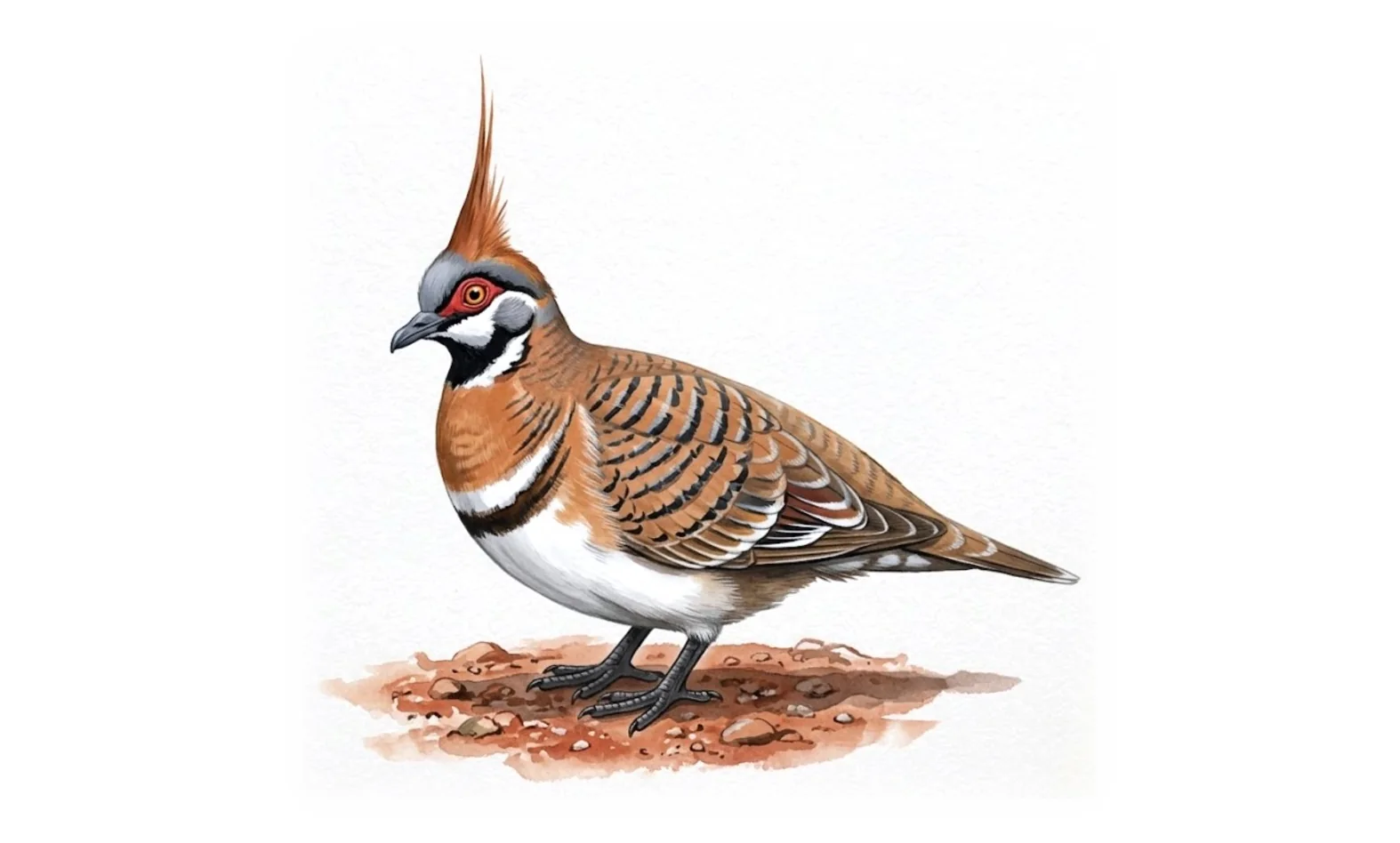
  • Crest — tall, pointed rufous crest; held erect
  • Face — bare red skin around eye; black-and-white stripes
  • Breast band — white band, bordered black below
  • Upperparts — cinnamon-rufous, boldly barred black
  • Belly — white belly (QLD ssp. leucogaster)
Sexes alike. Adult rich cinnamon-rufous, barred black above, with tall rufous crest, bare red facial skin, black-and-white face pattern and white breast band; QLD birds white-bellied. Juvenile duller and plainer-faced with shorter crest.

Behaviour

Eats seeds of spinifex, grasses and herbs, foraging on the ground in pairs or small flocks. Shelters from midday heat in shade, prefers to run rather than fly, and must drink daily. Locally common within its patchy QLD range.

Cairns Brisbane

Western & central-west inland

Distribution

Patchy in stony spinifex ranges of western QLD: the Mount Isa–Selwyn Ranges and Boodjamulla in the north-west, south-east to the Winton–Opalton jump-ups, Diamantina NP and the Grey Range near Windorah.

Habitat

Rocky arid hills, gorges and jump-up escarpments clothed in spinifex (Triodia) with scattered shrubs; always within reach of permanent or rock-hole water.

Breeding

Breeds at any time after rain. Nest a shallow, sparsely lined scrape under spinifex or a shrub. Clutch 2 creamy-white eggs; both parents incubate.

BirdNerd study deck · QLD SeriesQLD birds are white-bellied leucogaster (AFD); some lists treat NW QLD birds as nominate plumifera.
Mystery bird plate XXV
Faceboldly striped black and white
Eye skinblue-grey bare skin (southern ssp.)
Flankbold white stripe
Upperpartsgrey-brown
Underpartsgrey-brown breast
  1. 1Face boldly striped black and white
  2. 2Eye skin blue-grey bare skin (southern ssp.)
  3. 3Flank bold white stripe
  4. 4Upperparts grey-brown
  5. 5Underparts grey-brown breast
Adult southern ssp. — sexes alike No. XXV

Squatter Pigeon

Geophaps scripta

Columbidae · Pigeons & doves

No. XXV28–32 cmEPBC Vulnerable · QLD Vulnerable (southern ssp.)

Description

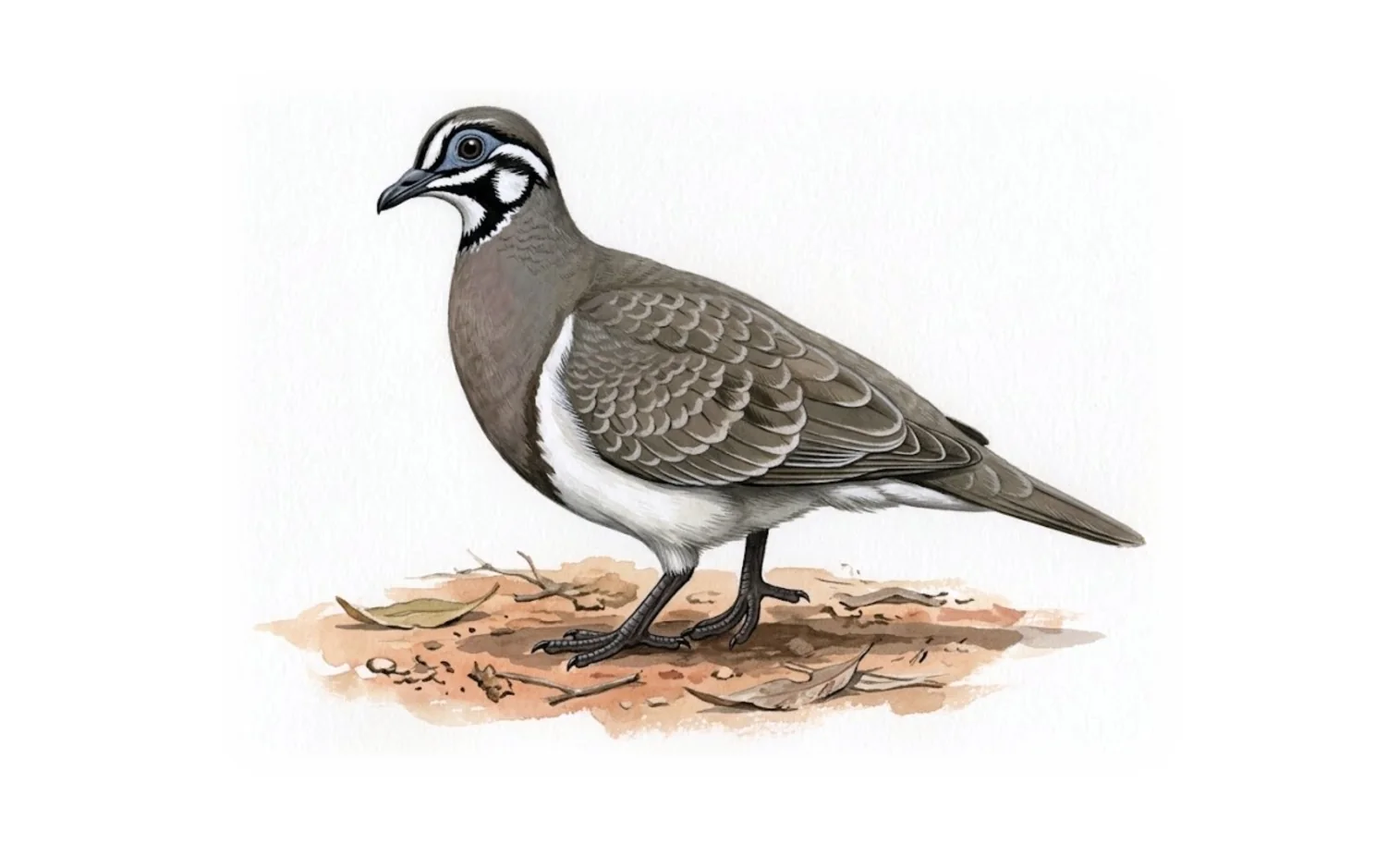
  • Face — boldly striped black and white
  • Eye skin — blue-grey bare skin (southern ssp.)
  • Flank — bold white stripe; side of breast to belly
  • Upperparts — grey-brown; wing coverts pale-scalloped
  • Underparts — grey-brown breast; white lower belly
Sexes alike. Adult grey-brown with black-and-white striped face, white flank stripe and white lower belly; eye skin blue-grey in southern scripta, yellow-orange to red in northern peninsulae. Juvenile duller, face pattern weaker, facial skin pale buff-yellow.

Behaviour

Ground forager on fallen seeds of grasses, herbs and acacias; drinks daily. In pairs or small coveys, larger groups at water. Common in the north; the southern subspecies is patchy and declining, persisting best in the Brigalow Belt.

Cairns Brisbane

Inland eastern Queensland

Distribution

Inland eastern QLD. Southern ssp. scripta from the Burdekin–Lynd divide south through the Brigalow Belt to the NSW border, west to Hughenden, Longreach and Charleville; northern peninsulae north of it.

Habitat

Open eucalypt, cypress-pine and acacia woodland on sandy or gravelly soils with patchy tussock grass and bare ground, within ~3 km of water; also roadsides and stockyards.

Breeding

Year-round in good years; peak Apr–Oct (dry season). Shallow scrape under grass, shrub or log, sparsely lined. Clutch 2 cream eggs; incubation ~17 days.

BirdNerd study deck · QLD SeriesSouthern scripta (threatened) south of the Burdekin–Lynd divide; northern peninsulae (Least Concern) to the north; broad intergrade zone.
Mystery bird plate XXVI
Eyebroad scarlet eye-ring of bare skin
Headplain pale blue-grey
Winggrey-brown, finely spotted white
Taillong and narrow
Bellyclean white belly and undertail
  1. 1Eye broad scarlet eye-ring of bare skin
  2. 2Head plain pale blue-grey
  3. 3Wing grey-brown, finely spotted white
  4. 4Tail long and narrow
  5. 5Belly clean white belly and undertail
Adult ♂ (♀ browner) No. XXVI

Diamond Dove

Geopelia cuneata

Columbidae · Pigeons & doves

No. XXVI19–24 cmLeast Concern

Description

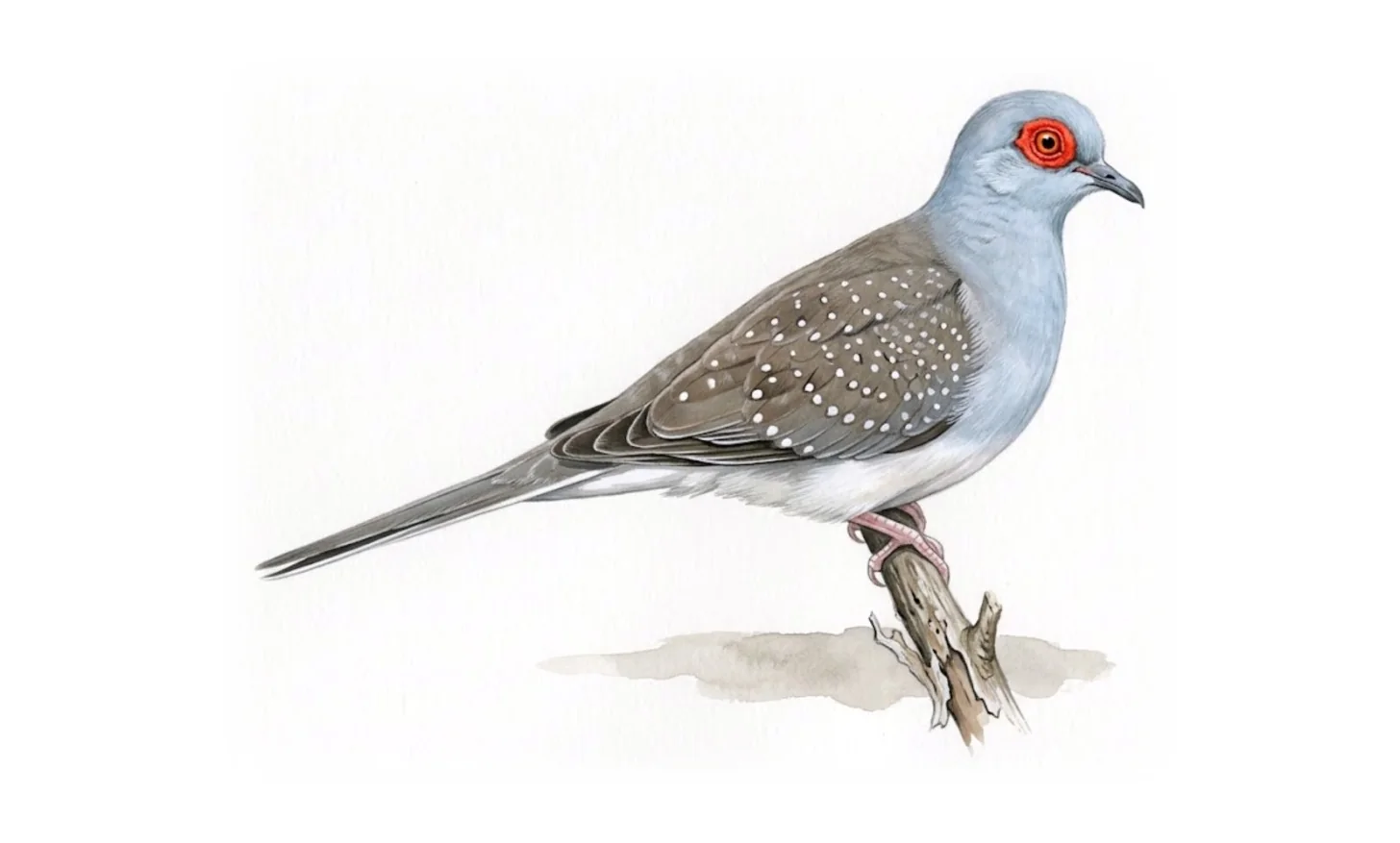
  • Eye — broad scarlet eye-ring of bare skin
  • Head — plain pale blue-grey; neck and breast too
  • Wing — grey-brown, finely spotted white
  • Tail — long and narrow; white outer feathers
  • Belly — clean white belly and undertail
Male: blue-grey head and breast, grey-brown wings finely spotted white, broad scarlet eye-ring. Female browner, with narrower, duller eye-ring. Juvenile brownish, barred and scalloped buff, with few white spots and a dull grey-brown eye-ring.

Behaviour

Eats tiny seeds of grasses and herbs picked from bare ground, plus some insects. Pairs and small flocks, larger at water. Dispersive, following rain; common in the west, irregular further east. Popular aviary bird, so escapes occur.

Cairns Brisbane

Western & central-west inland

Distribution

Western and central QLD: Channel Country, Mitchell-grass downs and north-west uplands, east to the Desert Uplands and Brigalow Belt; nomadic, sometimes reaching the Darling Downs, Gulf and coast after inland rains.

Habitat

Arid and semi-arid grassy woodland, mulga, spinifex and timbered watercourses; never far from water and often seen at bores, troughs and along tracks.

Breeding

Any time after good rain. Small, flimsy platform of fine twigs or grass in a low shrub or tree. Clutch 2 white eggs; both sexes incubate (~13 days).

BirdNerd study deck · QLD SeriesMonotypic; endemic to mainland Australia.
Mystery bird plate XXVII
Eyebare blue-grey skin around pale eye
Neckgrey, finely barred black and white
Upperpartsgrey-brown
Bellyplain pinkish-buff
Taillong, graduated
  1. 1Eye bare blue-grey skin around pale eye
  2. 2Neck grey, finely barred black and white
  3. 3Upperparts grey-brown
  4. 4Belly plain pinkish-buff
  5. 5Tail long, graduated
Adult — sexes alike No. XXVII

Peaceful Dove

Geopelia placida

Columbidae · Pigeons & doves

No. XXVII19–23 cmLeast Concern

Description

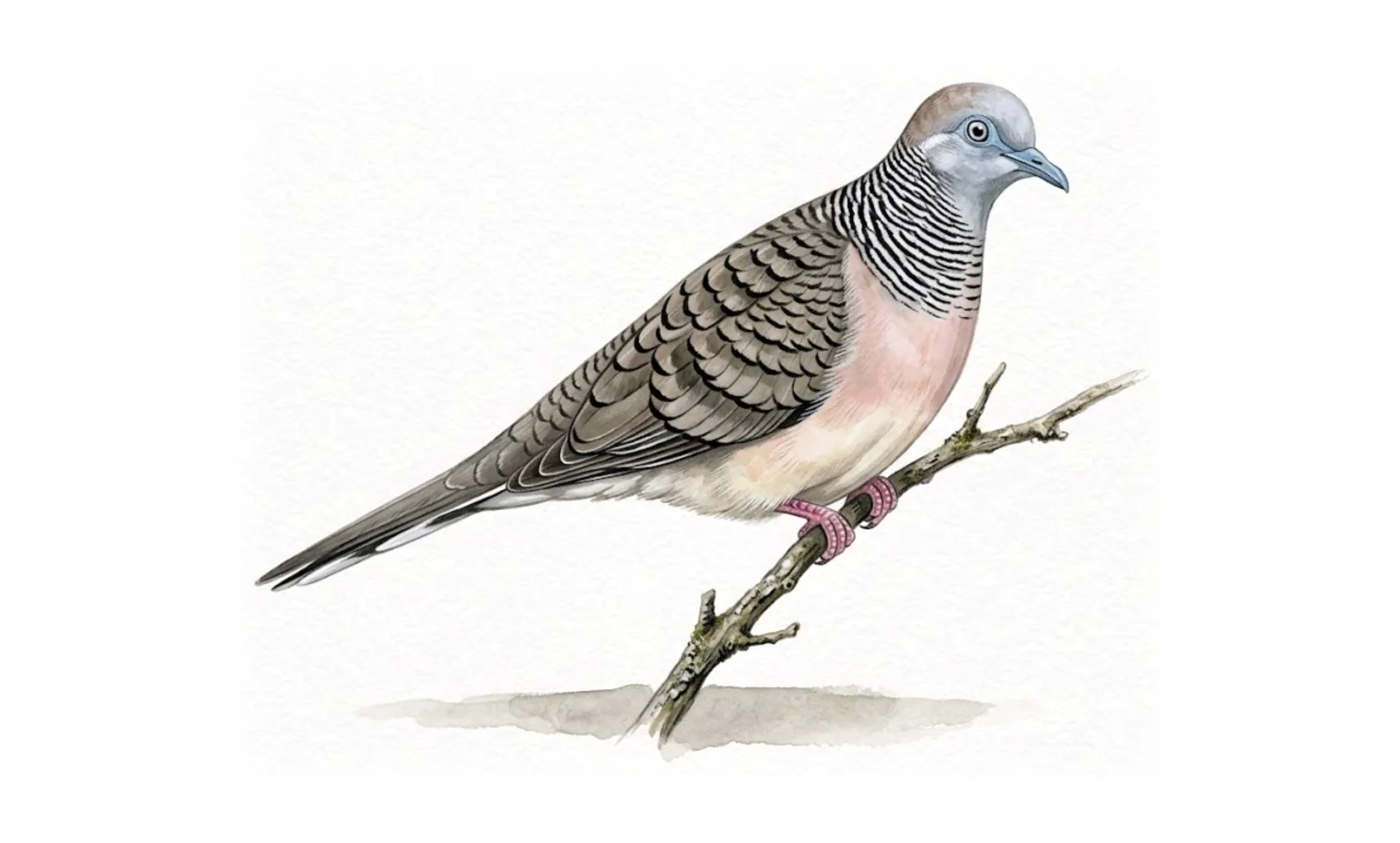
  • Eye — bare blue-grey skin around pale eye
  • Neck — grey, finely barred black and white
  • Upperparts — grey-brown; each feather barred black
  • Belly — plain pinkish-buff; lower breast and belly
  • Tail — long, graduated; broad white corners
Sexes alike; female marginally duller. Adult grey-brown above with fine black barring, grey face and finely barred neck and breast, pinkish belly, blue-grey eye skin. Juvenile browner with buff-tipped feathers, fainter barring and duller eye skin.

Behaviour

Eats small seeds of grasses and sedges with some insects, foraging on bare ground along tracks, lawns and paddocks. Usually in pairs or small groups; common and confiding. Sedentary, though small flocks form locally.

Cairns Brisbane

Statewide (suitable habitat)

Distribution

Throughout QLD in suitable habitat, from Torres Strait and Cape York down the coast and inland along timbered watercourses; common in Cairns, Townsville and Brisbane suburbs, scarcer in the arid far south-west.

Habitat

Open grassy woodland, riverside timber, rainforest and mangrove edges, farmland, parks and gardens; always within easy reach of water.

Breeding

Any month, mainly spring–summer. Frail platform of twigs, grass and roots in a tree or shrub, built by both sexes. Clutch 2 white eggs.

BirdNerd study deck · QLD Seriesplacida in most of QLD, papua on Cape York (AFD); split from Zebra Dove.
Mystery bird plate XXVIII
Headstreaky rufous-brown
Eyedeep red iris in adults
Billheavy, decurved
Wingshort, rounded
Tailvery long and broad
  1. 1Head streaky rufous-brown
  2. 2Eye deep red iris in adults
  3. 3Bill heavy, decurved
  4. 4Wing short, rounded
  5. 5Tail very long and broad
Breeding detail
Breeding
Adult non-breeding — sexes alike No. XXVIII

Pheasant Coucal

Centropus phasianinus

Cuculidae · Cuckoos & coucals

No. XXVIII50–70 cm; ♀ largerLeast Concern

Description

  • Head — streaky rufous-brown; pale shaft streaks
  • Eye — deep red iris in adults
  • Bill — heavy, decurved; pale horn when non-breeding
  • Wing — short, rounded; rufous barred black and cream
  • Tail — very long and broad; dark, finely barred buff
Sexes alike in plumage; female much larger. Breeding: black head, neck and underparts, black bill. Non-breeding: head, back and underparts rufous-buff with pale shaft streaks, horn bill. Juvenile like non-breeding but paler, spotted rufous, duller eye.

Behaviour

Hunts on the ground for large insects, frogs, lizards, eggs and nestlings, sometimes small mammals. Solitary or in pairs, skulking in dense grass. Common in the north and along the coast; benefits from weedy and cane-field cover.

Cairns Brisbane

Northern & eastern coastal wetlands

Distribution

Northern and eastern QLD: Torres Strait, Cape York and the Gulf plains (inland to the Cloncurry and Flinders rivers), then down the coast and ranges to the NSW border; sparse further inland.

Habitat

Dense tall grass, sedges, bracken and weedy thickets such as lantana and cane in open forest, woodland, swamp margins and farmland; often crosses roads.

Breeding

Sep–Mar (wet season). Platform of grass and sticks in dense grass, stems pulled over as a canopy. Clutch 3–5 white eggs; male incubates ~15 days.

BirdNerd study deck · QLD SeriesNominate phasianinus in eastern QLD; larger, darker-tailed melanurus from the Burdekin north, on Cape York and the Gulf.
Mystery bird plate XXIX
Plumage♂ entirely glossy blue-black
Eyestriking crimson-red iris
Billstout, pale ivory to greenish-horn
Taillong, broad and round-tipped
Legsdark blue-grey legs and feet
  1. 1Plumage ♂ entirely glossy blue-black
  2. 2Eye striking crimson-red iris
  3. 3Bill stout, pale ivory to greenish-horn
  4. 4Tail long, broad and round-tipped
  5. 5Legs dark blue-grey legs and feet
Adult ♂ (♀ spotted brown) No. XXIX

Pacific Koel

Eudynamys orientalis

Cuculidae · Cuckoos & coucals

No. XXIX39–46 cmLeast Concern

Description

  • Plumage — ♂ entirely glossy blue-black
  • Eye — striking crimson-red iris
  • Bill — stout, pale ivory to greenish-horn
  • Tail — long, broad and round-tipped
  • Legs — dark blue-grey legs and feet
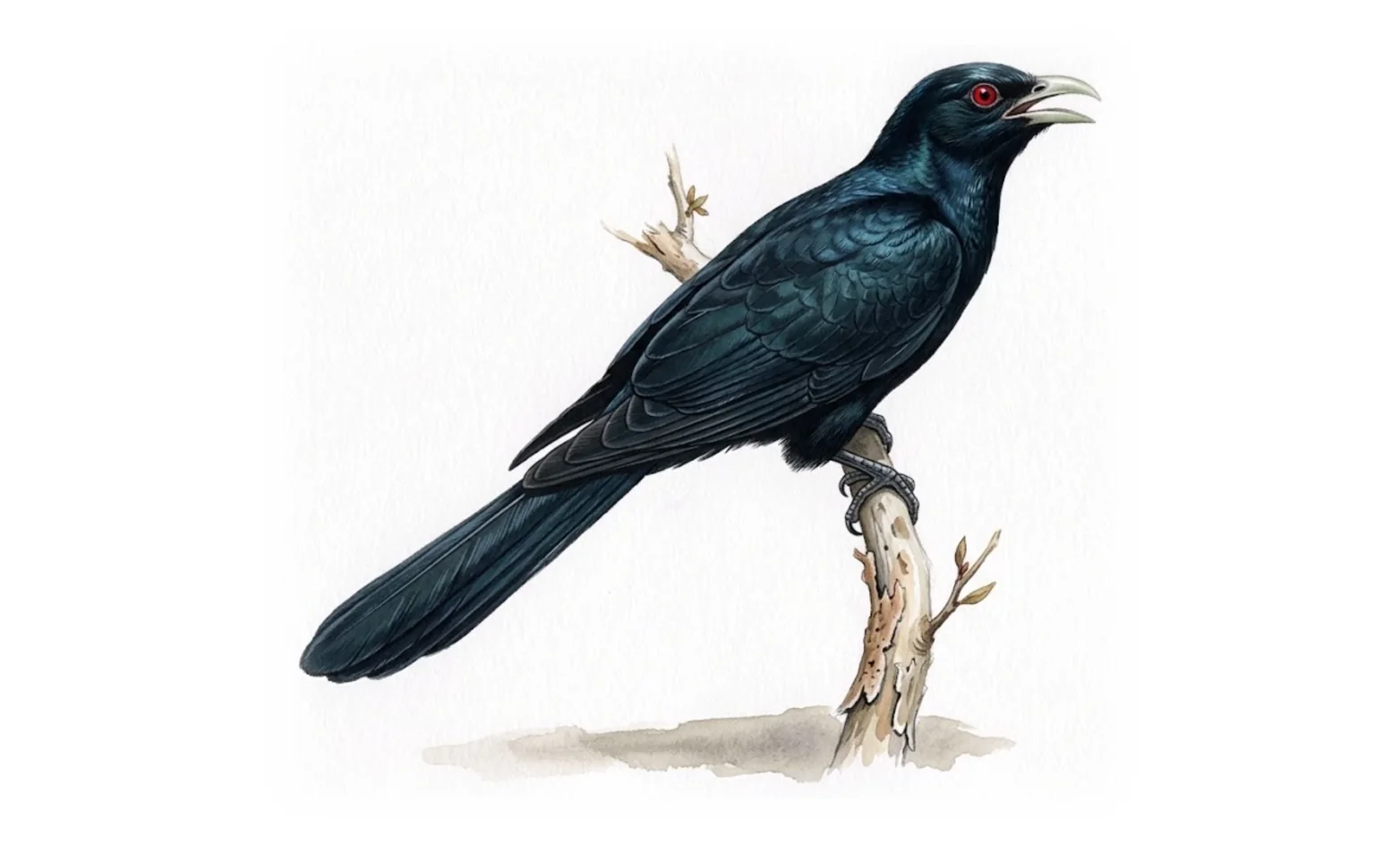
Male glossy blue-black with red eye and pale bill. Female glossy brown above, densely spotted white, with black crown and moustache and a buff stripe between; underparts buff, finely barred black. Juvenile rufous-buff, spotted and barred, eye dark.

Behaviour

Feeds in the canopy on fruit, especially native and introduced figs, with some insects. Solitary and shy, but very vocal by day and night when breeding. Common in coastal QLD and increasing in towns.

Cairns Brisbane

Eastern Queensland

Distribution

Breeding migrant (Sep–Apr) to northern and eastern QLD: Torres Strait, Cape York and the Gulf down the coast to SEQ, and inland along watercourses and towns; very common in coastal cities. A few overwinter in the north.

Habitat

Rainforest edges, tall riparian forest, mangroves and suburban parks and gardens with fruiting figs and other fleshy-fruited trees; keeps to dense canopy.

Breeding

Sep–Mar. Brood parasite: one egg in each host nest (friarbirds, figbirds, Magpie-lark, wattlebirds). Chick evicts host young and is fed for weeks.

BirdNerd study deck · QLD Seriescyanocephalus in central-east and SE QLD; subcyanocephalus in the north. WildNet name: Eastern Koel.
Mystery bird plate XXX
Throatwhite throat patches
Plumageblackish
Eyelarge dark eye
Wingsno white spots
Taillong, dark-barred
  1. 1Throat white throat patches
  2. 2Plumage blackish
  3. 3Eye large dark eye
  4. 4Wings no white spots
  5. 5Tail long, dark-barred
Adult — sexes alike No. XXX

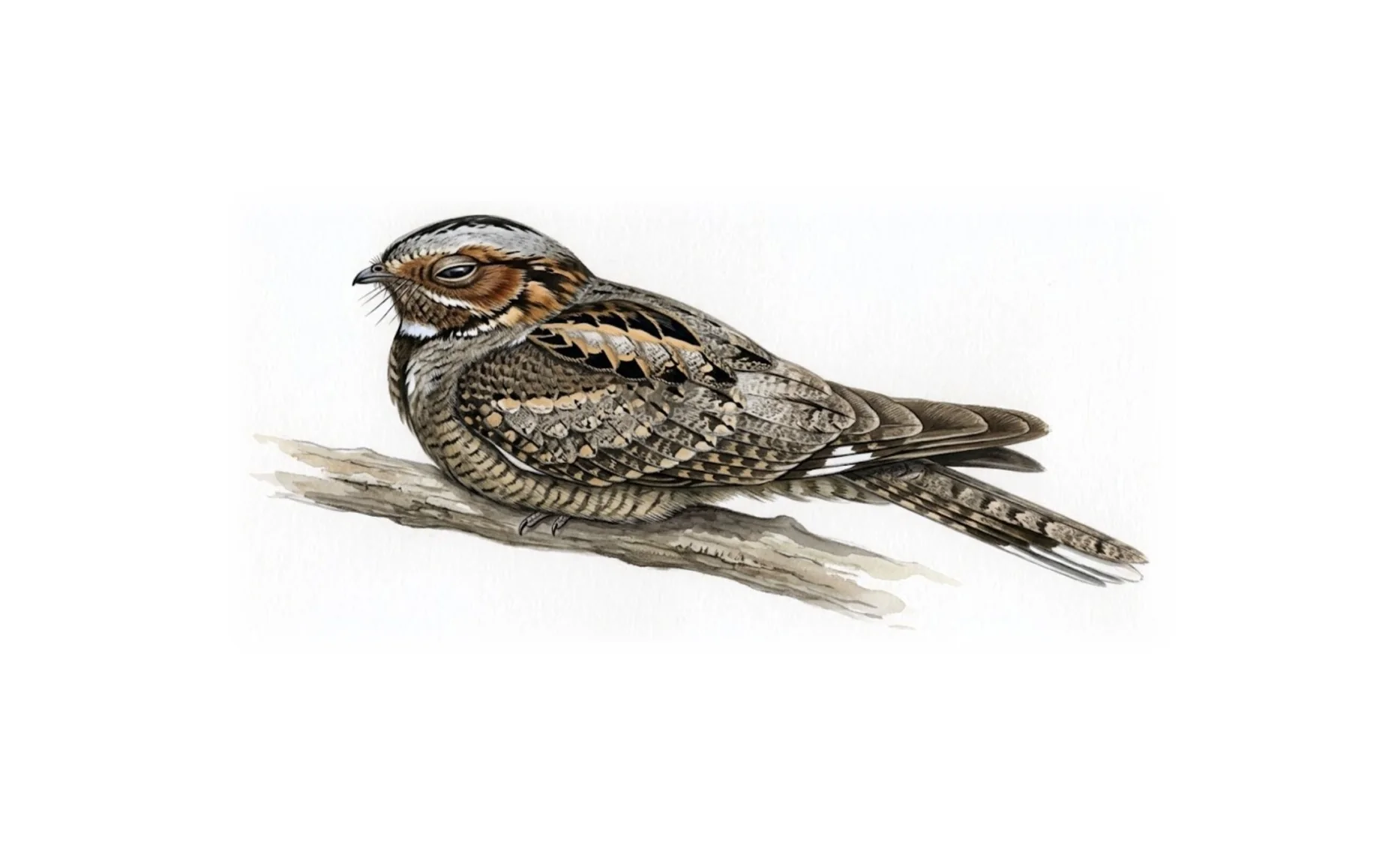
White-throated Nightjar

Eurostopodus mystacalis

Caprimulgidae · Nightjars

No. XXX30–35 cm; largest Australian nightjarLeast Concern

Description

  • Throat — white throat patches; one each side
  • Plumage — blackish; vermiculated silver-grey, buff, rufous
  • Eye — large dark eye; red eyeshine in torchlight
  • Wings — no white spots; wingtips reach tail tip
  • Tail — long, dark-barred; no white corners
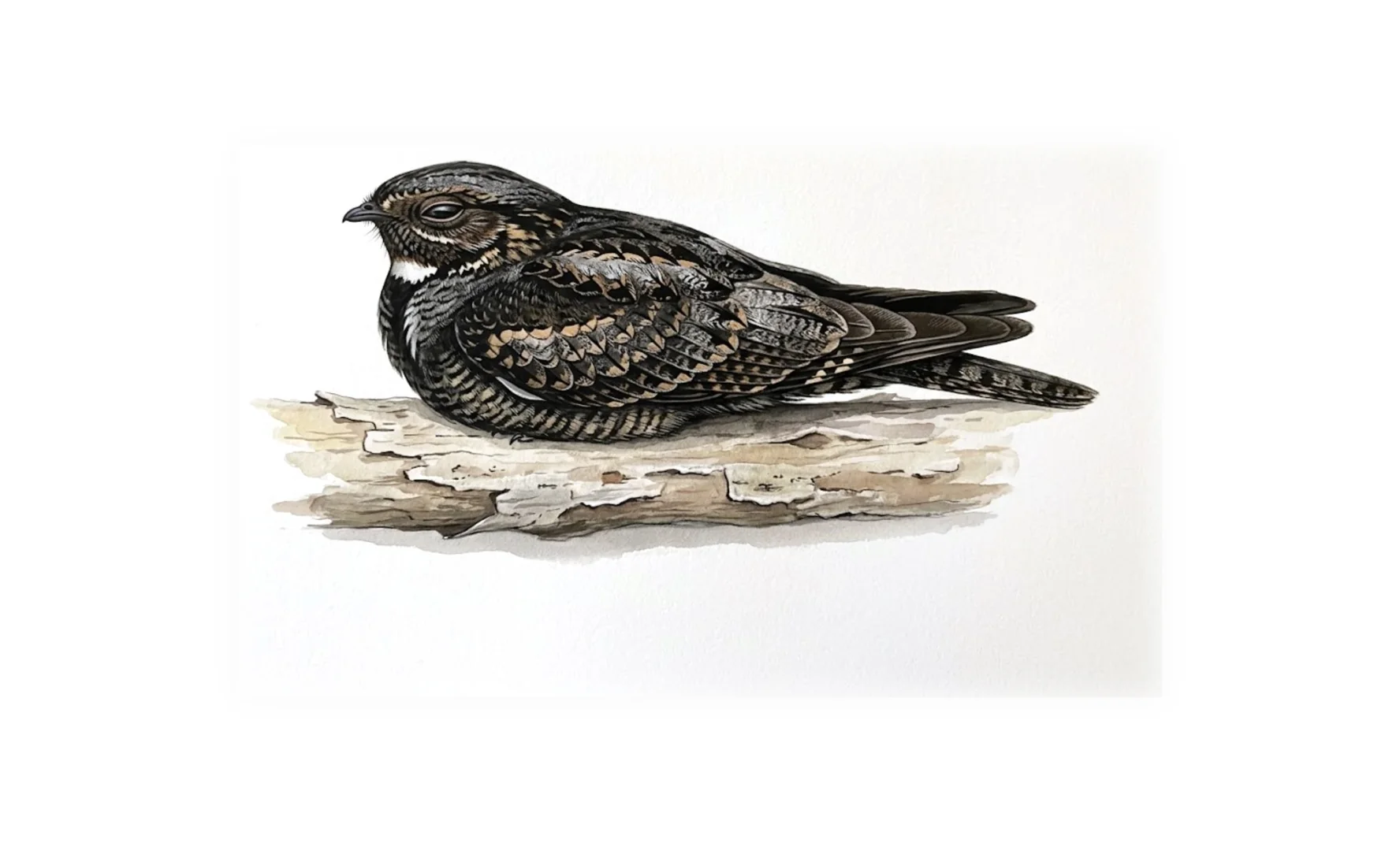
Sexes alike: blackish-grey, finely vermiculated silver-grey, buff and rufous; scalloped wing coverts; white throat patches; no white in wing or tail. Female averages slightly smaller. Juvenile paler and more rufous, with finer pattern and smaller throat patches.

Behaviour

Hawks moths, beetles and other flying insects at dusk and night over the canopy, clearings and watercourses. Solitary or in pairs; loose groups of up to ~20 on migration. Common but easily overlooked; very faithful to its day-roost sites.

Cairns Brisbane

Eastern Queensland

Distribution

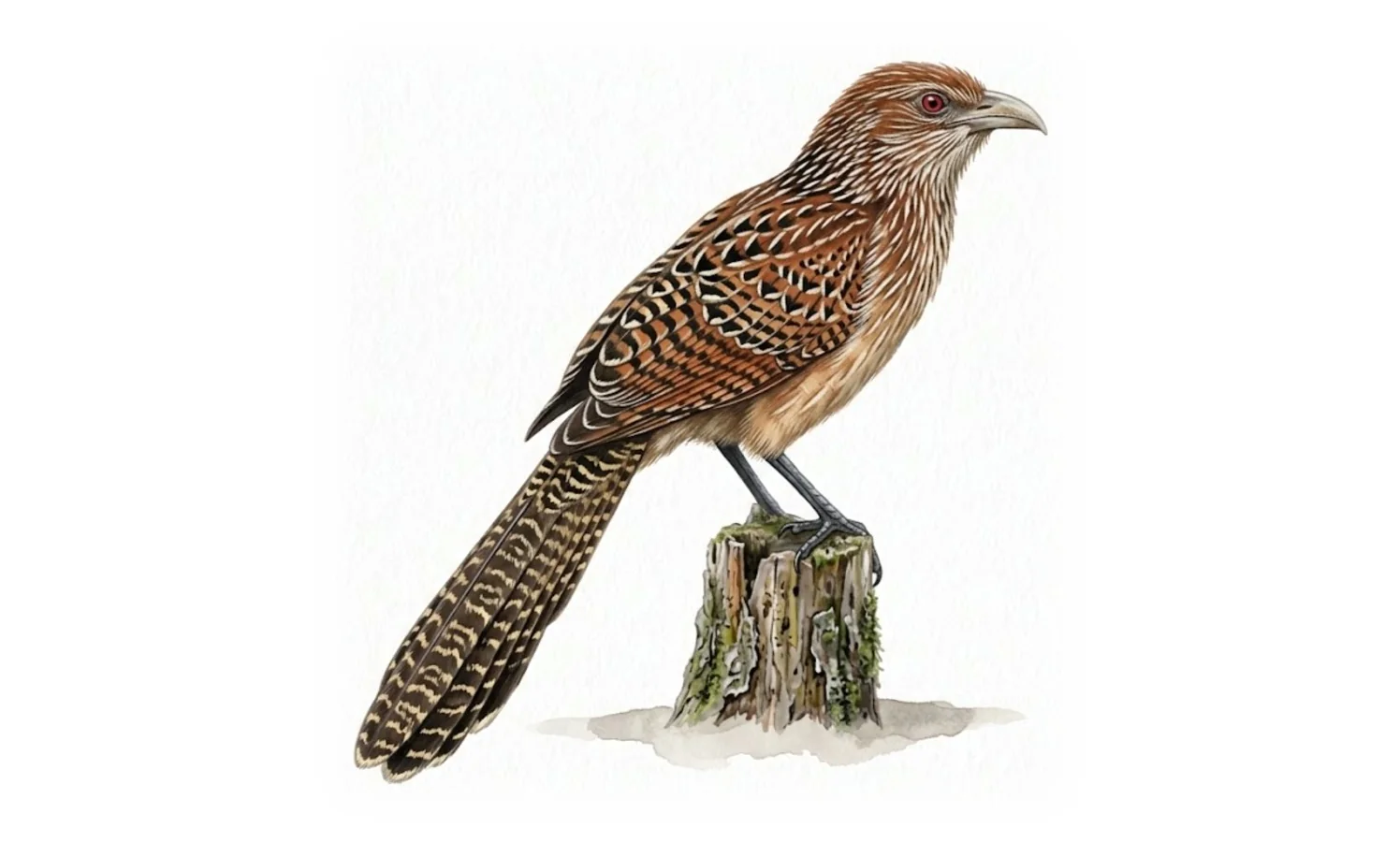
Eastern Queensland from Cape York to the NSW border, mainly on the coast and ranges but reaching several hundred km inland. Many Qld birds are resident; southern breeders winter in north Qld and New Guinea.

Habitat

Dry eucalypt forest and woodland with open understorey and deep leaf litter, especially stony ridges; also heathy forest, clearings, tracks and watercourses.

Breeding

Mainly Oct–Dec (Sep–Jan). Single cream egg, spotted dark purple-brown, laid on bare ground or litter, often beside a log or rock; no nest. Both parents incubate ~23–28 days.

BirdNerd study deck · QLD SeriesNominate mystacalis in Australia; island forms on the Solomons and New Caledonia are sometimes split as separate species.
Mystery bird plate XXXI
Throatlarge white throat patch
Crowngrey
Collarrufous-buff hind-neck collar
Covertsbig buff spots on dark coverts
Wingtipsfall well short of the tail tip
  1. 1Throat large white throat patch
  2. 2Crown grey
  3. 3Collar rufous-buff hind-neck collar
  4. 4Coverts big buff spots on dark coverts
  5. 5Wingtips fall well short of the tail tip
Adult — sexes alike No. XXXI

Spotted Nightjar

Eurostopodus argus

Caprimulgidae · Nightjars

No. XXXI25–31 cmLeast Concern

Description

  • Throat — large white throat patch; paired ovals
  • Crown — grey; black streaks down the centre
  • Collar — rufous-buff hind-neck collar
  • Coverts — big buff spots on dark coverts
  • Wingtips — fall well short of the tail tip
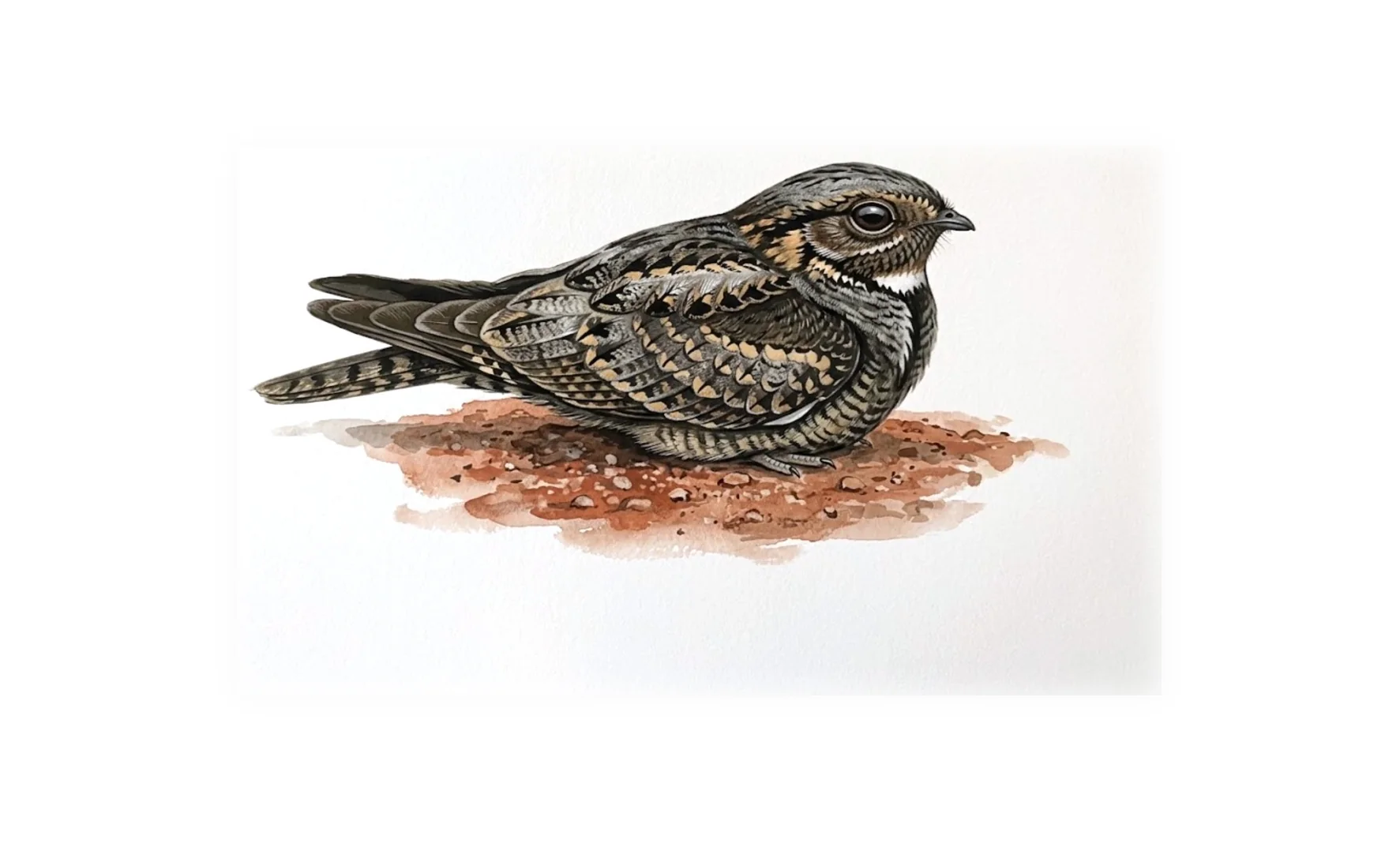
Sexes similar: grey above, streaked tawny and black; coverts boldly spotted buff; rufous collar; white throat patches; white patch on four outer primaries. Female slightly paler, more tawny, with smaller wing patch. Juvenile redder and finer-patterned; wing patch small, ochre-edged.

Behaviour

Hawks moths, beetles, grasshoppers and other flying insects within ~30 m of the ground; also hunts around lights and campfires. Usually single. Northern birds sedentary or nomadic; southern birds winter in the north. Fairly common; declining in the south.

Cairns Brisbane

Western & central-west inland

Distribution

Western and central Queensland — Channel Country, Mitchell Grass Downs, the Gulf country and north-west uplands — east to the Brigalow Belt and Einasleigh Uplands. Largely absent east of the Divide in the south-east.

Habitat

Dry open country: mulga and acacia scrub, mallee, spinifex, stony gibber plains and open eucalypt or savanna woodland; roosts on bare ground among stones and litter.

Breeding

Mainly Sep–Dec, earlier in the north; tied to rain in the arid zone. Single pale yellow-green egg blotched purple-brown, on bare ground or litter; no nest. Both sexes incubate ~30 days.

BirdNerd study deck · QLD SeriesMonotypic. Listed as Eurostopodus guttatus in many older Australian field guides.
Mystery bird plate XXXII
Eyehuge yellow eye
Facewhite brow above a dark eye-stripe
Billshort, stout and black
Wingblack shoulder bar
Legslong, pale olive-grey
  1. 1Eye huge yellow eye
  2. 2Face white brow above a dark eye-stripe
  3. 3Bill short, stout and black
  4. 4Wing black shoulder bar
  5. 5Legs long, pale olive-grey
Adult — sexes alike No. XXXII

Bush Stone-curlew

Burhinus grallarius

Burhinidae · Stone-curlews

No. XXXII52–58 cmLeast Concern

Description

  • Eye — huge yellow eye; staring expression
  • Face — white brow above a dark eye-stripe
  • Bill — short, stout and black
  • Wing — black shoulder bar; white panel below
  • Legs — long, pale olive-grey; thick 'knees'
Sexes alike: grey-brown above, streaked black and rufous; black shoulder bar over a white wing panel; whitish below with bold dark streaks; white brow; huge yellow eye. Juvenile paler and browner, fluffier, with softer streaking and a less distinct shoulder pattern.

Behaviour

Forages at night on insects, spiders, molluscs, frogs, small lizards and seeds, all taken from the ground. Roosts by day in pairs or small groups; loose flocks after breeding. Sedentary territorial pairs. Common in N Qld towns, sparse in farmland.

Cairns Brisbane

Statewide (suitable habitat)

Distribution

Widespread across Queensland from Cape York and the Gulf to the south-east in open woodland; scarce in the arid far south-west. Strong urban populations in Cairns, Townsville and Brisbane; declining in cleared farmland.

Habitat

Open grassy woodland with fallen timber and leaf litter; also savanna, paperbark and riverine woodland, mangrove edges, golf courses, cemeteries, parks and gardens.

Breeding

Jul–Jan. Clutch usually 2 (1–3), blotched buff eggs in a bare scrape on the ground, often beside a log or tree base. Both parents incubate ~4 weeks.

BirdNerd study deck · QLD SeriesMonotypic. Also called Bush Thick-knee; listed as Burhinus magnirostris in older books.
Mystery bird plate XXXIII
Billhuge, down-curved
Headplain, streaky
Upperpartsbrown
Breastbuff-brown, densely streaked
Legslong, blue-grey
  1. 1Bill huge, down-curved
  2. 2Head plain, streaky
  3. 3Upperparts brown
  4. 4Breast buff-brown, densely streaked
  5. 5Legs long, blue-grey
Adult — sexes alike; ♀ longer bill No. XXXIII

Eastern Curlew

Numenius madagascariensis

Scolopacidae · Sandpipers & allies

No. XXXIII60–66 cm; ♀ bill c. 18–19 cmEPBC Critically Endangered · QLD Critically Endangered

Description

  • Bill — huge, down-curved; pinkish base
  • Head — plain, streaky; no crown stripes
  • Upperparts — brown; heavily streaked, notched buff
  • Breast — buff-brown, densely streaked
  • Legs — long, blue-grey; tibia partly bare
Sexes alike in plumage: brown, heavily streaked and mottled, with brown rump and barred underwing. Female larger, with a markedly longer bill (average ~185 mm). Juvenile has a shorter bill and neater, buff-fringed upperparts. Breeding adults only slightly more rufous.

Behaviour

Probes mud and sand for crabs, ghost shrimps and molluscs, feeding by day and night. Singles or loose groups; roosts in flocks at high tide. Very wary of people and dogs. Uncommon and declining; occurs only in the East Asian–Australasian Flyway.

Cairns Brisbane

Coastal fringe

Distribution

Coastal Queensland from Torres Strait and the Gulf to the NSW border, mainly Aug–Mar. Key sites include Moreton Bay, Great Sandy Strait, Port Curtis and the Cairns Esplanade; some young birds stay through winter.

Habitat

Sheltered intertidal mudflats and sandflats, often near seagrass, mangroves and saltmarsh in estuaries and bays; roosts at high tide on sandbars, spits and saltmarsh.

Breeding

Breeds May–Jul on boggy marshes in eastern Russia and NE China. Clutch usually 4 in a grass-lined scrape. Does not breed in Australia; arrives Aug–Sep, leaves Feb–Mar.

BirdNerd study deck · QLD SeriesMonotypic. Named Far Eastern Curlew by the IOC and BirdLife Australia.
Mystery bird plate XXXIV
Neckglossy black
Billmassive, straight black dagger
Eyeyellow iris (♀)
Wingbroad black band across white wing
Legsvery long, coral-red
  1. 1Neck glossy black
  2. 2Bill massive, straight black dagger
  3. 3Eye yellow iris (♀)
  4. 4Wing broad black band across white wing
  5. 5Legs very long, coral-red
Adult ♀ (♂ has dark eye) No. XXXIV

Black-necked Stork

Ephippiorhynchus asiaticus

Ciconiidae · Storks

No. XXXIV129–137 cm; wingspan c. 2 m; ~4 kgLeast Concern

Description

  • Neck — glossy black; green and purple sheen
  • Bill — massive, straight black dagger
  • Eye — yellow iris (♀); dark brown in ♂
  • Wing — broad black band across white wing
  • Legs — very long, coral-red
Male: head and neck black glossed green and purple; white body; black wing band and tail; black bill; coral-red legs; dark brown eye. Female identical but with a yellow eye. Juvenile dull brown with a greyish-white belly and dusky legs; adult plumage gained over several years.

Behaviour

Eats fish, eels, crustaceans, frogs, reptiles and insects, stalking in water 5–30 cm deep and lunging or leaping at prey. Single birds, pairs or family groups; sedentary or partly nomadic. Fairly common in the north, scarce in the south-east.

Cairns Brisbane

Northern & eastern coastal wetlands

Distribution

Coastal and subcoastal wetlands of northern and eastern Queensland — Gulf plains, Cape York, the Burdekin and Fitzroy floodplains south to SEQ; sparser inland along rivers and waterholes to the north-west.

Habitat

Shallow freshwater wetlands — floodplain swamps, lagoons, billabongs and dams; also estuaries, tidal flats, mangrove edges, flooded pasture and sewage ponds.

Breeding

In Qld mostly Mar–Aug, laying chiefly Mar–May. Clutch 2–4 white eggs. Huge stick platform high in a tall tree near water, often reused; both parents incubate and feed the young.

BirdNerd study deck · QLD SeriesSsp. australis in Australia and New Guinea; nominate asiaticus in South and South-east Asia.
Mystery bird plate XXXV
Crestshort, pointed crest on the nape
Eyegolden-yellow, prominent, 'pop-eyed'
Headgrey head, neck and upper breast
Underpartswhite, boldly barred rufous-brown
Ventrufous-buff thighs and undertail
  1. 1Crest short, pointed crest on the nape
  2. 2Eye golden-yellow, prominent, 'pop-eyed'
  3. 3Head grey head, neck and upper breast
  4. 4Underparts white, boldly barred rufous-brown
  5. 5Vent rufous-buff thighs and undertail
Adult — sexes alike; ♀ larger No. XXXV

Pacific Baza

Aviceda subcristata

Accipitridae · Hawks, kites & eagles

No. XXXV35–46 cm; wingspan 80–105 cmLeast Concern

Description

  • Crest — short, pointed crest on the nape
  • Eye — golden-yellow, prominent, 'pop-eyed'
  • Head — grey head, neck and upper breast
  • Underparts — white, boldly barred rufous-brown
  • Vent — rufous-buff thighs and undertail
Adult grey head, neck, upper breast and back; white underparts with bold rufous-brown bars; rufous thighs and vent; nape crest; golden-yellow eye. Sexes similar; female heavier with browner crown. Juvenile browner, with fainter barring and brownish eye.

Behaviour

Takes large insects — especially stick insects and mantids — plus frogs, small lizards and occasionally fruit, snatched from foliage. Often in pairs or family parties; noisy when soaring, quiet in canopy. Fairly common in eastern and northern QLD.

Cairns Brisbane

Eastern seaboard

Distribution

Coastal and subcoastal eastern Queensland from Torres Strait and Cape York to the NSW border, west to the Gulf coast and inland along wooded rivers. Common in the tropics and increasingly in suburban SEQ.

Habitat

Edges of rainforest, monsoon forest, riparian woodland and tall eucalypt forest; also leafy suburbs, parks and paperbark swamps in well-watered areas.

Breeding

Sep–Feb, mainly Oct–Jan. Clutch 2–3. Flimsy flat stick nest high among leafy outer branches; the sitting bird's long tail juts over the rim.

BirdNerd study deck · QLD SeriesAustralian birds are nominate subcristata; NW Australian njikena is sometimes recognised. Also called Crested Hawk.
Mystery bird plate XXXVI
Shoulderblack patch on the folded wing
Eyered, set in a black 'comma'
Headwhite face, head and underparts
Upperpartspale ash-grey back and wings
Legsshort, bright yellow
  1. 1Shoulder black patch on the folded wing
  2. 2Eye red, set in a black 'comma'
  3. 3Head white face, head and underparts
  4. 4Upperparts pale ash-grey back and wings
  5. 5Legs short, bright yellow
Adult — sexes alike; ♀ larger No. XXXVI

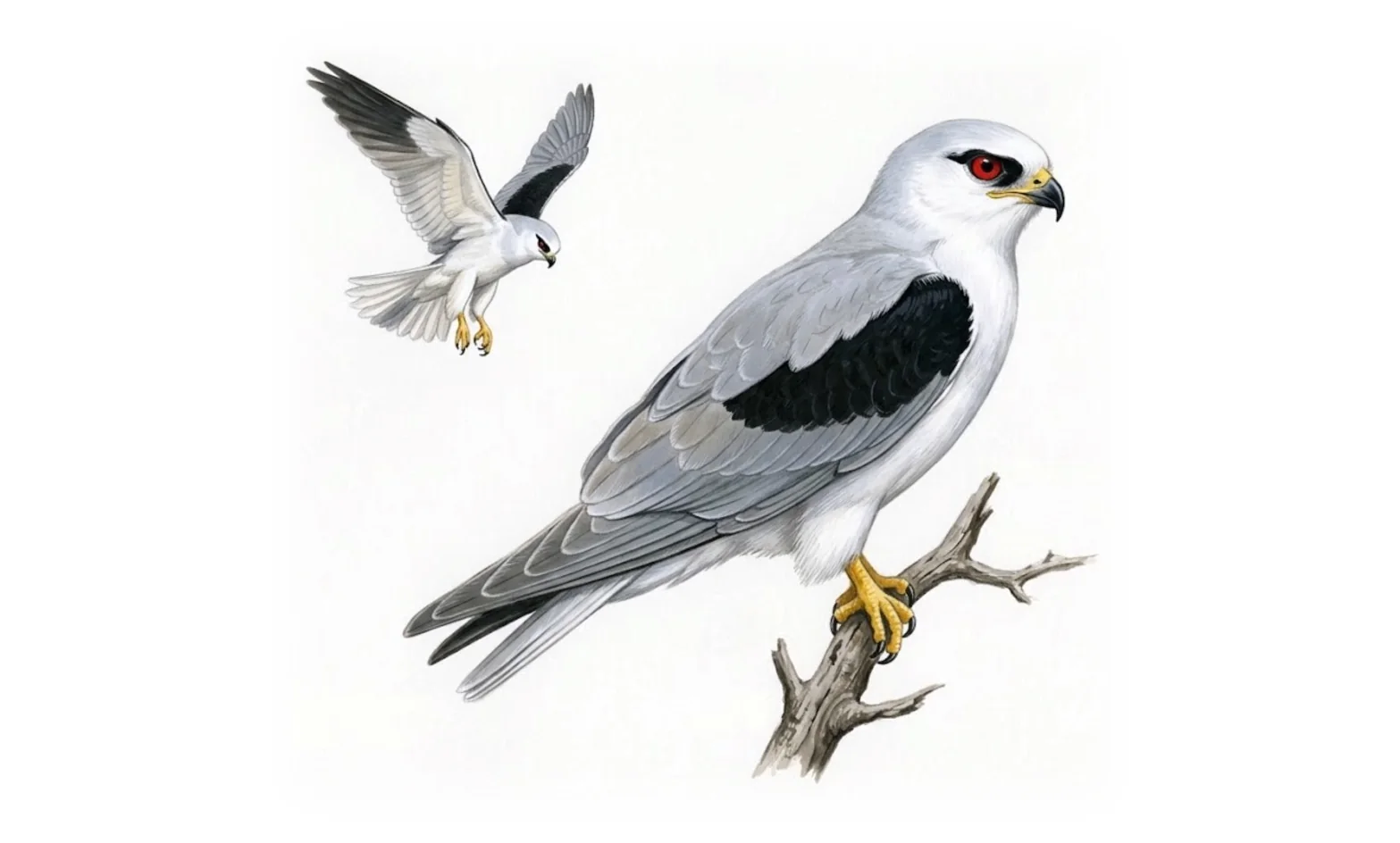
Black-shouldered Kite

Elanus axillaris

Accipitridae · Hawks, kites & eagles

No. XXXVI35–38 cm; wingspan 80–100 cmLeast Concern

Description

  • Shoulder — black patch on the folded wing
  • Eye — red, set in a black 'comma'
  • Head — white face, head and underparts
  • Upperparts — pale ash-grey back and wings
  • Legs — short, bright yellow; yellow cere
Adult white head and underparts, pale grey back and wings, black shoulder patch, red eye with black comma; yellow cere and legs. Sexes alike; female larger. Juvenile with rufous-brown wash on head and breast, brown-scalloped back, and browner eye.

Behaviour

Hunts mainly house mice and other small rodents, plus grasshoppers, by hovering and dropping feet-first; most active early and late in the day. Single, in pairs or small loose groups; nomadic. Common across QLD farmland.

Cairns Brisbane

Statewide (suitable habitat)

Distribution

Throughout Queensland in open country — farmland, coastal grasslands and inland plains from Cape York to the NSW border; most numerous on cleared farmland. Nomadic, irrupting where mice plague.

Habitat

Open grassland, crops, pasture with scattered trees, roadsides, airfields, swamp margins and vacant urban land.

Breeding

Mainly Jul–Dec, but any month when mice are plentiful. Clutch 3–4 (2–5). Untidy shallow stick cup high in a tree, or on a pole or bridge.

BirdNerd study deck · QLD SeriesMonotypic; formerly lumped with the Old World Black-winged Kite E. caeruleus.
Mystery bird plate XXXVII
Plumagedark brown
Headpaler, buff-streaked head
Billblack bill
Shoulderpale buff bar across the inner wing
Taillong, shallow-forked
  1. 1Plumage dark brown
  2. 2Head paler, buff-streaked head
  3. 3Bill black bill
  4. 4Shoulder pale buff bar across the inner wing
  5. 5Tail long, shallow-forked
Adult — sexes alike; ♀ larger No. XXXVII

Black Kite

Milvus migrans

Accipitridae · Hawks, kites & eagles

No. XXXVII47–55 cm; wingspan 1.2–1.5 mLeast Concern

Description

  • Plumage — dark brown; looks black at a distance
  • Head — paler, buff-streaked head; dark eye
  • Bill — black bill; yellow cere and gape
  • Shoulder — pale buff bar across the inner wing
  • Tail — long, shallow-forked; notch shows at rest
Adult dark brown with rufous and buff streaking on head, neck and underparts; pale bar across upperwing coverts; black bill, yellow cere and legs. Sexes alike; female slightly larger. Juvenile paler and more heavily buff-streaked, with buff tips to coverts and a shallower tail fork.

Behaviour

Opportunist scavenger and hunter of insects (especially grasshoppers), lizards, small mammals and birds; hawks flushed prey at fires and snatches scraps from tips and roads. Highly gregarious, in flocks of hundreds or thousands. Abundant in northern and inland QLD.

Cairns Brisbane

Statewide (suitable habitat)

Distribution

Throughout most of Queensland; abundant across the north, Gulf and the inland, gathering at towns, tips, stockyards and fires. Scarcer on the south-east coast, though now regular around SEQ and expanding.

Habitat

Open plains, grassland, savanna and timbered watercourses; strongly drawn to towns, rubbish tips, abattoirs, roadsides and grass fires.

Breeding

Mainly Jun–Dec (dry season in the north). Clutch usually 2–3. Bulky stick cup lined with wool, fur or rubbish, in a tree fork; often loose colonies.

BirdNerd study deck · QLD SeriesAustralian birds are M. m. affinis (also New Guinea and Sulawesi).
Mystery bird plate XXXVIII
Headpale sandy, finely streaked
Billsmall, dark grey
Wingssandy-brown coverts
Underpartspale sandy-buff, finely streaked
Taillong, rounded, plain pale brown
  1. 1Head pale sandy, finely streaked
  2. 2Bill small, dark grey
  3. 3Wings sandy-brown coverts
  4. 4Underparts pale sandy-buff, finely streaked
  5. 5Tail long, rounded, plain pale brown
Adult — sexes alike; ♀ larger No. XXXVIII

Whistling Kite

Haliastur sphenurus

Accipitridae · Hawks, kites & eagles

No. XXXVIII50–60 cm; wingspan 1.2–1.45 mLeast Concern

Description

  • Head — pale sandy, finely streaked; scruffy look
  • Bill — small, dark grey; brown eye
  • Wings — sandy-brown coverts; dark flight feathers
  • Underparts — pale sandy-buff, finely streaked
  • Tail — long, rounded, plain pale brown
Adult sandy-brown with pale, finely streaked head and underparts; dark brown flight feathers; cream legs, brown eye. Sexes alike; female larger. Juvenile more rufous and boldly streaked, with pale-spotted coverts and spotted upperparts.

Behaviour

Opportunist: carrion (roadkill, dead fish), plus live rabbits, rodents, birds, fish, reptiles and insects; robs other birds of prey. Usually alone, in pairs or small groups; congregates at abundant food. Common and widespread across QLD.

Cairns Brisbane

Statewide (suitable habitat)

Distribution

Common throughout Queensland in suitable habitat — coastal wetlands and estuaries from Cape York to the NSW border, Gulf floodplains and inland rivers, bores and swamps of the arid west. Partly nomadic in the south.

Habitat

Open woodland and farmland near water — rivers, swamps, lakes, floodplains, estuaries and mangroves; needs tall trees for nesting.

Breeding

Mainly Jul–Dec, often earlier in the tropics. Clutch usually 2 (1–3). Bulky stick platform lined with green leaves, high in a tall tree near water; reused for years.

BirdNerd study deck · QLD SeriesMonotypic; also New Guinea and New Caledonia.
Mystery bird plate XXXIX
Headwhite head and breast
Bodyrich chestnut body and wings
Wingtipsblack primary tips at the wingtip
Billpale horn-yellow, strongly hooked
Tailshort, rounded, chestnut
  1. 1Head white head and breast
  2. 2Body rich chestnut body and wings
  3. 3Wingtips black primary tips at the wingtip
  4. 4Bill pale horn-yellow, strongly hooked
  5. 5Tail short, rounded, chestnut
Adult — sexes alike; ♀ larger No. XXXIX

Brahminy Kite

Haliastur indus

Accipitridae · Hawks, kites & eagles

No. XXXIX45–51 cm; wingspan 1.1–1.25 mLeast Concern

Description

  • Head — white head and breast; unstreaked
  • Body — rich chestnut body and wings
  • Wingtips — black primary tips at the wingtip
  • Bill — pale horn-yellow, strongly hooked
  • Tail — short, rounded, chestnut; pale tip
Adult white head, neck and breast; chestnut body, wings and tail; black primary tips; pale horn bill, dark eye, yellow legs. Sexes alike; female larger. Juvenile dull brown with pale streaking on head and breast; adult plumage gained over 2–3 years.

Behaviour

Scavenges dead fish, crabs, offal and refuse; also takes live fish, frogs, insects and small reptiles from the water or ground surface. Pirates food from gulls, terns, Osprey and other kites. Single or in pairs; common in coastal north QLD.

Cairns Brisbane

Coastal fringe

Distribution

The whole Queensland coastline from Torres Strait and Cape York south to the NSW border, including the Gulf of Carpentaria coast and offshore islands. Common in the tropics, fewer around SEQ; rarely far inland.

Habitat

Mangroves, estuaries, tidal mudflats, beaches, harbours and coastal rivers; also nearby forest edges, towns, wharves and tips.

Breeding

Mainly Apr–Oct. Clutch 1–2. Stick nest lined with seaweed, leaves or rubbish, in a mangrove or tall tree near water; both parents incubate.

BirdNerd study deck · QLD SeriesAustralian birds are H. i. girrenera — head and breast white, without the dark streaks of Asian races.
Mystery bird plate XL
Headwhite head, neck and underparts
Wingsslate-grey back and folded wings
Billlarge, grey with a darker tip
Legsbare, cream-white
Tailshort wedge
  1. 1Head white head, neck and underparts
  2. 2Wings slate-grey back and folded wings
  3. 3Bill large, grey with a darker tip
  4. 4Legs bare, cream-white
  5. 5Tail short wedge
Adult — sexes alike; ♀ larger No. XL

White-bellied Sea-Eagle

Icthyophaga leucogaster

Accipitridae · Hawks, kites & eagles

No. XL75–85 cm; wingspan 1.8–2.2 mLeast Concern

Description

  • Head — white head, neck and underparts
  • Wings — slate-grey back and folded wings
  • Bill — large, grey with a darker tip
  • Legs — bare, cream-white; black talons
  • Tail — short wedge; grey base, white tip
Adult white head, neck, underparts and tail tip; slate-grey back and wings; black flight feathers; grey bill, dark brown eye, cream legs. Sexes alike; female larger. Juvenile brown with buff head and pale tail; adult plumage gained patchily by the fourth year.

Behaviour

Hunts fish, sea snakes, turtles, waterbirds and mammals up to swan size, snatched from the surface; also carrion and stolen prey. Permanent pairs hold territories year-round; feeds alone, in pairs or family groups. Common along the QLD coast.

Cairns Brisbane

Coastal fringe

Distribution

The entire Queensland coastline, islands and Torres Strait, including the Gulf of Carpentaria; also inland along major rivers, lakes and large dams such as Wivenhoe. Pairs resident year-round.

Habitat

Coasts, estuaries, bays, islands, mangroves and large rivers, lakes and reservoirs; perches and nests in tall trees overlooking water.

Breeding

Mainly May–Oct. Clutch usually 2; often one young raised. Huge stick nest high in a tall tree (to 30 m), or on rocks or the ground on islands; reused for years.

BirdNerd study deck · QLD SeriesMonotypic. Formerly Haliaeetus leucogaster; IOC now places sea-eagles in Icthyophaga.
Mystery bird plate XLI
Facial discchestnut owl-like disc
Underpartschestnut, densely white-spotted
Wingsblue-grey, spotted and barred darker
Taillong, wedge-tipped
Legsvery long, slender, bright yellow
  1. 1Facial disc chestnut owl-like disc
  2. 2Underparts chestnut, densely white-spotted
  3. 3Wings blue-grey, spotted and barred darker
  4. 4Tail long, wedge-tipped
  5. 5Legs very long, slender, bright yellow
Adult — sexes alike; ♀ larger No. XLI

Spotted Harrier

Circus assimilis

Accipitridae · Hawks, kites & eagles

No. XLI50–61 cm; wingspan 1.2–1.47 mLeast Concern

Description

  • Facial disc — chestnut owl-like disc; yellow eye
  • Underparts — chestnut, densely white-spotted
  • Wings — blue-grey, spotted and barred darker
  • Tail — long, wedge-tipped; boldly dark-barred
  • Legs — very long, slender, bright yellow
Adult blue-grey above, mottled darker and spotted white; chestnut facial disc and underparts spotted white; long barred tail; yellow eye and long yellow legs. Sexes similar; female larger. Juvenile brown above, buff below with streaks, dark eye, rufous facial disc.

Behaviour

Hunts by low, slow quartering with sudden drops onto ground birds (quail, button-quail, pipits, songlarks), rodents, rabbits and reptiles. Usually alone or in pairs; nomadic, following prey. Sparse but widespread across inland QLD grasslands.

Cairns Brisbane

Statewide (suitable habitat)

Distribution

Widespread but sparse over inland Queensland — Mitchell-grass downs, Channel Country, Gulf plains and Brigalow Belt — east to the Darling Downs and Burnett; scarce on the wetter east coast. Nomadic.

Habitat

Open grassland, grassy woodland, crops, stubble and saltbush plains; uses scattered trees for perching and nesting. Avoids dense forest.

Breeding

Mainly Aug–Dec, or after rain. Clutch usually 3 (2–4). Shallow stick platform lined with green leaves, in the outer foliage of a tree 2–15 m up.

BirdNerd study deck · QLD SeriesMonotypic; no geographic variation recognised across its range.
Mystery bird plate XLII
Plumageblackish-brown overall
Napetawny-bronze hackles on the nape
Billmassive
Legsfeathered to the toes
Taillong, wedge-shaped (diamond-tipped)
  1. 1Plumage blackish-brown overall
  2. 2Nape tawny-bronze hackles on the nape
  3. 3Bill massive
  4. 4Legs feathered to the toes
  5. 5Tail long, wedge-shaped (diamond-tipped)
Adult — sexes alike; ♀ larger No. XLII

Wedge-tailed Eagle

Aquila audax

Accipitridae · Hawks, kites & eagles

No. XLII89–106 cm; wingspan 1.8–2.3 mLeast Concern

Description

  • Plumage — blackish-brown overall
  • Nape — tawny-bronze hackles on the nape
  • Bill — massive; pale cream-pink base
  • Legs — feathered to the toes; cream feet
  • Tail — long, wedge-shaped (diamond-tipped)
Adult blackish-brown with tawny-bronze nape and paler wing-covert bar; legs feathered to the toes; pale cream bill, brown eye. Female larger and often slightly paler. Juvenile and immature golden-brown with rufous nape, darkening over 10+ years.

Behaviour

Takes rabbits, hares, wallabies, foxes, large birds and reptiles, and readily scavenges carrion and roadkill, where up to 20 may gather. Hunts alone, in pairs or cooperatively. Territorial pairs sedentary; fairly common throughout QLD.

Cairns Brisbane

Statewide (suitable habitat)

Distribution

Throughout Queensland from Cape York and the Gulf to the NSW border and the far south-west deserts; commonest in open inland country, scarce in rainforest and densely settled coastal areas.

Habitat

Open woodland, savanna, grassland, rangelands and farmland with tall trees; from coast to arid interior, avoiding rainforest and coastal heath.

Breeding

Mainly Apr–Sep in QLD. Clutch usually 2 (1–3); often only one chick fledges. Huge stick platform lined with leaves in the tallest tree; reused for years.

BirdNerd study deck · QLD SeriesMainland nominate audax in QLD; Tasmanian fleayi is EPBC Endangered.
Mystery bird plate XLIII
Facial discdark brown mask
Eyelarge, greenish-yellow to hazel
Headrounded
Upperpartsdark brown
Underpartsbuff, heavily blotched rufous-brown
  1. 1Facial disc dark brown mask
  2. 2Eye large, greenish-yellow to hazel
  3. 3Head rounded
  4. 4Upperparts dark brown
  5. 5Underparts buff, heavily blotched rufous-brown
Adult — sexes alike No. XLIII

Southern Boobook

Ninox boobook

Strigidae · Hawk-owls

No. XLIII27–36 cmLeast Concern

Description

  • Facial disc — dark brown mask; pale eyebrows
  • Eye — large, greenish-yellow to hazel
  • Head — rounded; no ear tufts
  • Upperparts — dark brown; white spots on scapulars
  • Underparts — buff, heavily blotched rufous-brown
Adult dark brown above with white-spotted scapulars and wings; buff underparts with rufous-brown blotches; pale facial disc with dark mask and whitish brows; eye greenish-yellow. Sexes alike; female often larger. Juvenile fluffy, paler with whitish underparts and dark mask.

Behaviour

Nocturnal; hawks moths and beetles, often under lights, and takes small mammals, birds and geckos from a perch. Roosts singly or in pairs in dense foliage or tree hollows. Common and widespread throughout QLD; sedentary pairs.

Cairns Brisbane

Statewide (suitable habitat)

Distribution

Throughout Queensland wherever there are trees — coast, ranges and inland watercourses from Cape York to the NSW border. Scarcer in the treeless south-west. Dark rufous Red Boobook in Wet Tropics rainforest.

Habitat

Forest, woodland, rainforest edges, riparian timber and scrub; also farmland with trees, parks and suburban gardens. Roosts by day in dense foliage.

Breeding

Eggs Aug–Oct in QLD. Clutch 2–3 (1–5). Unlined tree hollow 1–20 m up, mostly in eucalypts; female incubates while the male brings food.

BirdNerd study deck · QLD SeriesQLD: nominate boobook (south-east), ocellata (north and west), lurida Red Boobook (Wet Tropics); IOC name Australian Boobook.
Mystery bird plate XLIV
Eyelarge, yellow
Underpartsoff-white with bold dark V-chevrons
Upperpartsdark grey-brown, barred white
Feetmassive yellow toes
Headsmall for body
  1. 1Eye large, yellow
  2. 2Underparts off-white with bold dark V-chevrons
  3. 3Upperparts dark grey-brown, barred white
  4. 4Feet massive yellow toes
  5. 5Head small for body
Adult — sexes alike; ♂ larger No. XLIV

Powerful Owl

Ninox strenua

Strigidae · Hawk-owls

No. XLIV45–60 cm; wingspan to 1.4 mQLD Vulnerable

Description

  • Eye — large, yellow; dark grey-brown mask
  • Underparts — off-white with bold dark V-chevrons
  • Upperparts — dark grey-brown, barred white
  • Feet — massive yellow toes; dark claws
  • Head — small for body; no ear tufts
Adult dark grey-brown above with white barring; off-white below with bold dark chevrons; yellow eye in dark mask; massive yellow-orange feet. Sexes alike in plumage; male larger, broader-headed. Juvenile downy white head and underparts, sparse streaks, short tail.

Behaviour

Nocturnal; takes arboreal mammals — ringtail possums, greater gliders, sugar gliders — plus roosting birds and flying-foxes, seized from branches. Pairs mate for life and defend year-round territories. Sparse; QLD Vulnerable.

Cairns Brisbane

South-east & central-east

Distribution

South-east and central-east Queensland, mainly east of the Great Dividing Range, from the NSW border north to the Clarke Range near Eungella (west of Mackay), inland to the Bunya Mountains and Carnarvon Range.

Habitat

Tall open eucalypt forest and woodland, especially sheltered gullies and riparian forest with dense understorey; needs large old hollow-bearing trees.

Breeding

Mainly Apr–Sep. Clutch 2, rarely 1. Deep vertical hollow in a large old eucalypt; male prepares the hollow and feeds the incubating female.

BirdNerd study deck · QLD SeriesMonotypic; endemic to eastern and south-eastern Australia.
Mystery bird plate XLV
Billshort, broad, coral-red
Headdark brown head, blackish face
Throatglossy violet-blue throat
Plumagedull turquoise-green
Legsshort, coral-red legs
  1. 1Bill short, broad, coral-red
  2. 2Head dark brown head, blackish face
  3. 3Throat glossy violet-blue throat
  4. 4Plumage dull turquoise-green
  5. 5Legs short, coral-red legs
Adult — sexes alike No. XLV

Dollarbird

Eurystomus orientalis

Coraciidae · Rollers

No. XLV27–31 cmLeast Concern

Description

  • Bill — short, broad, coral-red; dark tip
  • Head — dark brown head, blackish face
  • Throat — glossy violet-blue throat
  • Plumage — dull turquoise-green; back and underparts
  • Legs — short, coral-red legs
Sexes alike; female slightly duller. Adult dark brown head, blue-green body, violet-blue throat, red bill and legs. Juvenile duller and browner, lacks the bright throat gloss, with dark brownish bill and legs.

Behaviour

Hawks large flying insects from a high exposed perch, often returning to the same perch; rarely takes prey on the ground. Usually solitary or in pairs; loose groups gather before migration. Common summer visitor.

Cairns Brisbane

Eastern Queensland

Distribution

Breeding migrant (Sep–Apr) across northern and eastern QLD: Cape York, the Gulf and the east coast to the NSW border, inland along timbered rivers to the central west; a few overwinter in the far north.

Habitat

Open eucalypt forest and woodland, riverside timber, rainforest edges, farmland and suburbs with tall dead limbs for perching and hollow-bearing trees for nesting.

Breeding

Mainly Oct–Jan. Nests in an unlined hollow high in a tree, often reused. Clutch 3–4 white eggs; both sexes incubate and feed the young.

BirdNerd study deck · QLD SeriesAustralian breeders are E. o. pacificus, which winters in New Guinea and Indonesia.
Mystery bird plate XLVI
Headdull brown head and neck (♂)
Billvery broad, bulbous grey bill
Crestsmall, rounded, hardly visible
Bodysooty black body and wings
Tailbright red panels
  1. 1Head dull brown head and neck (♂)
  2. 2Bill very broad, bulbous grey bill
  3. 3Crest small, rounded, hardly visible
  4. 4Body sooty black body and wings
  5. 5Tail bright red panels
Adult ♂ (♀ yellow head patches) No. XLVI

Glossy Black-Cockatoo

Calyptorhynchus lathami

Cacatuidae · Cockatoos

No. XLVI46–50 cm; smallest black-cockatooEPBC Vulnerable (ssp. lathami) · QLD Vulnerable

Description

  • Head — dull brown head and neck (♂)
  • Bill — very broad, bulbous grey bill
  • Crest — small, rounded, hardly visible
  • Body — sooty black body and wings
  • Tail — bright red panels; unbarred in males
Male sooty black with brown-washed head and plain bright red tail panels. Female browner, with irregular yellow patches on head and neck, and orange-red tail panels barred black. Juvenile like female but spotted yellow on breast, belly and flanks; young males gradually lose the yellow.

Behaviour

Specialist on she-oak seed, crushing closed cones with the bulbous bill and feeding for much of the day. Pairs, trios or small groups; larger gatherings at drinking sites before roosting. Quiet and inconspicuous; uncommon and patchily distributed.

Cairns Brisbane

South-east & central-east

Distribution

South-east and central-east Queensland: nominate lathami from the SEQ coast and islands inland to the Mitchell–Carnarvon area; ssp. erebus in central-east ranges from Kroombit Tops north to the Clarke–Connors Ranges.

Habitat

Open forest and woodland with stands of she-oak (Allocasuarina, Casuarina), often remnant patches in farmland; nests in large hollows of old eucalypts near water.

Breeding

Mainly Mar–Aug (sometimes other months). Single white egg in a deep hollow of a large old eucalypt, often reused; female incubates ~30 days; young fledge at ~3 months.

BirdNerd study deck · QLD SeriesNominate lathami in SEQ (EPBC Vulnerable); erebus in central-east Qld (QLD Vulnerable only); halmaturinus on Kangaroo Island.
Mystery bird plate XLVII
Maskblack mask from forehead through eye
Eyebrowyellow eyebrow
Throatbright lemon-yellow throat
Upperpartsdark olive-brown
Legslong, pale pinkish-cream legs
  1. 1Mask black mask from forehead through eye
  2. 2Eyebrow yellow eyebrow
  3. 3Throat bright lemon-yellow throat
  4. 4Upperparts dark olive-brown
  5. 5Legs long, pale pinkish-cream legs
Adult ♂ (♀ mask brown) No. XLVII

Yellow-throated Scrubwren

Neosericornis citreogularis

Acanthizidae · Thornbills & scrubwrens

No. XLVII12–15 cmLeast Concern

Description

  • Mask — black mask from forehead through eye
  • Eyebrow — yellow eyebrow; whiter above the bill
  • Throat — bright lemon-yellow throat
  • Upperparts — dark olive-brown; flight feathers edged yellow
  • Legs — long, pale pinkish-cream legs
Male: black mask and forehead bordered by a white-and-yellow eyebrow, bright yellow throat. Female similar but mask dark brown and less contrasting. Juvenile duller, with weaker face pattern and underparts washed fawn.

Behaviour

Forages almost entirely on the ground, raking leaf litter for insects, spiders and other invertebrates, plus some seeds. In pairs or family groups; sedentary and common in suitable rainforest. Joins other ground-foraging birds.

Cairns Brisbane

Eastern seaboard

Distribution

Two separate populations: the Wet Tropics from Cooktown to the Paluma Range (ssp. cairnsi), and the south-east QLD ranges from the Bunya Mtns and Blackall Range to Lamington and the Border Ranges.

Habitat

Floor and understorey of rainforest and wet eucalypt forest, especially damp, densely vegetated gullies and creek-lines with deep leaf litter.

Breeding

Mainly Aug–Feb. Bulky domed nest with hooded side entrance, hung 1–10 m up from a vine or branch, often over water. Clutch 2–3 brownish eggs.

BirdNerd study deck · QLD Seriescairnsi in the Wet Tropics; intermedius in SEQ. Formerly Sericornis, as still used by WildNet.
Mystery bird plate XLVIII
Facebare bright-blue skin around the eye
Headblack crown, nape and throat bib
Napenarrow white nape crescent
Mantlegolden olive-green back and wings
Underpartsclean white
  1. 1Face bare bright-blue skin around the eye
  2. 2Head black crown, nape and throat bib
  3. 3Nape narrow white nape crescent
  4. 4Mantle golden olive-green back and wings
  5. 5Underparts clean white
Adult — sexes alike No. XLVIII

Blue-faced Honeyeater

Entomyzon cyanotis

Meliphagidae · Honeyeaters

No. XLVIII26–32 cmLeast Concern

Description

  • Face — bare bright-blue skin around the eye
  • Head — black crown, nape and throat bib
  • Nape — narrow white nape crescent
  • Mantle — golden olive-green back and wings
  • Underparts — clean white; white stripe below eye
Sexes alike: black head and bib, white nape crescent and malar stripe, golden olive-green upperparts, white underparts; bare blue face skin, deeper cobalt below the eye. Juvenile has yellow-green face skin, brownish crown and paler grey bib.

Behaviour

Eats insects and other invertebrates gleaned from bark and foliage, plus nectar and fruit. Pairs or noisy parties of up to ~7, sometimes more; often with friarbirds and miners. Sedentary in the north, locally nomadic in the south. Common.

Cairns Brisbane

Statewide (suitable habitat)

Distribution

Throughout most of Queensland — common across the east and north from Cape York and the Gulf to the NSW border, and inland along timbered watercourses into the central west; scarce in the arid far south-west.

Habitat

Open forest and woodland, usually near water; also paperbark and riverine woodland, mangroves, banana plantations, orchards, parks and suburban gardens.

Breeding

Jun–Feb. Clutch 2, rarely 3. Usually takes over another species' old nest; otherwise builds a rough cup of bark. Both parents, sometimes with helpers, feed young.

BirdNerd study deck · QLD SeriesNominate cyanotis in eastern Qld; griseigularis on Cape York; white-winged albipennis in the Gulf and north-west.
Mystery bird plate XLIX
Crownblack crown and cheek mask
Eyebare yellow skin behind the eye
Billshort, bright yellow
Breastgrey, finely scalloped paler
Wingolive-yellow edging on wing feathers
  1. 1Crown black crown and cheek mask
  2. 2Eye bare yellow skin behind the eye
  3. 3Bill short, bright yellow
  4. 4Breast grey, finely scalloped paler
  5. 5Wing olive-yellow edging on wing feathers
Adult — sexes alike No. XLIX

Noisy Miner

Manorina melanocephala

Meliphagidae · Honeyeaters

No. XLIX24–28 cmLeast Concern

Description

  • Crown — black crown and cheek mask
  • Eye — bare yellow skin behind the eye
  • Bill — short, bright yellow
  • Breast — grey, finely scalloped paler
  • Wing — olive-yellow edging on wing feathers
Sexes alike: grey with black crown and cheeks; yellow bill, legs and bare skin behind the eye; olive-yellow edging to wing feathers; breast finely scalloped. Juvenile duller and browner, with a dark grey (not black) crown and smaller, paler yellow eye patch.

Behaviour

Eats insects, nectar, lerp, manna and fruit, gleaned in trees or on the ground. Lives in large, complex colonies that defend communal territories against most other birds. Very common and increasing, especially in fragmented habitat.

Cairns Brisbane

Eastern Queensland

Distribution

Eastern Queensland from the Atherton Tableland and Einasleigh Uplands south to the NSW border, including the coast, Brigalow Belt and Darling Downs; absent from Cape York, the Gulf and the arid west.

Habitat

Open eucalypt woodland and forest edges with sparse understorey; thrives in fragmented farmland, roadside timber, parks, gardens and suburban streets.

Breeding

Jul–Dec, often several broods. Clutch 2–4. Female builds a cup of twigs and grass in a tree fork and incubates alone; both sexes and helpers feed the young.

BirdNerd study deck · QLD SeriesCoastal nominate in SEQ; lepidota inland; titaniota on the NE uplands (Atherton–Einasleigh); leachi in Tasmania.
Mystery bird plate L
Headgrey crown, face and nape
Throatoff-white chin and throat
Underpartsbright yellow breast and belly
Rumpbright yellow rump in Qld birds
Billshort and black
  1. 1Head grey crown, face and nape
  2. 2Throat off-white chin and throat
  3. 3Underparts bright yellow breast and belly
  4. 4Rump bright yellow rump in Qld birds
  5. 5Bill short and black
Adult — sexes alike No. L

Eastern Yellow Robin

Eopsaltria australis

Petroicidae · Australasian robins

No. L15–17 cmLeast Concern

Description

  • Head — grey crown, face and nape; grey back
  • Throat — off-white chin and throat
  • Underparts — bright yellow breast and belly
  • Rump — bright yellow rump in Qld birds
  • Bill — short and black; dark eye
Sexes alike, female slightly smaller: grey head and back, off-white throat, bright yellow underparts; rump bright yellow in Qld birds. Pale wingbar in flight. Juvenile rufous-brown, streaked and spotted paler; later pale streaks are confined to the wings.

Behaviour

Perch-and-pounce hunter of insects, spiders and other arthropods, mostly taken from the ground. Single birds, pairs or family groups; tame, often approaching people. Common; some altitudinal movement to the lowlands in winter.

Cairns Brisbane

Eastern Queensland

Distribution

Eastern Queensland from the Cooktown area and Atherton Tableland south to the NSW border, mostly on the coast and ranges but extending inland to the Carnarvon and Blackdown ranges and the Bunya Mountains.

Habitat

Rainforest edges, wet and dry eucalypt forest and woodland with a shrubby understorey; also vine scrub, brigalow remnants, parks and large gardens.

Breeding

Jul–Jan; up to three broods. Clutch 2–3. Female builds a neat cup of bark and grass bound with web, decorated with lichen and bark strips, in an upright fork usually <5 m up.

BirdNerd study deck · QLD SeriesQld birds are ssp. chrysorrhoa (bright yellow rump); nominate australis, with an olive rump, in Vic and southern NSW.
Mystery bird plate LI
Browrufous-red eye patch
Headgrey crown and face
Backbrown saddle contrasts with grey
Underpartsboldly streaked white, edged black
Billfine, black, slightly decurved
  1. 1Brow rufous-red eye patch
  2. 2Head grey crown and face
  3. 3Back brown saddle contrasts with grey
  4. 4Underparts boldly streaked white, edged black
  5. 5Bill fine, black, slightly decurved
Adult ♂ (♀ rufous breast streaks) No. LI

Red-browed Treecreeper

Climacteris erythrops

Climacteridae · Australasian treecreepers

No. LI14–16 cmLeast Concern

Description

  • Brow — rufous-red eye patch; reaches ear-coverts
  • Head — grey crown and face; white throat
  • Back — brown saddle contrasts with grey
  • Underparts — boldly streaked white, edged black
  • Bill — fine, black, slightly decurved
Male: broad rufous eye patch reaching the ear-coverts; upper breast brownish-grey. Female: darker red-brown patch not extending behind the eye; upper breast white, broadly streaked rufous. Both: grey head, brown saddle. Juvenile near-adult within two months.

Behaviour

Eats insects, chiefly ants, gleaned and probed from bark as it hops up trunks and along branches; sometimes on the ground. Pairs or small cooperative groups holding year-round territories. Sedentary; uncommon to locally common.

Cairns Brisbane

South-east & central-east

Distribution

South-east Queensland only: ranges and foothills from the Jimna–Conondale area south through the D'Aguilar, Main and McPherson Ranges (Lamington, Springbrook), west to the Granite Belt (Girraween).

Habitat

Tall wet and dry eucalypt forest on ranges and foothills, favouring smooth-barked gums with ribbons of shed bark; often near rainforest edges and in gullies.

Breeding

Late Aug–early Feb. Clutch 2. Nest of bark fibre and grass lined with fur, at the bottom of a hollow in a near-vertical trunk or limb; female incubates.

BirdNerd study deck · QLD SeriesMonotypic; endemic to eastern Australia (SE Qld to eastern Victoria).
Mystery bird plate LII
Eyebrowpale buff brow over dark eye-stripe
Headplain greyish-brown crown and face
Throatpale buff-grey
Underpartslower breast streaked black and buff
Undertailcoverts barred black and white
  1. 1Eyebrow pale buff brow over dark eye-stripe
  2. 2Head plain greyish-brown crown and face
  3. 3Throat pale buff-grey
  4. 4Underparts lower breast streaked black and buff
  5. 5Undertail coverts barred black and white
Adult — sexes nearly alike No. LII

Brown Treecreeper

Climacteris picumnus

Climacteridae · Australasian treecreepers

No. LII16–18 cmLeast Concern · SE ssp. EPBC & QLD Vulnerable

Description

  • Eyebrow — pale buff brow over dark eye-stripe
  • Head — plain greyish-brown crown and face
  • Throat — pale buff-grey; ♂ black streaks below
  • Underparts — lower breast streaked black and buff
  • Undertail — coverts barred black and white
Sexes nearly alike: buff brow, dark eye-stripe, streaked lower breast. Male has a short band of black-edged streaks on the upper breast; female's are rufous. Juvenile duller, with fainter streaking and a pale rufous lower belly. Cape York birds much darker.

Behaviour

Eats insects, mostly ants, probed from bark as it hops up trunks or picked from the ground and fallen logs; sometimes pounces from a perch. Sedentary family groups on permanent territories. Common in good woodland, declining in fragments.

Cairns Brisbane

Inland eastern Queensland

Distribution

Eastern and central Queensland west of the wet coast: Brigalow Belt, Darling Downs, Einasleigh and Desert Uplands and mulga west to about Cunnamulla–Longreach; patchy on Cape York; SE ssp. only near the NSW border (Granite Belt).

Habitat

Dry open eucalypt woodland with a grassy floor, fallen logs and hollow trees — box, ironbark, river red gum and cypress; also riverine woodland and open mulga.

Breeding

Jun–Jan; often two broods. Clutch 2–3. Grass, feathers and fur in a tree hollow, stump or post; female incubates, male helpers feed her and the young.

BirdNerd study deck · QLD Seriesmelanotus (dark) on Cape York; picumnus over most of Qld; victoriae (EPBC & QLD Vulnerable) on the southern border.
Mystery bird plate LIII
Crownblack, densely spotted white
Eyebrowlong white brow above grey face
Throatbright yellow throat (♂)
Wingsblack with neat white spots
Rumpred rump, yellow undertail
  1. 1Crown black, densely spotted white
  2. 2Eyebrow long white brow above grey face
  3. 3Throat bright yellow throat (♂)
  4. 4Wings black with neat white spots
  5. 5Rump red rump, yellow undertail
Adult ♂ (♀ duller) No. LIII

Spotted Pardalote

Pardalotus punctatus

Pardalotidae · Pardalotes

No. LIII8–10 cmLeast Concern

Description

  • Crown — black, densely spotted white
  • Eyebrow — long white brow above grey face
  • Throat — bright yellow throat (♂)
  • Wings — black with neat white spots
  • Rump — red rump; yellow undertail
♂ black crown, wings and tail spotted white; white brow, grey face, bright yellow throat, buff underparts, red rump. ♀ duller, with buff-yellow crown spots and a pale cream to yellowish throat. Juvenile duller still, crown dull and largely unspotted, throat pale.

Behaviour

Gleans lerps, psyllids and other small insects, plus sugary leaf exudates, from eucalypt foliage high in the canopy. Pairs or small groups, joining mixed flocks in winter. Common in SEQ; largely sedentary with some altitudinal movement.

Cairns Brisbane

Eastern Queensland

Distribution

South-east QLD, the Darling Downs and the eastern Brigalow Belt (Carnarvon and Blackdown ranges), north via the Eungella ranges to the Wet Tropics uplands near Cooktown. Commonest in the south-east.

Habitat

Eucalypt forest and woodland, mainly in the canopy; also wet sclerophyll edges, parks and gardens with mature gums; needs earth banks for nesting.

Breeding

Aug–Jan. Clutch 3–5, usually 4, white. Bark-lined chamber at the end of a tunnel 0.5–1.5 m long dug into a bank; occasionally a tree hollow.

BirdNerd study deck · QLD SeriesNominate punctatus in SE and central QLD; militaris (smaller, larger-billed) in the Wet Tropics uplands.
Mystery bird plate LIV
Crownblack, finely spotted white
Eyebroworange-red at front
Eyepale straw-yellow iris
Wingsgolden-orange panel in folded wing
Breastwhitish, yellow centre patch
  1. 1Crown black, finely spotted white
  2. 2Eyebrow orange-red at front
  3. 3Eye pale straw-yellow iris
  4. 4Wings golden-orange panel in folded wing
  5. 5Breast whitish, yellow centre patch
Adult — sexes alike No. LIV

Red-browed Pardalote

Pardalotus rubricatus

Pardalotidae · Pardalotes

No. LIV10–12 cmLeast Concern

Description

  • Crown — black, finely spotted white
  • Eyebrow — orange-red at front; buff behind eye
  • Eye — pale straw-yellow iris
  • Wings — golden-orange panel in folded wing
  • Breast — whitish; yellow patch on centre breast
Sexes alike: black crown spotted white; brow orange-red before the eye, buff-yellow behind; pale yellow iris; grey-buff back; golden-orange wing panel; whitish below with yellow breast patch. Juvenile paler, crown duller, brow dull orange-yellow, eye olive.

Behaviour

Gleans insects and lerps from eucalypt foliage with its scoop-shaped bill; also beetles, ants and bugs. Alone, in pairs or small groups of up to six; sedentary. Fairly common along inland watercourses but easily overlooked.

Cairns Brisbane

Western & central-west inland

Distribution

Western and northern QLD: Channel Country, Mulga Lands and Mitchell Grass Downs, NW Highlands and Gulf Plains, east to the Einasleigh and Desert Uplands, and north through central and western Cape York Peninsula.

Habitat

Eucalypt woodland along watercourses — especially river red gum and coolibah — and open woodland, mallee and mulga in arid and semi-arid country.

Breeding

Mainly Jul–Dec, or after rain in arid areas. Clutch up to 4, white. Grass- and bark-lined chamber at the end of a tunnel in a bank, gully or dune.

BirdNerd study deck · QLD SeriesNominate rubricatus in inland QLD; yorki (smaller, brighter orange wing panel) on Cape York, from the base of the Gulf.
Mystery bird plate LV
Crownblack, unstreaked (E Qld)
Eyebrowwhite brow
Throatwhite chin, yellow throat
Wingwhite stripe with small red spot
Backplain olive-grey
  1. 1Crown black, unstreaked (E Qld)
  2. 2Eyebrow white brow
  3. 3Throat white chin, yellow throat
  4. 4Wing white stripe with small red spot
  5. 5Back plain olive-grey
Adult — sexes alike No. LV

Striated Pardalote

Pardalotus striatus

Pardalotidae · Pardalotes

No. LV9.5–11.5 cmLeast Concern

Description

  • Crown — black; unstreaked in E QLD form
  • Eyebrow — white brow; orange-yellow fore-spot
  • Throat — white chin; yellow throat and breast
  • Wing — white stripe with small red spot
  • Back — plain olive-grey; buff rump
Sexes nearly alike: black crown, white brow with orange-yellow fore-spot, white chin, yellow throat, olive-grey back, white wing stripe with red (or yellow) spot. Female crown slightly duller. Juvenile much paler, crown grey-brown and finely streaked, face pattern faint.

Behaviour

Gleans insects, larvae and lerps from eucalypt leaves, mainly high in the canopy, sometimes lower in shrubs. In pairs when breeding; flocks of tens in winter, when southern birds disperse. Abundant in eastern QLD.

Cairns Brisbane

Statewide (suitable habitat)

Distribution

Throughout QLD wherever there are trees, from Cape York and the Gulf to the Channel Country and the south-east coast; scarcest in treeless downs and the driest dunefields. Very common in SEQ.

Habitat

Almost any wooded habitat — eucalypt forest and woodland, mallee, riverine and coastal woodland, parks and gardens; least common in dense rainforest.

Breeding

Jul–Jan in QLD. Clutch 3–5, white. Cup or domed nest of bark and grass in a tree hollow, earth-bank tunnel or crevice in a building; both sexes incubate.

BirdNerd study deck · QLD Seriesmelanocephalus in central & SE QLD; uropygialis on Cape York & NE QLD; substriatus in the central-west (streaked crown).
Mystery bird plate LVI
Throatclean white throat
Underpartsbright lemon-yellow breast and belly
Eyered iris
Upperpartsplain grey-brown
Taildark; white spots near the tip
  1. 1Throat clean white throat
  2. 2Underparts bright lemon-yellow breast and belly
  3. 3Eye red iris
  4. 4Upperparts plain grey-brown
  5. 5Tail dark; white spots near the tip
Adult — sexes alike No. LVI

White-throated Gerygone

Gerygone olivacea

Acanthizidae · Thornbills & gerygones

No. LVI10–11.5 cmLeast Concern

Description

  • Throat — clean white throat; sharp edge to yellow
  • Underparts — bright lemon-yellow breast and belly
  • Eye — red iris; small pale spot above lores
  • Upperparts — plain grey-brown; wings slightly darker
  • Tail — dark; white spots near tip of outer feathers
Sexes alike: grey-brown above, white throat, bright yellow from breast to belly with white undertail; red eye; white spots near tail tip. Juvenile lacks the white throat — yellow from chin to belly, with a pale eye-ring and dull brown eye.

Behaviour

Eats insects and spiders, gleaned from leaves and bark or snatched while hovering at the outer foliage. In pairs or alone, often in mixed feeding flocks with thornbills and pardalotes. Common but easily overlooked when not singing.

Cairns Brisbane

Eastern Queensland

Distribution

Widespread in eastern QLD from the NSW border to Cape York, inland through the Brigalow Belt and Einasleigh Uplands, and west across the Gulf Plains to the NT border. Absent from the arid south-west and Channel Country.

Habitat

Open eucalypt forest and woodland, especially with a shrubby understorey; also paperbark and riverine woodland along watercourses. Avoids closed rainforest.

Breeding

Sep–Jan in the south; longer in the north. Clutch 2–3. Pendulous oval nest of bark strips bound with cobweb, hooded side entrance and trailing tail, hung in outer foliage.

BirdNerd study deck · QLD Seriesolivacea in eastern QLD; rogersi in the Gulf country; cinerascens on Cape York Peninsula (H&M4).
Mystery bird plate LVII
Throatblack chin and throat
Faceshort white whisker below the eye
Eyered iris
Underpartslemon-yellow breast and belly
Upperpartsolive-green back
  1. 1Throat black chin and throat
  2. 2Face short white whisker below the eye
  3. 3Eye red iris
  4. 4Underparts lemon-yellow breast and belly
  5. 5Upperparts olive-green back
Adult ♂ (♀ pale-throated) No. LVII

Fairy Gerygone

Gerygone palpebrosa

Acanthizidae · Thornbills & gerygones

No. LVII10–11.5 cmLeast Concern

Description

  • Throat — black chin and throat; Cape York ♂
  • Face — short white whisker below the eye
  • Eye — red iris; tiny white spot before eye
  • Underparts — lemon-yellow breast and belly
  • Upperparts — olive-green back; browner wings and tail
♂ olive above, yellow below, red eye; Cape York ♂ (personata) has a black chin and throat with a white whisker stripe; southern ♂ (flavida) throat yellowish to dusky, black reduced or absent. ♀ lacks dark throat, has white loral spot. Juvenile duller, eye brown.

Behaviour

Feeds on small insects and spiders, gleaned from leaves or taken while hovering at foliage tips. In pairs or small family parties, sometimes with mixed flocks. Fairly common in the Wet Tropics and on Cape York; scarcer south of Mackay.

Cairns Brisbane

Eastern seaboard

Distribution

Coastal eastern QLD from the tip of Cape York south through the Wet Tropics and the Townsville–Mackay coast to the Rockhampton area, thinning to the Sunshine Coast and Gympie hinterland. Mainly lowlands and foothills.

Habitat

Rainforest edges and vine scrub, gallery forest along streams, paperbark swamps and mangroves; also regrowth and gardens near rainforest.

Breeding

Mainly Sep–Feb. Clutch 2–3. Pendulous domed nest with hooded side entrance and long loose 'tail', hung from a twig, often beside a wasp nest.

BirdNerd study deck · QLD Seriespersonata on Cape York south to the Cairns area; flavida from Cairns to the Rockhampton area and beyond (H&M4).
Mystery bird plate LVIII
Tailwhite base and broad black band
Facepale grey, thin white eye-ring
Eyedark red iris in adults
Upperpartsplain brownish-grey, browner rump
Underpartswhitish, greyer on the breast
  1. 1Tail white base and broad black band
  2. 2Face pale grey, thin white eye-ring
  3. 3Eye dark red iris in adults
  4. 4Upperparts plain brownish-grey, browner rump
  5. 5Underparts whitish, greyer on the breast
Adult — sexes alike No. LVIII

Western Gerygone

Gerygone fusca

Acanthizidae · Thornbills & gerygones

No. LVIII10–11.5 cmLeast Concern

Description

  • Tail — white base and broad black band; white tips
  • Face — pale grey; thin white eye-ring and brow
  • Eye — dark red iris in adults
  • Upperparts — plain brownish-grey, browner rump
  • Underparts — whitish, greyer on the breast
Sexes alike: brownish-grey above, pale grey face with thin white eye-ring and short whitish brow, whitish underparts, dark red eye; tail white-based with a black band and white tips. Juvenile has a faint yellowish wash to the face and underparts and a brown eye.

Behaviour

Eats small insects and spiders, gleaned from outer foliage or snapped up in short fluttering sallies and hovers. Alone or in pairs, joining mixed flocks in winter. Uncommon to locally common in inland QLD; partly migratory or dispersive.

Cairns Brisbane

Inland eastern Queensland

Distribution

Inland southern and central QLD west of the Divide: Darling Downs, Maranoa, Mulga Lands and Brigalow Belt north to the Desert Uplands, with sparse records to the Mt Isa area. Some move east to SEQ hinterland in winter.

Habitat

Dry open eucalypt forest and woodland, river red gum and coolibah along watercourses, mulga and other acacia scrubs, and cypress-pine woodland.

Breeding

Aug–Feb, mostly Sep–Dec. Clutch 2–4. Compact domed nest of grass and bark fibre bound with cobweb, hooded side entrance and wispy tail, hung 2–10 m up.

BirdNerd study deck · QLD SeriesQLD birds belong to the eastern inland forms (exsul / mungi, H&M4); nominate fusca is in SW Australia.
Mystery bird plate LIX
Facegrey face, short white brow
Eyered-brown iris in adults
Upperpartsolive-brown crown and back
Flanksbuff-brown flanks
Taildark subterminal band
  1. 1Face grey face, short white brow
  2. 2Eye red-brown iris in adults
  3. 3Upperparts olive-brown crown and back
  4. 4Flanks buff-brown flanks
  5. 5Tail dark subterminal band
Adult — sexes alike No. LIX

Brown Gerygone

Gerygone mouki

Acanthizidae · Thornbills & gerygones

No. LIX9.5–11 cmLeast Concern

Description

  • Face — grey face; short white brow over lores
  • Eye — red-brown iris in adults
  • Upperparts — olive-brown crown and back
  • Flanks — pale grey-white below; flanks buff-brown
  • Tail — dark subterminal band; white tips
Sexes alike: olive-brown above (greyer olive in the northern race), grey face with a short white brow, pale grey-white underparts with buff-brown flanks, red-brown eye; dark tail band with white tips. Juvenile duller and browner-faced, with a weaker brow and dark eye.

Behaviour

Gleans and hover-gleans small insects and spiders from foliage at all heights, mostly mid-storey to canopy. In pairs or groups of up to about eight, often leading mixed flocks. Common and sedentary in suitable forest.

Cairns Brisbane

Eastern seaboard

Distribution

Three separate eastern populations: the Wet Tropics (Cooktown to Paluma), the Clarke Range around Eungella, and south-east QLD from Kroombit Tops and the Bunya Mtns to the Border Ranges and the coast.

Habitat

Rainforest and wet sclerophyll forest, especially damp gullies; also adjacent tall open forest, riparian vegetation and well-vegetated gardens.

Breeding

Aug–Feb. Clutch 2–3. Rounded domed nest of roots, fibre, moss and cobweb with a hooded side entrance and tapering 'tail', hung from a low branch or vine.

BirdNerd study deck · QLD Seriesmouki in the Wet Tropics; amalia in east-central QLD; richmondi in SE QLD to Vic (H&M4).
Mystery bird plate LX
Facebare blackish-grey facial skin
Billheavy, black, low sloping casque
Eyedeep red iris
Throatsilvery-grey hackles, streaked dark
Crownfeathered grey-buff, finely streaked
  1. 1Face bare blackish-grey facial skin
  2. 2Bill heavy, black, low sloping casque
  3. 3Eye deep red iris
  4. 4Throat silvery-grey hackles, streaked dark
  5. 5Crown feathered grey-buff, finely streaked
Adult — sexes alike No. LX

Helmeted Friarbird

Philemon buceroides yorki

Meliphagidae · Honeyeaters

No. LX32–36 cmLeast Concern

Description

  • Face — bare blackish-grey facial skin
  • Bill — long, heavy, black; low sloping casque
  • Eye — deep red iris; brownish in young birds
  • Throat — silvery-grey hackles, streaked dark
  • Crown — feathered grey-buff, finely streaked
Sexes alike; males longer-winged and heavier. Adult grey-brown with bare blackish facial skin, red iris, heavy black bill and low casque; silvery hackles on throat. Juvenile: grey or dull brown iris, little or no casque; immature has whitish fringes on the back.

Behaviour

Takes nectar, fruit, seeds and insects, also spiders and small lizards, mostly in the outer canopy. Gregarious, in pairs to large noisy flocks at blossom; aggressive towards other honeyeaters. Common and largely sedentary.

Cairns Brisbane

Northern & eastern coastal wetlands

Distribution

Coastal and near-coastal NE Queensland: Cape York Peninsula (incl. Weipa and Iron Range) south through the Wet Tropics, Townsville and the Whitsundays to about Sarina; scarce further south and inland.

Habitat

Rainforest edges, monsoon and gallery forest, mangroves, paperbark swamps and woodland; abundant in towns, parks and gardens with flowering or fruiting trees.

Breeding

Mainly Sep–Jan. Clutch 2–4. Deep cup of bark strips and grass bound with web, slung from a leafy outer fork, often over water.

BirdNerd study deck · QLD SeriesQld birds are ssp. yorki ('Hornbill Friarbird'; P. yorki in IOC 2006–24). BirdLife Australia and IOC 15.1+ keep it in P. buceroides.
Mystery bird plate LXI
Headentirely bare black head and neck
Billblack, with a prominent upright knob
Eyered iris in bare black face
Throatsilvery-white hackles
Tailgrey-brown, tipped whitish
  1. 1Head entirely bare black head and neck
  2. 2Bill black, with a prominent upright knob
  3. 3Eye red iris in bare black face
  4. 4Throat silvery-white hackles
  5. 5Tail grey-brown, tipped whitish
Adult — sexes alike No. LXI

Noisy Friarbird

Philemon corniculatus

Meliphagidae · Honeyeaters

No. LXI31–35 cmLeast Concern

Description

  • Head — entirely bare black head and neck
  • Bill — black, with a prominent upright knob
  • Eye — red iris in bare black face
  • Throat — silvery-white hackles; throat and breast
  • Tail — grey-brown, tipped whitish
Sexes alike; female slightly smaller. Adult: bare black head and neck, red iris, knobbed black bill, silvery throat hackles, white-tipped tail. Juvenile: knob inconspicuous, forehead and nape feathered, khaki-brown iris, breast feathers edged lemon; immature has a smaller knob.

Behaviour

Takes nectar, insects, fruit and sometimes eggs or nestlings, feeding high in the canopy and rarely on the ground. Pairs to large noisy flocks, often with Little Friarbirds and wattlebirds; aggressive. Common; partly migratory.

Cairns Brisbane

Eastern Queensland

Distribution

Eastern Queensland from Cape York Peninsula south to the NSW border, inland through the Einasleigh Uplands, Desert Uplands and Brigalow Belt to the Darling Downs and Maranoa; sparse in the arid west.

Habitat

Dry eucalypt forest and woodland, especially flowering ironbarks, bloodwoods and paperbarks; also coastal heath, wetland margins, farm timber, orchards and gardens.

Breeding

Jul–Jan; one or two broods. Clutch 2–4, usually 3. Female builds a large deep cup of bark and grass bound with web, slung from a fork, and incubates alone.

BirdNerd study deck · QLD SeriesNominate corniculatus on Cape York (and S New Guinea); monachus over central and southern Qld.
Mystery bird plate LXII
Facebare blue-grey face
Billslender, curved and black
Crowngrey-brown crown, finely scaled
Breastpale grey with fine white streaks
Upperpartsplain grey-brown
  1. 1Face bare blue-grey face
  2. 2Bill slender, curved and black
  3. 3Crown grey-brown crown, finely scaled
  4. 4Breast pale grey with fine white streaks
  5. 5Upperparts plain grey-brown
Adult — sexes alike No. LXII

Little Friarbird

Philemon citreogularis

Meliphagidae · Honeyeaters

No. LXII25–29 cmLeast Concern

Description

  • Face — bare blue-grey face; below and behind eye
  • Bill — slender, curved and black; no casque
  • Crown — grey-brown crown, finely scaled
  • Breast — pale grey with fine white streaks
  • Upperparts — plain grey-brown; paler collar
Sexes alike in plumage and size. Adult grey-brown above with paler collar, bare blue-grey face patch, brown eye, pale grey underparts finely white-streaked on the breast. Juvenile browner, with yellow chin and throat and darker blue-black facial skin.

Behaviour

Eats nectar and insects, also flowers, fruit and seeds, almost always in tree canopies. Alone, in pairs or small flocks, often with other honeyeaters; aggressive at blossom. Common and widespread; resident in the north, partly migratory in the south.

Cairns Brisbane

Statewide (suitable habitat)

Distribution

Throughout most of Queensland: Cape York and the Gulf through the tropics and down the east coast to SEQ, and inland along timbered watercourses to the Channel Country; sparse in the far south-west.

Habitat

Open eucalypt and paperbark woodland, usually near water: riverine trees, swamps, lagoons, mangroves and monsoon-forest edges; also parks, gardens and towns.

Breeding

Aug–Apr; may raise two broods. Clutch 2–3, rarely 4. Both build a deep, often see-through cup of bark and grass near or over water; female incubates.

BirdNerd study deck · QLD SeriesNominate citreogularis over most of Qld; sordidus in the far north-west (Gulf country).
Mystery bird plate LXIII
Headwhite head and nape in both sexes
Eyeorange-yellow iris and eye-ring
Billslender, slightly upturned
Wingorange-rufous band, bold in flight
Feetyellow, long-toed for clinging
  1. 1Head white head and nape in both sexes
  2. 2Eye orange-yellow iris and eye-ring
  3. 3Bill slender, slightly upturned
  4. 4Wing orange-rufous band, bold in flight
  5. 5Feet yellow, long-toed for clinging
Adult — sexes alike No. LXIII

Varied Sittella

Daphoenositta chrysoptera leucocephala

Neosittidae · Sittellas

No. LXIII10–12 cmLeast Concern

Description

  • Head — white head and nape in both sexes
  • Eye — orange-yellow iris and eye-ring
  • Bill — slender, slightly upturned; dark tip
  • Wing — orange-rufous band, bold in flight
  • Feet — yellow, long-toed for clinging
White-headed form: sexes alike, both with white head; female reportedly more heavily streaked below. In Striated, White-winged and Black-capped forms the male has a dark cap and the female a dark hood. Juveniles paler, pale-spotted above.

Behaviour

Gleans and probes for insects and spiders in bark crevices, working head-down along branches and trunks. Always in chattering flocks of 5–20 that move swiftly between trees. Fairly common, but has declined with woodland clearing.

Cairns Brisbane

Statewide (suitable habitat)

Distribution

Throughout Queensland wherever there is woodland, from Cape York and the Gulf to SEQ and west along timbered creeks; the White-headed form is the common bird of central and south-east Qld.

Habitat

Eucalypt woodland and open forest, especially rough-barked ironbarks and stringybarks and trees with dead limbs; also brigalow, mulga and riverine woodland.

Breeding

Mainly Aug–Jan. Clutch usually 3. Cone-shaped cup of bark and web, decorated with bark flakes, in an upright fork high in a tree; group feeds the young.

BirdNerd study deck · QLD SeriesWhite-headed leucocephala (C & SE Qld) shown; striata on Cape York/NE, leucoptera NW, pileata SW; intergrades in central Qld.
Mystery bird plate LXIV
Facesolid black mask
Mantlesoft blue-grey
Wingblackish, pale-edged flight feathers
Underpartspale grey breast
Billstout, black and slightly hooked
  1. 1Face solid black mask
  2. 2Mantle soft blue-grey
  3. 3Wing blackish, pale-edged flight feathers
  4. 4Underparts pale grey breast
  5. 5Bill stout, black and slightly hooked
Adult — sexes alike No. LXIV

Black-faced Cuckoo-shrike

Coracina novaehollandiae

Campephagidae · Cuckoo-shrikes & trillers

No. LXIV30–36 cmLeast Concern

Description

  • Face — solid black mask; forehead to throat
  • Mantle — soft blue-grey; grey crown above mask
  • Wing — blue-grey; blackish, pale-edged flight feathers
  • Underparts — pale grey breast; white belly and vent
  • Bill — stout, black and slightly hooked
Sexes alike. Adult: black forehead, face and throat; blue-grey crown, back, wings and breast; white belly and undertail. Immature: mask reduced to a black stripe through the eye, throat pale grey; juvenile faintly barred on the breast. Full mask acquired in about a year.

Behaviour

Eats insects and other invertebrates such as caterpillars, beetles and grasshoppers, gleaned from foliage, hawked or snatched from the ground; also some fruit and seeds. Pairs or family groups; flocks of up to 100 after breeding. Common; partly nomadic and migratory.

Cairns Brisbane

Statewide (suitable habitat)

Distribution

Throughout Queensland, from Cape York and the Gulf to the Channel Country and the south-east, in almost any wooded country. Numbers swell in winter as southern birds move north; some continue to New Guinea.

Habitat

Almost any open wooded habitat: eucalypt forest and woodland, acacia scrub, riverine trees, farmland, parks and suburbs, often on powerlines; avoids rainforest.

Breeding

Aug–Feb; opportunistic in arid areas. Clutch 2–3. Small, shallow saucer of sticks and bark bound with cobweb on a horizontal fork; both sexes build and rear the young.

BirdNerd study deck · QLD SeriesSsp. melanops across mainland QLD; nominate novaehollandiae breeds in Tasmania and winters on the mainland.
Mystery bird plate LXV
Facenarrow black mask
Throatwhite to very pale grey
Mantlepale blue-grey
Underpartspale grey breast
Billblack, slimmer than Black-faced's
  1. 1Face narrow black mask
  2. 2Throat white to very pale grey
  3. 3Mantle pale blue-grey
  4. 4Underparts pale grey breast
  5. 5Bill black, slimmer than Black-faced's
Adult pale morph — sexes alike No. LXV

White-bellied Cuckoo-shrike

Coracina papuensis

Campephagidae · Cuckoo-shrikes & trillers

No. LXV26–28 cmLeast Concern

Description

  • Face — narrow black mask; bill to just behind eye
  • Throat — white to very pale grey
  • Mantle — pale blue-grey; crown, back and coverts
  • Underparts — pale grey breast; clean white belly
  • Bill — black; slimmer than Black-faced's
Sexes alike; adult ♂ has a tiny white spot above the rear of the eye. Pale morph: grey above, black mask bill-to-eye, white throat and belly. Dark morph (mainly south-east): black head, throat and breast, barred below. Juvenile browner and mottled, with a faint mask.

Behaviour

Gleans insects and other invertebrates from foliage and hawks them in flight; also takes some fruit, seeds and nectar. Single birds, pairs or small groups; mostly resident with some seasonal movement. Fairly common in the north, scarcer in the south.

Cairns Brisbane

Eastern Queensland

Distribution

Northern and eastern Queensland: Cape York Peninsula and the Gulf country west to Mount Isa, south through the Wet Tropics, Einasleigh Uplands and Brigalow Belt to the south-east; sparse in the south-west.

Habitat

Open eucalypt forest and woodland, riverine forest, paperbark swamps, rainforest edges, mangroves and well-treed parks and gardens.

Breeding

Aug–Mar. Clutch 1–3. Shallow cup of grass, twigs and bark bound with web and decorated with lichen, on a horizontal fork 7–10 m up; both sexes incubate 21–22 days.

BirdNerd study deck · QLD SeriesQLD: oriomo (Cape York and NE), hypoleuca (Gulf and NW), artamoides (central and SE). Dark morph mostly in robusta of NSW–SA.
Mystery bird plate LXVI
Eyebright yellow iris
Headslate blue-grey head and throat
Underpartsboldly barred black and white
Mantledark slate-grey back and wings
Taillong, dark grey
  1. 1Eye bright yellow iris
  2. 2Head slate blue-grey head and throat
  3. 3Underparts boldly barred black and white
  4. 4Mantle dark slate-grey back and wings
  5. 5Tail long, dark grey
Adult — sexes similar No. LXVI

Barred Cuckoo-shrike

Coracina lineata

Campephagidae · Cuckoo-shrikes & trillers

No. LXVI24–28 cmLeast Concern

Description

  • Eye — bright yellow iris; blackish lores
  • Head — slate blue-grey head and throat
  • Underparts — boldly barred black and white
  • Mantle — dark slate-grey back and wings
  • Tail — long, dark grey; barred undertail coverts
Adult: slate blue-grey head, throat and upperparts, yellow eye, blackish lores; breast to undertail barred black and white. Sexes similar; female's barring may reach higher on the breast. Juvenile: dark eye, scalloped upperparts, whitish underparts with finer, broken barring.

Behaviour

Feeds mainly on fruit, especially native figs, plucked in quick sallies through the canopy; also takes insects from foliage. Gregarious, in pairs or flocks of up to ~20, and roosts communally. Uncommon; most numerous in the Wet Tropics.

Cairns Brisbane

Eastern seaboard

Distribution

Eastern Queensland: patchy on eastern Cape York Peninsula (Iron and McIlwraith Ranges), commonest in the Wet Tropics, then south along the coast and ranges via the Mackay hinterland to the south-east.

Habitat

Rainforest, especially its edges, and adjacent wet sclerophyll and riverine forest; wanders to fruiting figs in open forest, farmland and town parks.

Breeding

Mainly Oct–Jan. Clutch 1–2. Small, shallow cup of twigs and bark bound with cobweb, placed high in a tree fork and hard to see.

BirdNerd study deck · QLD SeriesNominate lineata in eastern Australia; nine other races in New Guinea and the Solomon Islands.
Mystery bird plate LXVII
Eyepale yellow iris
Headpale ash-grey head, neck and breast
Wingblack, contrasting with grey back
Underpartswhite, finely barred black
Taillong, black and distinctly forked
  1. 1Eye pale yellow iris
  2. 2Head pale ash-grey head, neck and breast
  3. 3Wing black, contrasting with grey back
  4. 4Underparts white, finely barred black
  5. 5Tail long, black and distinctly forked
Adult — sexes alike No. LXVII

Ground Cuckoo-shrike

Coracina maxima

Campephagidae · Cuckoo-shrikes & trillers

No. LXVII33–37 cmLeast Concern

Description

  • Eye — pale yellow iris; small black lores
  • Head — pale ash-grey head, neck and breast
  • Wing — black, contrasting with grey back
  • Underparts — white, finely barred black; rump barred
  • Tail — long, black and distinctly forked
Sexes alike: pale grey head, mantle and breast; black lores and wings; belly, rump and undertail white, finely barred black; forked black tail; pale yellow eye. Juvenile: dark eye and dark eye-line, with fine broken black barring on the throat and upperparts.

Behaviour

Eats mainly insects (grasshoppers, locusts, mantids, beetles, caterpillars) and spiders, taken while walking and running over bare ground. Lives in small family groups, often three or four. Uncommon, thinly spread and partly nomadic.

Cairns Brisbane

Inland eastern Queensland

Distribution

Thinly across inland Queensland west of the Divide, from the Gulf country and Mount Isa uplands through the Mitchell Grass Downs and Channel Country to the Darling Downs; east to the Lockyer and South Burnett.

Habitat

Open grassy woodland and lightly timbered plains (mulga, brigalow, box and cypress-pine) with bare ground, often near watercourses; also paddocks with scattered trees.

Breeding

Aug–Nov. Clutch 2–3 (up to 5), glossy olive, spotted brown. Shallow cup of grass, bark and stems bound with web in a fork 3–15 m up; helpers feed the young.

BirdNerd study deck · QLD SeriesMonotypic; endemic to mainland Australia. Sometimes placed in its own genus, Pteropodocys.
Mystery bird plate LXVIII
Headwhite eyebrow
Backglossy black (♂)
Wingwhite covert streaks and edges
Underpartswhite, faint grey barring
Ventcinnamon-buff
  1. 1Head white eyebrow
  2. 2Back glossy black (♂)
  3. 3Wing white covert streaks and edges
  4. 4Underparts white, faint grey barring
  5. 5Vent cinnamon-buff
Adult ♂ (♀ browner) No. LXVIII

Varied Triller

Lalage leucomela

Campephagidae · Cuckoo-shrikes & trillers

No. LXVIII18–20 cmLeast Concern

Description

  • Head — white eyebrow; black crown and eye-stripe
  • Back — glossy black in ♂; brownish-grey in ♀
  • Wing — black; white covert streaks and edges
  • Underparts — white; fine grey barring on breast, flanks
  • Vent — cinnamon-buff; lower belly and undertail
Male glossy black above with white eyebrow, black eye-stripe and white-streaked wing coverts; white below, finely barred grey, vent cinnamon-buff. Female browner-grey above with buff brow; underparts greyer, more heavily barred. Juvenile like female, mottled buff above.

Behaviour

Eats fruit (notably figs) plus insects, seeds and some nectar, mostly in the outer foliage of the mid to upper canopy, occasionally near the ground. Single birds or pairs. Sedentary; common in the Wet Tropics and on Cape York, less so in the south-east.

Cairns Brisbane

Eastern seaboard

Distribution

Eastern Queensland from the tip of Cape York south through the Wet Tropics and the coast and ranges to the NSW border; also down western Cape York Peninsula to the south-east Gulf. Rare far inland of the Divide.

Habitat

Rainforest edges, vine scrub, monsoon forest, mangroves, paperbark swamps and riverine or wetter eucalypt forest; visits fruiting figs in parks and gardens.

Breeding

Mainly Aug–Feb. Single egg in a tiny, shallow cup of twigs, tendrils and bark bound with web, on a slender horizontal fork, often in a paperbark or mangrove.

BirdNerd study deck · QLD SeriesSsp. yorki from Cape York south to about Mackay; nominate leucomela further south. Rufous-vented races occur in the NT and Kimberley.
Mystery bird plate LXIX
Headgrey-brown, dark eye-line
Wingblack, white shoulder bar
Backgrey-brown when non-breeding
Underpartswhite to buff-white, unmarked
Billshort, slender and black
  1. 1Head grey-brown, dark eye-line
  2. 2Wing black, white shoulder bar
  3. 3Back grey-brown when non-breeding
  4. 4Underparts white to buff-white, unmarked
  5. 5Bill short, slender and black
Breeding detail
Breeding
Adult ♂ non-breeding (♀ similar) No. LXIX

White-winged Triller

Lalage tricolor

Campephagidae · Cuckoo-shrikes & trillers

No. LXIX16–19 cmLeast Concern

Description

  • Head — grey-brown; faint pale brow, dark eye-line
  • Wing — black; white shoulder bar and edgings
  • Back — grey-brown when non-breeding; grey rump
  • Underparts — white to buff-white, unmarked
  • Bill — short, slender and black
Breeding ♂ glossy black crown, face and back, black wings with broad white shoulder and edgings, grey rump, white below. Non-breeding (eclipse) ♂ grey-brown above but keeps black-and-white wings. Female brown above, buff-white below, wings brown edged buff. Juvenile mottled buff.

Behaviour

Eats mainly insects, gleaned from foliage, hawked in the air or taken on the ground; also some fruit, seeds and nectar. Pairs or loose flocks; strongly nomadic and migratory, appearing in numbers where insects are plentiful. Common, especially inland.

Cairns Brisbane

Statewide (suitable habitat)

Distribution

Throughout Queensland in open country, from Cape York and the Gulf to the Channel Country and south-east; commonest inland. Present all year in the north and inland; mainly a spring–summer breeding visitor in the south-east.

Habitat

Open eucalypt and acacia woodland with grassy ground cover, tree-lined watercourses in semi-arid country, brigalow and mulga, and lightly timbered farmland.

Breeding

Sep–Dec in the south; after rain inland. Clutch 2–3. Small, frail cup of bark and grass bound with web on a horizontal branch or fork; both sexes incubate ~14 days.

BirdNerd study deck · QLD SeriesMonotypic. Formerly lumped in White-shouldered Triller L. sueurii; older books use that name.
Mystery bird plate LXX
Crestfull rounded helmet crest
Billmassive dark-grey bill (♂)
Bodyglossy black, unspotted in adult ♂
Tailscarlet panels (♂)
Eyedark eye; no coloured eye-ring
  1. 1Crest full rounded helmet crest
  2. 2Bill massive dark-grey bill (♂)
  3. 3Body glossy black, unspotted in adult ♂
  4. 4Tail scarlet panels (♂)
  5. 5Eye dark eye; no coloured eye-ring
Female ♀ detail
Female ♀
Adult ♂ (♀ yellow-spotted) No. LXX

Red-tailed Black-Cockatoo

Calyptorhynchus banksii

Cacatuidae · Cockatoos

No. LXX55–60 cmLeast Concern

Description

  • Crest — full rounded helmet crest; raised when alert
  • Bill — massive dark-grey bill (♂); whitish in ♀
  • Body — glossy black, unspotted in adult ♂
  • Tail — scarlet panels (♂); black centre and tip
  • Eye — dark brown eye; no bare coloured eye-ring
Adult ♂ glossy black with dark-grey bill and scarlet tail panels. ♀ brownish-black, spotted pale yellow on head, neck and wing coverts, barred yellow below, with orange-yellow tail panels barred black and a whitish bill. Juvenile like ♀; young ♂ gain red tail over ~4 years.

Behaviour

Eats seeds of eucalypts (especially bloodwoods), casuarinas, acacias and grevilleas, plus fruit; often feeds on the ground on fallen seed and weeds. Gregarious, from pairs to flocks of hundreds; common in the north, declined in SEQ and NSW.

Cairns Brisbane

Statewide (suitable habitat)

Distribution

Northern and eastern QLD: Cape York, the Gulf plains, Wet Tropics and the Townsville–Mackay–Rockhampton coast and woodlands inland; now patchy in SEQ. Ssp. samueli along Channel Country rivers in the south-west.

Habitat

Eucalypt woodland and open forest, especially bloodwood country, riverine woodland and coastal casuarinas; also farmland, parks and street trees in towns such as Townsville.

Breeding

Mainly autumn–winter (c. May–Sep) in QLD. Lays 1 white egg (rarely 2) in a deep vertical hollow of a tall, often dead eucalypt; ♀ alone incubates c. 30 days.

BirdNerd study deck · QLD SeriesQLD: nominate banksii in the north and east (incl. former macrorhynchus); samueli on SW rivers. EPBC-listed graptogyne and naso absent.
Mystery bird plate LXXI
Cheekyellow ear patch
Eye-ringpink to red bare eye-ring (♂)
Billgrey-black bill (♂)
Bodybrownish-black, fringed yellow
Taillong; broad pale-yellow panels
  1. 1Cheek yellow ear patch
  2. 2Eye-ring pink to red bare eye-ring (♂)
  3. 3Bill grey-black bill (♂)
  4. 4Body brownish-black, fringed yellow
  5. 5Tail long; broad pale-yellow panels
Adult ♂ (♀ pale bill, grey ring) No. LXXI

Yellow-tailed Black-Cockatoo

Zanda funerea

Cacatuidae · Cockatoos

No. LXXI55–65 cmLeast Concern

Description

  • Cheek — yellow ear patch; small and dull in ♂
  • Eye-ring — pink to red bare eye-ring (♂)
  • Bill — grey-black bill (♂); pale horn in ♀
  • Body — brownish-black; feathers fringed yellow
  • Tail — long; broad pale-yellow panels, flecked
Adult ♂: small, dull yellow ear patch, pink-red eye-ring, grey-black bill, yellow tail panels lightly flecked. ♀: larger, brighter cheek patch, grey eye-ring, pale horn bill, more heavily flecked tail panels. Juvenile like ♀; young ♂ bill darkens by 2–4 years.

Behaviour

Feeds on seeds of banksias, hakeas, casuarinas, eucalypts and plantation pines, and on wood-boring larvae. Pairs and family groups join flocks, sometimes 100+ outside breeding. Common in SEQ, scarce further north; declining in parts of its range.

Cairns Brisbane

South-east & central-east

Distribution

South-east Queensland from the NSW border and Granite Belt to the Sunshine Coast, Bunya Mtns and Burnett, thinning north to Gladstone, the Berserker Range near Rockhampton and the Carnarvon–Blackdown ranges.

Habitat

Eucalypt forest and woodland, coastal banksia and casuarina heath, and exotic pine plantations; flocks also visit suburban parks and gardens to feed.

Breeding

Mainly autumn–winter in QLD (c. Apr–Jul). 1–2 white eggs in a large hollow high in an old eucalypt; ♀ incubates c. 4 weeks while ♂ feeds her. Usually one young raised.

BirdNerd study deck · QLD SeriesNominate funerea throughout QLD; xanthanotus (incl. whiteae of some authors) in SA, western Vic and Tasmania.
Mystery bird plate LXXII
Crestred & yellow bands when raised
Headsalmon-pink face, neck and breast
Mantlewhite back and wings
Billpale horn-white bill
Eyedark brown (♂); pinkish-red (♀)
  1. 1Crest red & yellow bands when raised
  2. 2Head salmon-pink face, neck and breast
  3. 3Mantle white back and wings
  4. 4Bill pale horn-white bill
  5. 5Eye dark brown (♂); pinkish-red (♀)
Adult ♂ (♀ red-pink eye) No. LXXII

Pink Cockatoo

Lophochroa leadbeateri

Cacatuidae · Cockatoos

No. LXXII35–40 cmEPBC Endangered · QLD Endangered

Description

  • Crest — tall; white folded, red & yellow raised
  • Head — salmon-pink face, neck and breast
  • Mantle — white back and wings; faint pink wash
  • Bill — pale horn-white bill
  • Eye — dark brown in ♂; pinkish-red in ♀
Sexes similar. ♂ has dark brown iris and narrower yellow crest band; ♀ pinkish-red iris and broader yellow band. Juvenile duller and paler pink, with brown iris and a less clearly banded crest. Rarely hybridises with Galah.

Behaviour

Feeds mostly on the ground on seeds of native grasses, melons, cypress pine and saltbush, plus roots, bulbs and insect larvae. Pairs or small parties; larger flocks where food is rich. Uncommon and declining; largely sedentary near water.

Cairns Brisbane

Western & central-west inland

Distribution

South-west Queensland, mainly south of about 25°S: Mulga Lands and Channel Country around Cunnamulla (Bowra, Currawinya), Thargomindah, Quilpie, Charleville and St George, north to Windorah and Isisford.

Habitat

Semi-arid mulga, cypress-pine, belah and box woodland and river red gum or coolibah lines near permanent water; feeds on open ground and roadsides nearby.

Breeding

Mainly Aug–Dec. 2–4 white eggs (usually 3–4) in a deep hollow of a large old eucalypt or cypress pine; both sexes incubate c. 26 days. Pairs nest well apart.

BirdNerd study deck · QLD SeriesEastern nominate leadbeateri in QLD (EPBC Endangered); mollis in central and WA. QLD WildNet still uses Cacatua.
Mystery bird plate LXXIII
Crestpale pink to whitish cap
Facedeep rose-pink face, neck and breast
Eyepink eye-ring; dark-brown iris (♂)
Wingssilver-grey back, wings and rump
Billpale horn bill
  1. 1Crest pale pink to whitish cap
  2. 2Face deep rose-pink face, neck and breast
  3. 3Eye pink eye-ring; dark-brown iris (♂)
  4. 4Wings silver-grey back, wings and rump
  5. 5Bill pale horn bill
Adult ♂ (♀ pink-red eye) No. LXXIII

Galah

Eolophus roseicapilla

Cacatuidae · Cockatoos

No. LXXIII34–38 cmLeast Concern

Description

  • Crest — pale pink to whitish cap; short crest
  • Face — deep rose-pink face, neck and breast
  • Eye — bare pinkish eye-ring; dark-brown iris (♂)
  • Wings — silver-grey back, wings and rump
  • Bill — pale horn bill; grey legs
Sexes alike except iris: dark brown in ♂, pink to red-brown in ♀. Juvenile duller, with greyish wash on crown, crest and breast, smooth whitish eye-ring and brown iris. Western roseicapilla has a grey-white, not pink, eye-ring.

Behaviour

Feeds mainly on the ground on grass and weed seeds and spilt grain, also roots, shoots and insect larvae. Pairs bond for life; gathers in flocks of hundreds outside breeding. Abundant and increasing; a crop pest in places.

Cairns Brisbane

Statewide (suitable habitat)

Distribution

Throughout Queensland, from the Channel Country and Gulf plains to the east coast; abundant on inland plains and farmland and now common in Brisbane, Townsville and Cairns. Sparse on northern Cape York.

Habitat

Open country with scattered trees: grassland, farmland, lightly timbered plains and watercourses, usually near water; also sports fields, parks and roadsides.

Breeding

Feb–Jul in the north; Jul–Dec in the south. 2–5 (usually 3–4) white eggs in a tree hollow lined with leaves; both sexes incubate c. 25 days.

BirdNerd study deck · QLD Seriesalbiceps over most of QLD; kuhli (paler, smaller, shorter crest) in the north, from the Gulf to the Burdekin and s. Cape York.
Mystery bird plate LXXIV
Crestlong, thin, upswept crest
Facebright yellow face and forehead (♂)
Cheekround orange ear patch
Wingbold white panel on folded wing
Taillong, pointed, dark grey
  1. 1Crest long, thin, upswept crest
  2. 2Face bright yellow face and forehead (♂)
  3. 3Cheek round orange ear patch
  4. 4Wing bold white panel on folded wing
  5. 5Tail long, pointed, dark grey
Adult ♂ (♀ grey face) No. LXXIV

Cockatiel

Nymphicus hollandicus

Cacatuidae · Cockatoos

No. LXXIV30–33 cm; half is tailLeast Concern

Description

  • Crest — long, thin, upswept crest; grey-yellow
  • Face — bright yellow face and forehead (♂)
  • Cheek — round orange ear patch
  • Wing — bold white panel on folded wing
  • Tail — long, pointed, dark grey; plain below (♂)
Adult ♂: bright yellow face, forehead and crest, vivid orange ear patch, plain dark tail. ♀: face greyish with faint yellow wash, duller ear patch, undertail barred yellow and flight feathers spotted yellow. Juvenile like ♀; young ♂ moult to adult face at 6–9 months.

Behaviour

Eats seeds of grasses, herbs, acacias and crops such as sorghum and sunflower, mostly gathered on the ground. In pairs or flocks, up to hundreds at water. Common inland; strongly nomadic, with influxes after good rain.

Cairns Brisbane

Western & central-west inland

Distribution

Throughout inland Queensland west of the ranges — Channel Country, Mulga Lands, Mitchell-grass downs, Gulf plains and Brigalow Belt — reaching the coast in dry years. Scarce on the wet east coast and Cape York.

Habitat

Open woodland, grassland, mulga and farmland, always within reach of water; roosts and nests in trees along watercourses and around dams and bores.

Breeding

Any month after good rain inland; mainly Aug–Dec in the south. 4–7 white eggs in a tree hollow near water; both sexes incubate c. 3 weeks.

BirdNerd study deck · QLD SeriesMonotypic; sole member of Nymphicus, placed in its own subfamily (Nymphicinae) within the cockatoos.
Mystery bird plate LXXV
Billvery long, slender upper mandible
Faceorange-red lores and forehead
Eye-ringbare blue-grey skin around the eye
Throatorange-red band across throat
Crestshort white crest, rarely raised
  1. 1Bill very long, slender upper mandible
  2. 2Face orange-red lores and forehead
  3. 3Eye-ring bare blue-grey skin around the eye
  4. 4Throat orange-red band across throat
  5. 5Crest short white crest, rarely raised
Adult — sexes alike No. LXXV

Long-billed Corella

Cacatua tenuirostris

Cacatuidae · Cockatoos

No. LXXV38–41 cmLeast Concern · introduced in QLD

Description

  • Bill — very long, slender upper mandible
  • Face — orange-red lores and forehead
  • Eye-ring — bare blue-grey skin around the eye
  • Throat — orange-red band across throat
  • Crest — short white crest, rarely raised
Sexes alike; ♂ averages slightly larger with a longer bill. Plumage white with orange-red lores, forehead and throat band, yellow wash under wings and tail, and bare blue-grey eye-ring. Juvenile similar but with a shorter bill and less red.

Behaviour

Digs for roots, corms, bulbs and seeds on lawns and pasture, also takes grain and fallen fruit; often mixes with Little Corellas and Galahs. Highly social. In QLD local and mostly urban; can damage turf, crops and fittings.

Cairns Brisbane

South-east & central-east

Distribution

Not native: feral flocks from aviary escapes, centred on Brisbane, Ipswich, Logan, Moreton Bay and the Gold Coast, with smaller groups at Toowoomba, Bundaberg, Rockhampton–Yeppoon, Townsville and Cairns.

Habitat

In QLD mainly urban: parks, sports fields, golf courses and grassy riverbanks with large old trees; native range is grassy woodland and farmland.

Breeding

Jul–Nov in native range. 2–3 white eggs on decayed wood in a hollow of a large old eucalypt; both sexes incubate c. 24 days. Breeding in QLD feral flocks is little documented.

BirdNerd study deck · QLD SeriesMonotypic. QLD birds descend from escaped or released captives; closest relative is the Western Corella of WA.
Mystery bird plate LXXVI
Eyebare blue-grey eye-skin
Lorespink-red smudge between eye and bill
Billshort, stubby, horn-white bill
Crestshort white crest, usually laid flat
Plumageall white
  1. 1Eye bare blue-grey eye-skin
  2. 2Lores pink-red smudge between eye and bill
  3. 3Bill short, stubby, horn-white bill
  4. 4Crest short white crest, usually laid flat
  5. 5Plumage all white
Adult — sexes alike No. LXXVI

Little Corella

Cacatua sanguinea

Cacatuidae · Cockatoos

No. LXXVI35–42 cmLeast Concern

Description

  • Eye — bare blue-grey eye-skin; baggiest below eye
  • Lores — pink-red smudge between eye and bill
  • Bill — short, stubby, horn-white bill
  • Crest — short white crest, usually laid flat
  • Plumage — all white; faint yellow wash under tail
Sexes alike in plumage; female slightly smaller, with a smaller bare eye-ring. Juvenile like adult but eye-skin less extensive and paler, lores less pink. Eastern gymnopis has more extensive bluish eye-skin and pinker lores than northern birds; normantoni is slightly smaller.

Behaviour

Eats grass and herb seeds, cereal grain, bulbs and roots, mostly dug or picked from the ground; also seeds in trees. Highly gregarious, roosting communally and mixing with Galahs and Sulphur-crested Cockatoos. Common to abundant; can be a crop and town pest.

Cairns Brisbane

Statewide (suitable habitat)

Distribution

Most of Qld: common across the west, inland and Gulf country (ssp. normantoni on western Cape York and the south-east Gulf); now widespread on the SEQ and central coasts. Scarce in Wet Tropics rainforest.

Habitat

Open grassy woodland, plains and farmland with tall trees near water, especially river red gums and coolibahs; also crops, sportsfields, parks and town lawns.

Breeding

Mainly May–Oct (earlier in the north), opportunistically after rain. 2–4 eggs in a tree hollow, sometimes a cliff crevice; often in loose colonies. Both sexes incubate ~25 days.

BirdNerd study deck · QLD Seriesgymnopis in central, southern and eastern Qld; normantoni on western Cape York and the Gulf plains, intergrading near the south-east Gulf.
Mystery bird plate LXXVII
Crestlong sulphur-yellow crest
Billlarge, hooked, grey-black bill
Eyebare white eye-ring
Ear-covertsfaint pale-yellow wash on cheeks
Plumageall white
  1. 1Crest long sulphur-yellow crest
  2. 2Bill large, hooked, grey-black bill
  3. 3Eye bare white eye-ring
  4. 4Ear-coverts faint pale-yellow wash on cheeks
  5. 5Plumage all white
Adult ♂ (♀ red-brown eye) No. LXXVII

Sulphur-crested Cockatoo

Cacatua galerita

Cacatuidae · Cockatoos

No. LXXVII45–50 cmLeast Concern

Description

  • Crest — long sulphur-yellow crest; tips curl up at rest
  • Bill — large, hooked, grey-black bill
  • Eye — bare white eye-ring; dark iris (♂)
  • Ear-coverts — faint pale-yellow wash on cheeks
  • Plumage — all white; yellow wash under tail
Sexes alike in plumage; at close range the male's iris is dark brown to black and the female's red-brown. Juveniles closely resemble adults. Ssp. fitzroyi of the southern Gulf/NW Qld has a pale blue (not white) bare eye-ring and a slightly longer crest.

Behaviour

Eats seeds of grasses, herbs and crops, plus nuts, berries, roots, bulbs and insect larvae, often dug from the ground or torn from trees. Pairs and family groups join flocks of tens to hundreds; common to abundant, often a crop and urban pest.

Cairns Brisbane

Statewide (suitable habitat)

Distribution

Throughout Qld wherever there are tall trees: abundant in the east and on Cape York, through the Gulf and along inland watercourses; scarce on treeless downs and in the far south-west. Ssp. fitzroyi in the Gulf west of the Flinders.

Habitat

Forest, woodland, riverine red gums, rainforest edges and mangroves; also farmland, parks and city suburbs. Needs large hollow-bearing trees for nesting.

Breeding

May–Sep in the north, Aug–Jan in the south. 1–3 eggs in a large tree hollow prepared by both sexes; both incubate ~30 days; young leave the nest at ~9 weeks.

BirdNerd study deck · QLD SeriesNominate galerita across eastern and northern Qld incl. Cape York; fitzroyi (pale blue eye-ring) from the NT east to the Flinders R. and Selwyn Ra.
Mystery bird plate LXXVIII
Headall-green, no blue or red
Billbright coral-red, hooked bill
Breastyellow crescents scale green breast
Eyeorange-red iris
Taillong, pointed, all-green tail
  1. 1Head all-green, no blue or red
  2. 2Bill bright coral-red, hooked bill
  3. 3Breast yellow crescents scale green breast
  4. 4Eye orange-red iris
  5. 5Tail long, pointed, all-green tail
Adult — sexes alike No. LXXVIII

Scaly-breasted Lorikeet

Trichoglossus chlorolepidotus

Psittaculidae · Lorikeets

No. LXXVIII22–24 cmLeast Concern

Description

  • Head — all-green head; no blue or red
  • Bill — bright coral-red, hooked bill
  • Breast — yellow crescents scale green breast and neck
  • Eye — orange-red iris; narrow grey eye-ring
  • Tail — long, pointed, all-green tail
Sexes alike. Adult bright green with heavy yellow scaling on the breast and neck, red bill and orange-red iris; orange-red underwing coverts show only in flight. Juvenile duller, with less yellow scaling, a brownish-orange bill and brown iris.

Behaviour

Feeds on nectar and pollen of eucalypts, melaleucas, bottlebrushes, banksias and umbrella trees, plus fruit, seeds and insects. In pairs or noisy flocks, often with Rainbow Lorikeets, which can crowd it out at feeders. Sedentary but local numbers track flowering.

Cairns Brisbane

Eastern seaboard

Distribution

Eastern Qld from Cooktown and the Atherton Tableland south along the coast and ranges to the NSW border, inland to the eastern Brigalow Belt; sparse north through Cape York to the tip. Commonest in SE coastal lowlands.

Habitat

Lowland eucalypt and paperbark forest and woodland, coastal heath, riverine trees and well-treed suburbs and parks; follows flowering eucalypts, melaleucas and grevilleas.

Breeding

Mainly Aug–Feb. 2 eggs on decayed wood in a eucalypt hollow 3–25 m up; female incubates ~24 days while the male feeds her; young fledge at ~6 weeks.

BirdNerd study deck · QLD SeriesMonotypic. Wild hybrids with Rainbow Lorikeet occur occasionally.
Mystery bird plate LXXIX
Facered forehead and band through eye
Crownblue crown patch (smaller in ♀)
Breastyellow patch on side of breast
Billblack bill with red tip
Napebronze-olive wash on nape and mantle
  1. 1Face red forehead and band through eye
  2. 2Crown blue crown patch (smaller in ♀)
  3. 3Breast yellow patch on side of breast
  4. 4Bill black bill with red tip
  5. 5Nape bronze-olive wash on nape and mantle
Adult ♂ (♀ less blue on crown) No. LXXIX

Musk Lorikeet

Glossopsitta concinna

Psittaculidae · Lorikeets

No. LXXIX20–23 cmLeast Concern

Description

  • Face — red forehead and band through eye to ear
  • Crown — blue crown patch (smaller in ♀)
  • Breast — yellow patch on side of breast
  • Bill — black bill with red tip
  • Nape — bronze-olive wash on nape and mantle
Sexes similar; the female has less blue on the crown and is slightly duller. Juvenile duller overall, with less extensive red on the face, little or no blue on the crown and a brownish bill. In flight all show a golden-yellow underside to the tail.

Behaviour

Feeds mainly on eucalypt nectar and pollen taken with a brush-tipped tongue; also fruit, seeds, insects and larvae, and sometimes orchard fruit. Gregarious and noisy, often with other lorikeets; nomadic, following flowering. Uncommon in Qld.

Cairns Brisbane

South-east & central-east

Distribution

Uncommon in far south-east Qld, mostly south of 27°S: Granite Belt, Border Rivers and Darling Downs east to Main Range, Scenic Rim and the Brisbane–Gold Coast hinterland; sparse north to Gympie and the Bunya Mtns.

Habitat

Tall open eucalypt forest and woodland, including box–ironbark and riverine red gums, plus flowering street trees and parks; usually high in the canopy.

Breeding

Aug–Jan. 2 white eggs on chewed wood in a hollow of a living eucalypt, often near water, entered by a tiny hole; female incubates ~22 days; young fledge at ~7 weeks.

BirdNerd study deck · QLD SeriesNominate concinna on the mainland incl. Qld; didimus in Tasmania. AviList 2025 moves it to Trichoglossus (T. concinnus).
Mystery bird plate LXXX
Facered forehead, lores, eye-surround
Billsmall, all-black bill
Eyegolden or orange-yellow iris
Napebronze-olive wash on nape and mantle
Bodygreen, yellower below
  1. 1Face red forehead, lores, eye-surround
  2. 2Bill small, all-black bill
  3. 3Eye golden or orange-yellow iris
  4. 4Nape bronze-olive wash on nape and mantle
  5. 5Body green, yellower below
Adult ♂ (♀ duller) No. LXXX

Little Lorikeet

Parvipsitta pusilla

Psittaculidae · Lorikeets

No. LXXX15–18 cmLeast Concern

Description

  • Face — red forehead, lores, eye-surround and throat
  • Bill — small, all-black bill
  • Eye — golden or orange-yellow iris
  • Nape — bronze-olive wash on nape and mantle
  • Body — bright green; yellower green below
Sexes nearly alike; female slightly duller, with less extensive red. Juvenile duller, with a paler orange-red face, brown iris and brownish bill. In flight all show yellowish-green underwings and a green tail. Smallest of the Australian lorikeets.

Behaviour

Feeds on nectar and pollen of eucalypts, melaleucas, bloodwoods and angophoras, plus fruit such as mistletoe berries. Usually in small, fast flocks, often mixed with other lorikeets; nomadic, following flowering. Uncommon to locally common.

Cairns Brisbane

Eastern Queensland

Distribution

Eastern Qld from the Atherton Tableland and Mt Molloy south to the NSW border, on the coast, ranges and inland slopes of the Great Dividing Range; patchy and nomadic in the north, more regular in the south-east.

Habitat

Dry open eucalypt forest and woodland, especially flowering ironbarks, boxes, bloodwoods and paperbarks; also riverine trees, paddock trees and gardens.

Breeding

May–Nov in the north, Jun–Jan in the south. 3–5 (usually 4) eggs on decayed wood in a small eucalypt hollow; female incubates ~3 weeks.

BirdNerd study deck · QLD SeriesMonotypic. IOC uses Parvipsitta; BirdLife Australia retains Glossopsitta pusilla; AviList 2025 uses Psitteuteles pusillus.
Mystery bird plate LXXXI
Facecrimson face, edged yellow
Crowndull violet-blue crown patch
Shoulderred patch at bend of wing
Wingblue wing coverts
Taillong, pointed, dull red above
  1. 1Face crimson face, edged yellow
  2. 2Crown dull violet-blue crown patch
  3. 3Shoulder red patch at bend of wing
  4. 4Wing blue wing coverts
  5. 5Tail long, pointed, dull red above
Adult ♂ (♀ slightly duller) No. LXXXI

Swift Parrot

Lathamus discolor

Psittaculidae · Old World parrots

No. LXXXIc. 25 cm; slim, with long pointed tailEPBC Critically Endangered · QLD Endangered

Description

  • Face — crimson forehead, chin and throat, edged yellow
  • Crown — dull violet-blue crown patch
  • Shoulder — red patch at bend of wing
  • Wing — blue wing coverts; dark blue flight feathers
  • Tail — long, slender, pointed; dull red above
Male bright green with crimson forehead, chin and throat bordered yellow, blue crown, red shoulder, red underwing coverts and red undertail. Female slightly duller, with less red on the face and a pale underwing bar. Juvenile duller still, with a brown (not pale) iris.

Behaviour

Feeds mainly on eucalypt nectar and lerps (sugary psyllid covers), plus some seeds and fruit, in the outer canopy. Highly nomadic, tracking flowering across the winter range in small flocks, often with lorikeets. In QLD usually only a few birds in most winters.

Cairns Brisbane

South-east & central-east

Distribution

Rare, irregular winter visitor (May–Sep, mostly Jun–Aug) to south-east QLD: Brisbane, Logan, Ipswich, Gold Coast, Toowoomba and the Southern Downs; strays north to Bundaberg. Numbers vary greatly between years.

Habitat

Flowering or lerp-infested eucalypt forest and woodland, e.g. ironbarks, spotted gum and forest red gum; also bushland reserves, parks and street trees.

Breeding

Tasmania only, Sep–Jan, mainly on the east and south-east coasts. Nests in hollows of old eucalypts; usually 3–5 white eggs (max 6). Does not breed in QLD.

BirdNerd study deck · QLD SeriesMonotypic: one freely interbreeding migratory population across Tasmania and the mainland.
Mystery bird plate LXXXII
Headall-scarlet head and underparts
Billorange-red upper, black lower
Eyeyellow iris in adults
Wingpale green stripe on coverts
Taillong, broad, blackish-green
  1. 1Head all-scarlet head and underparts
  2. 2Bill orange-red upper, black lower
  3. 3Eye yellow iris in adults
  4. 4Wing pale green stripe on coverts
  5. 5Tail long, broad, blackish-green
Female ♀ detail
Female ♀
Adult ♂ (♀ green-headed) No. LXXXII

Australian King-Parrot

Alisterus scapularis

Psittaculidae · Old World parrots

No. LXXXII41–43 cm; far-northern birds smallerLeast Concern

Description

  • Head — all-scarlet head, neck and underparts (♂)
  • Bill — orange-red upper mandible; black lower mandible
  • Eye — yellow iris in adults; brown in juveniles
  • Wing — deep green; pale green stripe on coverts
  • Tail — long, broad, blackish-green
Male: scarlet head, neck and underparts, blue band on hindneck, blue rump, pale green shoulder stripe, orange-red and black bill, yellow iris. Female: green head and breast, red belly and undertail, dark grey bill, small or no shoulder stripe. Juvenile like female, with brown iris.

Behaviour

Eats seeds, fruit, berries, nuts, blossoms and buds, mostly in trees but also on the ground; raids orchards and visits feeders. In pairs or small family groups, larger flocks in autumn–winter. Common in SEQ; tame around habitation.

Cairns Brisbane

Eastern seaboard

Distribution

Coast and ranges from Mt Amos near Cooktown south through the Wet Tropics uplands, Paluma, Eungella and the central-east ranges to SEQ and the NSW border; inland to Carnarvon Gorge, the Bunya Mts and Darling Downs.

Habitat

Rainforest, wet sclerophyll and tall eucalypt forest, their edges and gullies; visits nearby orchards, farmland, parks and gardens with fruiting trees.

Breeding

Sep–Jan. Deep hollow in a large tree, eggs laid on wood dust far below the entrance; up to 6 white eggs (usually ~5); female incubates ~20 days; young fledge at ~5 weeks.

BirdNerd study deck · QLD SeriesSmaller minor in NE QLD uplands (Mt Amos to the Paluma Ra); nominate scapularis from central QLD south.
Mystery bird plate LXXXIII
Headbright lime-green head
Mantleblack back and scapulars (♂)
Winglarge scarlet patch on wing coverts
Billcoral-red; orange-red iris
Tailgreen, narrow yellow tip
  1. 1Head bright lime-green head
  2. 2Mantle black back and scapulars (♂)
  3. 3Wing large scarlet patch on wing coverts
  4. 4Bill coral-red; orange-red iris
  5. 5Tail green, narrow yellow tip
Female ♀ detail
Female ♀
Adult ♂ (♀ green-backed) No. LXXXIII

Red-winged Parrot

Aprosmictus erythropterus

Psittaculidae · Old World parrots

No. LXXXIII31–33 cmLeast Concern

Description

  • Head — bright lime-green head and underparts
  • Mantle — black back and scapulars (♂)
  • Wing — large scarlet patch on wing coverts
  • Bill — coral-red bill; orange-red iris
  • Tail — green, square-ended; narrow yellow tip
Male: lime-green with black mantle and scapulars, deep blue rump, large scarlet wing patch, red bill and eye. Female: duller green including the back, red reduced to a narrow strip along the wing edge, paler blue rump. Juvenile female-like, with yellowish bill and pale brown eye.

Behaviour

Eats seeds of eucalypts, acacias and hopbush, plus mistletoe berries, fruit, nectar, blossoms and insects, mostly in the canopy, sometimes on the ground. In pairs or small parties, larger flocks after breeding; partly nomadic. Fairly common.

Cairns Brisbane

Statewide (suitable habitat)

Distribution

Widespread over most of QLD, from Cape York and the Gulf across the inland to the Mulga Lands and Darling Downs; scarce on the SEQ coast and in Wet Tropics rainforest, and sparse in the far south-west Channel Country.

Habitat

Eucalypt and acacia woodland, especially timbered watercourses, brigalow and riverine forest; also semi-arid scrub and sometimes mangroves.

Breeding

Mainly Aug–Feb, earlier (Apr–Jul) in the far north. Deep hollow in a living or dead tree, often near water; 3–6 white eggs; female incubates while the male feeds her.

BirdNerd study deck · QLD SeriesNominate erythropterus in eastern and inland QLD; coccineopterus on Cape York and in the Gulf country west to the Kimberley.
Mystery bird plate LXXXIV
Foreheadnarrow red band (not Cloncurry)
Collaryellow band across the hindneck
Mantledark slaty blue-black back
Bellyorange-yellow band across belly
Wingpale yellow-green coverts
  1. 1Forehead narrow red band (not Cloncurry)
  2. 2Collar yellow band across the hindneck
  3. 3Mantle dark slaty blue-black back
  4. 4Belly orange-yellow band across belly
  5. 5Wing pale yellow-green coverts
Adult ♂ (♀ duller) No. LXXXIV

Australian Ringneck

Barnardius zonarius

Psittaculidae · Old World parrots

No. LXXXIVc. 33–37 cm; long tailLeast Concern

Description

  • Forehead — narrow red band (absent in Cloncurry form)
  • Collar — yellow band across the hindneck
  • Mantle — dark slaty blue-black back
  • Belly — irregular orange-yellow band across belly
  • Wing — pale yellow-green coverts; blue outer wing
Mallee male: green head, red forehead band, yellow hind-collar, dark blue-black mantle, orange-yellow belly band. Female duller, with greyer olive-tinged mantle, often a pale underwing bar. Juvenile duller still, with wing bar. Cloncurry form: no red band, paler, broad yellow belly.

Behaviour

Eats seeds of grasses, herbs and trees, plus fruit, blossoms, nectar, insect larvae and spilt grain, feeding mostly on the ground. Usually in pairs or small family groups; resident or locally nomadic. Common along inland watercourses.

Cairns Brisbane

Western & central-west inland

Distribution

Mallee Ringneck across the south-west and central-west (Mulga Lands, Channel Country margins), east to St George–Goondiwindi and north to Longreach–Winton; Cloncurry Ringneck in the north-west, Mt Isa–Cloncurry to Boulia.

Habitat

Eucalypt-lined watercourses (river red gum, coolibah), mulga, box and other semi-arid woodland; Cloncurry form along gum creeks in rocky spinifex hills.

Breeding

Mainly Aug–Dec, often triggered by rain; earlier (Jun–Jul) in the north. Hollow in a living or dead eucalypt; 4–6 white eggs; female incubates ~20 days.

BirdNerd study deck · QLD SeriesMallee Ringneck barnardi (south-west to central-west) and Cloncurry Ringneck macgillivrayi (north-west); intermediates where they meet.
Mystery bird plate LXXXV
Headbright red head and upper breast
Cheekclean white cheek patch
Breastyellow lower breast
Mantleblack feathers edged golden-yellow
Wingviolet-blue shoulder and outer wing
  1. 1Head bright red head and upper breast
  2. 2Cheek clean white cheek patch
  3. 3Breast yellow lower breast
  4. 4Mantle black feathers edged golden-yellow
  5. 5Wing violet-blue shoulder and outer wing
Adult ♂ (♀ duller) No. LXXXV

Eastern Rosella

Platycercus eximius

Psittaculidae · Old World parrots

No. LXXXV28–32 cmLeast Concern

Description

  • Head — bright red head, neck and upper breast
  • Cheek — clean white cheek patch
  • Breast — yellow lower breast; pale green belly
  • Mantle — black feathers edged golden-yellow, scalloped
  • Wing — violet-blue shoulder and outer wing
Male: red head and breast, white cheeks, yellow lower breast, pale green belly, red undertail, black back edged gold, blue wings. Female similar but duller, with less intense red and usually a pale underwing bar. Juvenile duller still, with green on the nape and an underwing bar.

Behaviour

Eats grass and weed seeds, eucalypt and acacia seed, fruit, buds, flowers, nectar and insects, mostly on the ground. In pairs or small flocks, larger groups after breeding. Locally common on the Granite Belt; scarce elsewhere in QLD.

Cairns Brisbane

South-east & central-east

Distribution

South-east QLD only: commonest on the Granite Belt and Southern Downs (Stanthorpe–Warwick) and west along the Border Rivers to about Goondiwindi; also the Scenic Rim and McPherson Ra; scattered birds farther north.

Habitat

Open grassy eucalypt woodland, granite country, timbered farmland and pasture edges, roadsides, orchards, parks and golf courses.

Breeding

Aug–Feb. Tree hollow, sometimes a stump, post or nest box; 4–8 (usually 5) white eggs; female incubates ~19 days while the male feeds her.

BirdNerd study deck · QLD SeriesQLD birds are elecica ('Golden-mantled Rosella', NE NSW–SE QLD); nominate eximius farther south; diemenensis in Tasmania.
Mystery bird plate LXXXVI
Headpale lemon to creamy white head
Cheekwhite patch
Mantleblack feathers edged yellow
Shoulderviolet-blue shoulder and wing edge
Underpartspale blue below; red vent
  1. 1Head pale lemon to creamy white head
  2. 2Cheek white patch
  3. 3Mantle black feathers edged yellow
  4. 4Shoulder violet-blue shoulder and wing edge
  5. 5Underparts pale blue below; red vent
Adult ♂ southern ssp. (♀ duller) No. LXXXVI

Pale-headed Rosella

Platycercus adscitus

Psittaculidae · Old World parrots

No. LXXXVI28–34 cmLeast Concern

Description

  • Head — pale lemon to creamy white; no red
  • Cheek — white patch; blue lower edge in far north
  • Mantle — black feathers edged yellow; scalloped
  • Shoulder — violet-blue shoulder and wing edge
  • Underparts — pale blue breast and belly; red vent
Sexes similar; female slightly smaller and duller and keeps a pale underwing bar that adult males lack. Juvenile duller, with scattered orange-red feathers on the head and a yellowish to brownish bill; full adult plumage is attained in the second year.

Behaviour

Eats seeds of grasses, thistles and trees, plus fruit, flowers, insects and larvae; feeds mostly on the ground in shade, also in shrubs and trees. Usually in pairs or family parties. Common and largely sedentary; has adapted well to farmland and suburbs.

Cairns Brisbane

Eastern Queensland

Distribution

Eastern half of Qld, from the tip of Cape York to the NSW border; west to the Gulf country (Croydon–Normanton) in the north and to about Charleville inland in the south. Absent from the arid south-west.

Habitat

Open eucalypt woodland and savanna with a grassy understorey, tree-lined watercourses, farmland with remnant trees, parks and leafy suburbs; avoids dense rainforest.

Breeding

South: mainly Sep–Jan; Cape York (nominate) mainly Feb–Jun. Lays 4–8 white eggs on wood dust in a deep tree hollow, often near water; female incubates ~19 days.

BirdNerd study deck · QLD SeriesNominate adscitus on Cape York (to ~Cooktown); palliceps from ~Mackay south; broad intergrade zone between. Sometimes lumped with Eastern Rosella.
Mystery bird plate LXXXVII
Faceyellow, unbarred face
Cheekviolet spot, black throat spots
Ceredeep blue in ♂
Upperpartsbarred black and yellow
Underpartsbright grass-green
  1. 1Face yellow, unbarred face
  2. 2Cheek violet spot, black throat spots
  3. 3Cere deep blue in ♂
  4. 4Upperparts barred black and yellow
  5. 5Underparts bright grass-green
Adult ♂ (♀ cere pale/brown) No. LXXXVII

Budgerigar

Melopsittacus undulatus

Psittaculidae · Old World parrots

No. LXXXVII17–18 cmLeast Concern

Description

  • Face — yellow forehead, face and throat; unbarred
  • Cheek — violet-blue spot; black throat spots
  • Cere — deep blue in ♂; pale blue/brown in ♀
  • Upperparts — barred black and yellow; nape to wings
  • Underparts — bright grass-green; long blue-green tail
Plumage alike. Adult ♂ cere deep blue; ♀ cere pale blue-white, turning buff-brown when breeding. Adults have a pale iris ring. Juvenile duller, with barring down to the cere, all-dark eyes and small throat spots; young males have a pinkish-violet cere.

Behaviour

Eats seeds of grasses and herbs such as spinifex and saltbush, taken mostly from the ground. Gregarious, in flocks of a few to 100+, at times tens of thousands. Drinks often, mainly in the morning. Abundant but erratic, moving with rain.

Cairns Brisbane

Western & central-west inland

Distribution

Inland and western Qld: Channel Country, Mitchell Grass Downs, Mulga Lands and Gulf plains, reaching east to the Brigalow Belt and Darling Downs in good seasons. Birds near the coast are mostly escaped cage birds.

Habitat

Arid and semi-arid open country: grassland, spinifex, saltbush and mulga shrubland, open woodland and tree-lined watercourses; rarely far from water.

Breeding

Breeds whenever rain brings seeding grass; can raise several broods. Lays 4–8 white eggs in a bare hollow in a tree, stump or log; female incubates; young fledge at ~35 days.

BirdNerd study deck · QLD SeriesMonotypic. Wild birds are uniformly green-and-yellow across Australia; all other colours are captive mutations.
Mystery bird plate LXXXVIII
Foreheadcream-buff (♂); grey (♀)
Facewhite line under eye
Breastpinkish-grey in ♂
Wingmetallic green, blue and copper bars
Legsshort and pinkish-red
  1. 1Forehead cream-buff (♂); grey (♀)
  2. 2Face white line under eye
  3. 3Breast pinkish-grey in ♂
  4. 4Wing metallic green, blue and copper bars
  5. 5Legs short and pinkish-red
Adult ♂ (♀ grey forehead) No. LXXXVIII

Common Bronzewing

Phaps chalcoptera

Columbidae · Pigeons & doves

No. LXXXVIII30–36 cmLeast Concern

Description

  • Forehead — cream-buff in ♂; grey in ♀
  • Face — white line under eye; dark eye-stripe
  • Breast — pinkish-grey in ♂; greyer in ♀
  • Wing — metallic green, blue and copper bars
  • Legs — short and pinkish-red
Male has a cream-buff forehead, purplish-brown crown and pinkish-grey breast. Female duller, with a grey forehead and a greyer, less pink breast. Both sexes have a white line under the eye. Juvenile duller and browner, with little or no metallic sheen in the wing.

Behaviour

Feeds on the ground on seeds of acacias, grasses, herbs and weeds, plus some leaves. Usually alone, in pairs or small groups; drinks regularly, often at dusk. Common and widespread; tolerates cleared land wherever some shrub cover remains.

Cairns Brisbane

Statewide (suitable habitat)

Distribution

Throughout Qld in suitable habitat, from the NSW border north to southern Cape York and west to the NT border. Scarce on northern Cape York and in the Wet Tropics; absent from dense rainforest and treeless plains.

Habitat

Open forest, woodland, brigalow and acacia scrub, coastal heath and farmland with cover; feeds on the ground, usually near water, and shelters in dense shrubs.

Breeding

Mainly Aug–Jan but can breed in any month. Two white eggs on a flimsy stick platform, usually low in a tree or shrub; both sexes incubate for ~15 days.

BirdNerd study deck · QLD SeriesMonotypic; no geographic subspecies recognised.
Mystery bird plate LXXXIX
Crowngrey, bold dark central streak
Ear patchrich rufous-brown ear-coverts
Throatwhite patch on lower throat
Scapularsrow of black feathers edged buff
Taillong; broad white tips (♂)
  1. 1Crown grey, bold dark central streak
  2. 2Ear patch rich rufous-brown ear-coverts
  3. 3Throat white patch on lower throat
  4. 4Scapulars row of black feathers edged buff
  5. 5Tail long; broad white tips (♂)
Adult ♂ (♀ buff tail spots) No. LXXXIX

Large-tailed Nightjar

Caprimulgus macrurus

Caprimulgidae · Nightjars

No. LXXXIX25–29 cmLeast Concern

Description

  • Crown — greyish; bold dark central streak
  • Ear patch — rich rufous-brown ear-coverts
  • Throat — white patch on lower throat
  • Scapulars — row of black feathers edged buff
  • Tail — long; ♂ broad white outer tips
Male has large white patches on the outer primaries and broad white tips to the outer tail feathers. Female very similar but slightly paler, with smaller buff wing patches and narrower buff tail tips. Juvenile paler and buffier, with dusky, indistinct tail patches.

Behaviour

Eats flying insects (moths, beetles, crickets, termite swarms), caught in sallies from a low perch or in flight over clearings, roads and around lights. Solitary or in pairs; sedentary and territorial. Common within its range.

Cairns Brisbane

Northern & eastern coastal wetlands

Distribution

Coastal and subcoastal N and E Qld: Torres Strait and Cape York Peninsula (west coast south to the Norman River), through the Wet Tropics to Mackay–Sarina; sparse south to Fraser Coast, recently Sunshine Coast–Moreton Bay.

Habitat

Edges and clearings of rainforest and monsoon forest, paperbark swamps, mangroves and riparian or coastal woodland; roosts by day in leaf litter or on low branches.

Breeding

Mainly Aug–Jan in Qld. No nest: 1–2 pinkish-buff, sparsely marked eggs laid on bare ground or leaf litter, often in shade. Both sexes incubate.

BirdNerd study deck · QLD SeriesC. m. schlegelii in Qld (and NT, New Guinea); yorki is a synonym. IOC has split off Andaman, Mees's and Jerdon's nightjars.
Mystery bird plate XC
Headtwo black bands meet on nape
Eyelarge, dark brown; no eyeshine
Billtiny, hidden in bristles
Underpartswhitish, finely barred grey
Taillong, finely barred grey and dusky
  1. 1Head two black bands meet on nape
  2. 2Eye large, dark brown; no eyeshine
  3. 3Bill tiny, hidden in bristles
  4. 4Underparts whitish, finely barred grey
  5. 5Tail long, finely barred grey and dusky
Adult grey morph (♀ may be rufous) No. XC

Australian Owlet-nightjar

Aegotheles cristatus

Aegothelidae · Owlet-nightjars

No. XC21–25 cmLeast Concern

Description

  • Head — two black crown bands; meet on nape
  • Eye — large, dark brown; no eyeshine
  • Bill — tiny; hidden in fine whisker bristles
  • Underparts — whitish, finely barred grey
  • Tail — long, finely barred grey and dusky
Sexes similar. Grey morph commonest; a rufous (russet-brown) morph occurs mostly in females, mainly in northern and inland Australia, and grey females are often rufous-tinged. Juvenile like adult, with blurred face and nape bands and more spotting.

Behaviour

Eats insects, chiefly beetles, grasshoppers and ants, caught in short sallies from a perch or snatched from the ground and foliage. Usually alone or in pairs, holding territories year-round. Common, but heard far more often than seen.

Cairns Brisbane

Statewide (suitable habitat)

Distribution

Throughout Qld, from the NSW border to the tip of Cape York and west to the NT border, including the arid south-west; anywhere with trees old enough to hold hollows. Common but seldom seen.

Habitat

Open forest and woodland, mulga and other acacia scrub, riverine trees and timbered farmland; needs tree hollows (or rock crevices) for day roosts and nests.

Breeding

Mainly Aug–Dec, one brood. Lays 3–4 (2–5) white eggs on a bed of green leaves in a tree hollow or crevice; incubation ~4 weeks; young fledge at ~4 weeks.

BirdNerd study deck · QLD SeriesA. c. cristatus throughout Qld (also S New Guinea); tasmanicus in Tasmania. Desert birds are paler.
Mystery bird plate XCI
Facewhite face
Billslender, pointed, grey-black bill
Bodypale blue-grey
Breastbuff-chestnut plumes
Legslong, dull olive-yellow
  1. 1Face white face
  2. 2Bill slender, pointed, grey-black bill
  3. 3Body pale blue-grey
  4. 4Breast buff-chestnut plumes
  5. 5Legs long, dull olive-yellow
Adult — sexes alike No. XCI

White-faced Heron

Egretta novaehollandiae

Ardeidae · Herons & egrets

No. XCI60–70 cm; ~500–550 gLeast Concern

Description

  • Face — white face; forehead, cheeks and chin
  • Bill — slender, pointed, grey-black bill
  • Body — pale blue-grey; flight feathers darker
  • Breast — buff-chestnut plumes; brightest when breeding
  • Legs — long, dull olive-yellow
Sexes alike; female slightly smaller. Adult: white face, pale blue-grey body, grey back plumes and buff-chestnut breast plumes, longer and brighter when breeding, when the legs flush pinkish-orange. Juvenile duller, with little or no white on the face, a pinkish-buff wash below and no plumes.

Behaviour

Eats fish, frogs, insects, crustaceans and worms, stalking slowly, standing and waiting, or stirring the bottom with a foot. Usually alone or in pairs; loose flocks gather on flooded ground after rain. Common and widespread throughout Queensland.

Cairns Brisbane

Statewide (suitable habitat)

Distribution

Throughout Queensland, from Torres Strait and Cape York to the Channel Country and the NSW border, wherever there is water — coast, inland rivers, bores and claypans. The most frequently seen heron statewide.

Habitat

Almost any wet place: tidal mudflats, rock platforms, mangroves, estuaries, swamps, rivers, farm dams, flooded pasture, sports fields and garden ponds.

Breeding

Mostly Aug–Dec, but recorded in almost any month after rain. Usually solitary. Untidy stick platform 4–40 m up in a tree. Clutch 3–5 blue-green eggs; both sexes incubate.

BirdNerd study deck · QLD SeriesUsually treated as monotypic. Also occurs in New Zealand, New Guinea, New Caledonia and eastern Indonesia.
Mystery bird plate XCII
Neckwhite, black spots on foreneck
Headall-white head
Backslate-black; maroon plumes
Billlong, dagger-like, black
Legslong, black legs and feet
  1. 1Neck white, black spots on foreneck
  2. 2Head all-white head
  3. 3Back slate-black; maroon plumes
  4. 4Bill long, dagger-like, black
  5. 5Legs long, black legs and feet
Adult — sexes alike No. XCII

White-necked Heron

Ardea pacifica

Ardeidae · Herons & egrets

No. XCII76–106 cm; 650–900 gLeast Concern

Description

  • Neck — white; double row of black spots on foreneck
  • Head — all-white head; greenish-yellow eye
  • Back — slate-black; maroon plumes when breeding
  • Bill — long, dagger-like, black
  • Legs — long, black legs and feet
Sexes alike; female averages smaller. Adult: white head and neck with a double row of black spots down the foreneck, slate-black body, dark underparts streaked white. Breeding: maroon plumes on back and breast. Juvenile: neck washed grey, heavier spotting, no plumes.

Behaviour

Eats frogs, fish, crustaceans, insects and small reptiles, walking slowly or standing in shallow water and wet grass, then lunging. Usually single or in pairs, defending feeding spots; flocks form at flooded sites. Common but nomadic.

Cairns Brisbane

Statewide (suitable habitat)

Distribution

Throughout Queensland, from Cape York and the Gulf plains to the Channel Country, Darling Downs and SEQ. Nomadic, flocking to inland floodplains after rain; most numerous in the south and centre-west.

Habitat

Shallow fresh water: farm dams, flooded pasture, swamps, claypans, river pools and roadside ditches; also wet grassland, and occasionally tidal flats.

Breeding

Any month after good rain; mostly Sep–Feb in the south, Dec–Mar in the north. Loose stick platform in a tree over water, alone or in colonies. Clutch usually 4 (2–6).

BirdNerd study deck · QLD SeriesMonotypic; breeds only in Australia. Alternative name Pacific Heron.
Mystery bird plate XCIII
Capdark cap, drooping nape plumes
Neckwhite throat and neck
Billyellow, dagger-shaped
Bodydark slate-blue body and wings
Legsyellow to orange-yellow
  1. 1Cap dark cap, drooping nape plumes
  2. 2Neck white throat and neck
  3. 3Bill yellow, dagger-shaped
  4. 4Body dark slate-blue body and wings
  5. 5Legs yellow to orange-yellow
Adult — sexes alike No. XCIII

Pied Heron

Egretta picata

Ardeidae · Herons & egrets

No. XCIII43–55 cm; 225–280 gLeast Concern

Description

  • Cap — dark slate cap; drooping nape plumes
  • Neck — white throat and neck; sharply defined
  • Bill — yellow, dagger-shaped; dusky base
  • Body — dark slate-blue body and wings
  • Legs — yellow to orange-yellow
Sexes alike; male slightly heavier. Adult: dark slate cap with nape plumes, white throat and neck, slate-blue body. In courtship bill and legs turn bright yellow and the eye orange-red. Immature: white head without cap or crest, browner back; kept for over a year.

Behaviour

Eats mainly insects, also small fish, frogs and crustaceans, gleaning from vegetation, stabbing in shallow water or following cattle. Often in loose flocks and mixed egret aggregations; uses rice fields, sewage ponds and tips. Common in the Gulf.

Cairns Brisbane

Northern & eastern coastal wetlands

Distribution

Coastal and subcoastal wetlands of the Gulf of Carpentaria, Cape York and Torres Strait; sparse down the east coast to about Townsville and Broad Sound, vagrant further south. Moves inland to swamps in the wet.

Habitat

Freshwater swamps, floodplain lagoons, wet grassland, tidal mudflats and mangroves; also rice fields, sewage ponds and rubbish tips. Roosts in mangroves.

Breeding

Mainly Feb–Apr in the late wet season (Jan–Jun). Colonial, in mangroves with other waterbirds. Small stick platform 2–5 m above water; clutch 2–4 blue-green eggs.

BirdNerd study deck · QLD SeriesMonotypic. Sometimes placed in Ardea. Also occurs in New Guinea and Wallacea.
Mystery bird plate XCIV
Crestshort, pointed brown crest
Headsmall, dark slate-grey
Backrich chestnut-brown back and wings
Underpartsdark slate-grey breast and belly
Legsmassive orange legs
  1. 1Crest short, pointed brown crest
  2. 2Head small, dark slate-grey
  3. 3Back rich chestnut-brown back and wings
  4. 4Underparts dark slate-grey breast and belly
  5. 5Legs massive orange legs
Adult — sexes alike No. XCIV

Orange-footed Scrubfowl

Megapodius reinwardt

Megapodiidae · Mound-builders

No. XCIV42–47 cm; ~0.9 kgLeast Concern

Description

  • Crest — short, pointed brown crest; rear crown
  • Head — small; dark slate-grey head and neck
  • Back — rich chestnut-brown back and wings
  • Underparts — dark slate-grey breast and belly
  • Legs — massive orange legs; big feet
Sexes alike; female slightly smaller. Adult: dark slate-grey head, neck and underparts, short pointed brown crest, chestnut-brown back and wings, short dark tail, orange legs. Juvenile: smaller and duller, browner, with a reduced crest. Chicks are fully feathered and independent.

Behaviour

Eats seeds, fallen fruit, roots and invertebrates such as snails and beetles, raking deep into leaf litter. Sedentary pairs hold territories year-round, advertising with loud calls, often at night. Common in the Wet Tropics; tame around Cairns.

Cairns Brisbane

Northern & eastern coastal wetlands

Distribution

Torres Strait and Cape York Peninsula south through the Wet Tropics and coastal north Queensland to the Whitsundays, Mackay district and about Yeppoon; also many offshore islands. Mainly lowlands.

Habitat

Rainforest, monsoon and vine forest, gallery forest along creeks, mangrove edges and beach scrub; also shady parks and gardens near forest, e.g. in Cairns.

Breeding

Mainly Jul–Mar. Pairs build and tend a huge mound of soil, sand and litter, warmed by decomposition; eggs are buried in it at intervals through the season. No parental care.

BirdNerd study deck · QLD SeriesQld birds: yorki (Cape York) and castanonotus (Cooktown–Yeppoon; chestnut back); tumulus in NT and WA. Limits debated.
Mystery bird plate XCV
Throat♂ orange-buff face and throat
Breast♂ black central patch
Upperpartsbold cream-white shaft streaks
Headpale crown stripe and eyebrow
Legspale pinkish legs and feet
  1. 1Throat ♂ orange-buff face and throat
  2. 2Breast ♂ black central patch
  3. 3Upperparts bold cream-white shaft streaks
  4. 4Head pale crown stripe and eyebrow
  5. 5Legs pale pinkish legs and feet
Adult ♂ (♀ cream-throated) No. XCV

Stubble Quail

Coturnix pectoralis

Phasianidae · Quails & pheasants

No. XCV16–20 cm; 75–125 gLeast Concern

Description

  • Throat — ♂ orange-buff face and throat; ♀ cream
  • Breast — ♂ black central patch; white streaks
  • Upperparts — grey-brown; bold cream-white shaft streaks
  • Head — pale crown stripe and eyebrow
  • Legs — pale pinkish legs and feet
Male: orange-buff face and throat, black central breast patch and black-streaked flanks, all crossed by white shaft streaks. Female: slightly larger, cream throat, breast buff with dark spotting and no black patch. Juvenile like female but duller and more mottled.

Behaviour

Eats seeds, grain, green shoots and some insects, scratching on the ground by day. In pairs or small coveys; highly nomadic, moving with rainfall and crop growth. Common in good seasons on the Darling Downs; reluctant to fly until flushed.

Cairns Brisbane

Inland eastern Queensland

Distribution

Mainly southern and central Queensland: Darling Downs, Brigalow Belt and central highlands west to the Mitchell-grass downs and Channel Country. Nomadic and irruptive after rain; scarce in the tropical north.

Habitat

Native tussock and Mitchell grassland, saltbush, and grassy crops such as wheat, barley and lucerne, plus their stubble. Prefers dense cover; avoids forest.

Breeding

Aug–Apr, or any month after rain. Grass-lined scrape in tussock grass or crop, hidden by pulled-over grass. Clutch 5–14; female incubates about 21 days.

BirdNerd study deck · QLD SeriesMonotypic; endemic to Australia. Also called Pectoral Quail or Grey Quail.
Mystery bird plate XCVI
Plumagerich brown, fine wavy barring
Backthin white shaft streaks on brown
Eyeiris red to orange-yellow
Billshort, stout, blackish-grey
Legsorange-yellow legs and feet
  1. 1Plumage rich brown, fine wavy barring
  2. 2Back thin white shaft streaks on brown
  3. 3Eye iris red to orange-yellow
  4. 4Bill short, stout, blackish-grey
  5. 5Legs orange-yellow legs and feet
Adult ♂ (♀ blotched black above) No. XCVI

Brown Quail

Synoicus ypsilophorus

Phasianidae · Quails & pheasants

No. XCVI17–22 cm; 80–140 gLeast Concern

Description

  • Plumage — rich brown; fine black wavy barring
  • Back — thin white shaft streaks on brown
  • Eye — iris red to orange-yellow
  • Bill — short, stout, blackish-grey
  • Legs — orange-yellow legs and feet
Sexes similar; colour varies from grey-brown to rufous. Male: plainer, finely barred below with wavy black chevrons. Female: upperparts with large black blotches and bolder white streaks, flanks more boldly barred. Juvenile duller and more mottled.

Behaviour

Eats grass and weed seeds, green shoots and insects, foraging on the ground under cover, mainly early and late in the day. Pairs and family coveys; sedentary or locally nomadic, keeping to a home range. Common in SEQ and coastal grasslands.

Cairns Brisbane

Statewide (suitable habitat)

Distribution

Widespread in coastal and subcoastal Queensland, from Torres Strait and Cape York through the Gulf country and the whole east coast to SEQ; also inland in wetter grasslands. Sparse in the arid south-west.

Habitat

Dense grassland and sedges, swamp margins, cane and crop edges, heath, grassy woodland understorey and weedy roadsides; favours rank, often damp, cover.

Breeding

Mostly spring–summer in the south and the wet season in the north, or after rain. Grass-lined scrape hidden in a tussock. Clutch 7–12; female incubates about 21 days.

BirdNerd study deck · QLD SeriesMainland ssp. australis; nominate ypsilophorus in Tasmania. Formerly Coturnix ypsilophora.
Mystery bird plate XCVII
Head♀ black face and throat
Breast♀ black, with bold white crescents
Eyepale white-to-cream iris
Upperpartschestnut, streaked and spotted white
Legsbright yellow legs and feet
  1. 1Head ♀ black face and throat
  2. 2Breast ♀ black, with bold white crescents
  3. 3Eye pale white-to-cream iris
  4. 4Upperparts chestnut, streaked and spotted white
  5. 5Legs bright yellow legs and feet
Male ♂ detail
Male ♂
Adult ♀ (♂ pale-faced) No. XCVII

Black-breasted Button-quail

Turnix melanogaster

Turnicidae · Buttonquails

No. XCVII17–19 cm; ♀ largerEPBC Vulnerable · QLD Vulnerable

Description

  • Head — ♀ black face and throat; white-flecked
  • Breast — ♀ black, with bold white crescents
  • Eye — pale white-to-cream iris
  • Upperparts — chestnut, streaked and spotted white
  • Legs — bright yellow legs and feet
Reversed dimorphism. Female larger: black face, throat and breast, the breast boldly marked with white crescents; chestnut upperparts streaked white. Male smaller: whitish face and throat speckled black, breast scalloped black and white, far less black. Juvenile like a dull male.

Behaviour

Eats beetles, ants, earwigs and other invertebrates, pivot-feeding in deep leaf litter. Females hold territories of about 2–10 ha. In pairs or small groups; sedentary, secretive and reluctant to fly. Uncommon and very patchily distributed.

Cairns Brisbane

South-east & central-east

Distribution

South-east Qld (and far NE NSW): from Byfield near Rockhampton south to the Border Ranges, west to Palmgrove NP, Barakula SF and the Bunya Mountains, east to Cooloola and K'gari. Patchy.

Habitat

Dry rainforest and vine thicket with deep leaf litter: semi-evergreen vine thicket, bottle-tree and hoop-pine scrub, Acacia thickets and coastal dune vine scrub.

Breeding

Mainly Sep–Apr, linked to rain. Leaf- or moss-lined scrape hidden at a tree base or under a shrub. Clutch 3–4 (to 5); the male alone incubates, for about 2–3 weeks.

BirdNerd study deck · QLD SeriesMonotypic; endemic to SE Qld and NE NSW. Listed as Black-breasted Button-quail. NSW Critically Endangered (2026 review proposes Vulnerable).
Mystery bird plate XCVIII
Eyeorange-red iris
Mantlerich chestnut neck sides, shoulders
Breastgrey, boldly spotted white
Wingblack, white-edged bars on chestnut
Legsbright yellow legs and feet
  1. 1Eye orange-red iris
  2. 2Mantle rich chestnut neck sides, shoulders
  3. 3Breast grey, boldly spotted white
  4. 4Wing black, white-edged bars on chestnut
  5. 5Legs bright yellow legs and feet
Male ♂ detail
Male ♂
Adult ♀ (♂ duller, smaller) No. XCVIII

Painted Button-quail

Turnix varius

Turnicidae · Button-quails

No. XCVIII17–23 cm; ♀ largerLeast Concern

Description

  • Eye — orange-red iris; stout grey bill
  • Mantle — rich chestnut neck sides, shoulders
  • Breast — grey, boldly spotted white
  • Wing — black, white-edged bars on chestnut
  • Legs — bright yellow legs and feet
Reversed dimorphism. Female larger and brighter, with rich chestnut on the neck sides, shoulders and back. Male smaller and duller, the chestnut largely replaced by buff and grey-brown. Both have red eyes and grey breasts spotted white. Juvenile duller, more mottled.

Behaviour

Eats seeds, fallen fruit, leaves and insects, raking the litter by spinning on alternate legs. Active mainly at dusk, night and early morning; usually in pairs or small family parties. Resident or locally dispersive; fairly common but easily overlooked.

Cairns Brisbane

Eastern Queensland

Distribution

Eastern QLD from the NSW border north through the south-east, Darling Downs and Brigalow Belt to the Mackay hinterland, and on the Atherton Tableland and Einasleigh Uplands; sparse on Cape York, absent from the arid west.

Habitat

Dry eucalypt and ironbark forest and woodland with a fairly closed canopy, some understorey and deep leaf litter, often on stony ridges.

Breeding

Mainly Aug–Feb. Female builds a domed nest of grass and leaves under a tussock, rock or sapling. Clutch 3–4; the male alone incubates (c. 13 days) and tends the chicks.
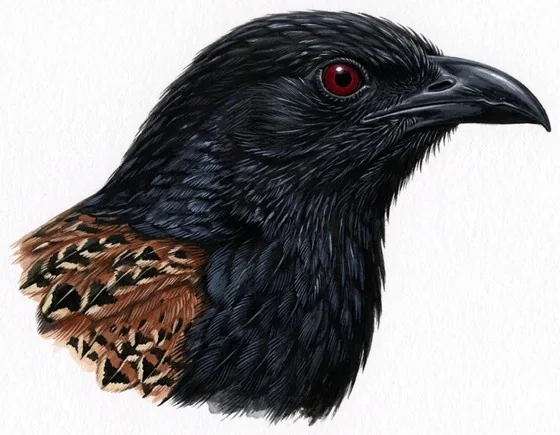
BirdNerd study deck · QLD SeriesNominate varius throughout QLD; scintillans is confined to the Houtman Abrolhos, WA. IOC/AviList spelling: Painted Buttonquail.
Mystery bird plate XCIX
Eyepale cream iris
Faceorange-buff face and throat
Breastorange-rufous; flanks barred
Upperpartsgrey-brown, finely streaked buff
Legspinkish legs and feet
  1. 1Eye pale cream iris
  2. 2Face orange-buff face and throat
  3. 3Breast orange-rufous; flanks barred
  4. 4Upperparts grey-brown, finely streaked buff
  5. 5Legs pinkish legs and feet
Male ♂ detail
Male ♂
Adult ♀ (♂ paler, barred) No. XCIX

Red-chested Button-quail

Turnix pyrrhothorax

Turnicidae · Button-quails

No. XCIX12–16 cm; ♀ largerLeast Concern

Description

  • Eye — pale cream iris; stout blue-grey bill
  • Face — orange-buff face and throat
  • Breast — plain orange-rufous; flanks finely barred
  • Upperparts — grey-brown, finely streaked buff
  • Legs — pinkish legs and feet
Reversed dimorphism. Female larger and brighter: rich orange-rufous throat, breast and flanks, flank barring fine and rarely reaching the breast. Male smaller and paler, breast dull orange-buff with bold black bars and crescents on its sides. Juvenile darker above, scalloped breast.

Behaviour

Eats grass and crop seeds plus insects, scratching and pivoting on one foot in litter and grass. Mostly crepuscular and nocturnal; alone, in pairs or groups of up to five. Partly nomadic; uncommon to locally common, often overlooked.

Cairns Brisbane

Statewide (suitable habitat)

Distribution

Much of QLD: Cape York and the Gulf Plains, Einasleigh Uplands and Burdekin, central QLD, the Darling Downs and south-east grasslands; sparse and erratic in the arid south-west, nomadic after rain.

Habitat

Dense tussock grassland and grassy open woodland (eucalypt, acacia, paperbark), also crops, stubble and weedy pasture with good ground cover.

Breeding

N QLD mainly Feb–Jul; south Sep–Feb, or after good rain. Female builds a grass-lined scrape under a tussock. Clutch usually 4; male incubates 13–18 days.

BirdNerd study deck · QLD SeriesMonotypic; endemic to mainland Australia. IOC/AviList spelling: Red-chested Buttonquail.
Mystery bird plate C
Facial discwhite heart, thin buff rim
Eyesmall, dark
Upperpartsgrey and golden-buff
Underpartswhite to cream
Legsfeathered halfway; grey toes
  1. 1Facial disc white heart, thin buff rim
  2. 2Eye small, dark
  3. 3Upperparts grey and golden-buff
  4. 4Underparts white to cream
  5. 5Legs feathered halfway; grey toes
Adult — sexes alike No. C

Eastern Barn Owl

Tyto alba delicatula

Tytonidae · Barn & masked owls

No. C30–39 cmLeast Concern

Description

  • Facial disc — white, heart-shaped; thin buff rim
  • Eye — small, dark; pale pinkish bill
  • Upperparts — grey and golden-buff; fine black-white dots
  • Underparts — white to cream; sparse small dark spots
  • Legs — long, feathered halfway; greyish toes
Sexes alike in pattern; females slightly larger. Females tend to be darker and buffier below with more, larger dark flecks; males paler and whiter, but the two overlap widely. Juvenile resembles adult once feathered; nestlings are downy white.

Behaviour

Eats mainly small mammals, especially introduced house mice and rats, plus some birds, insects, frogs and lizards; locates prey by ear, often from flight. Nocturnal, solitary or in pairs. Moderately common across QLD, rising and falling with rodents.

Cairns Brisbane

Statewide (suitable habitat)

Distribution

Throughout QLD, from Cape York to the NSW border and west to the Channel Country and Gulf; commonest in open farmland, cane fields and grassland, and abundant inland during rodent plagues.

Habitat

Open country: grassland, farmland, cane fields, open woodland and riparian strips; roosts by day in hollows, dense foliage, caves or buildings.

Breeding

Any month, in response to food; often twice a year. Nest an unlined tree hollow, cave or building cavity. Clutch 3–6, rarely up to 12; female incubates.

BirdNerd study deck · QLD SeriesBirdLife Aust.: Tyto alba delicatula. IOC/AviList and QLD WildNet treat it as a full species, Eastern Barn Owl Tyto javanica.
Mystery bird plate CI
Facial disclong heart-shape
Upperpartsdark chocolate, small pale spots
Winggolden-buff primaries, barred dark
Underpartswhite to buff
Legsvery long, sparsely feathered, pale
  1. 1Facial disc long heart-shape
  2. 2Upperparts dark chocolate, small pale spots
  3. 3Wing golden-buff primaries, barred dark
  4. 4Underparts white to buff
  5. 5Legs very long, sparsely feathered, pale
Adult — sexes similar; ♀ larger No. CI

Eastern Grass Owl

Tyto longimembris

Tytonidae · Barn & masked owls

No. CI32–42 cm; ♀ larger; wingspan 1–1.16 mLeast Concern

Description

  • Facial disc — long heart-shape; whitish to buff
  • Upperparts — dark chocolate-brown; small pale spots
  • Wing — golden-buff primaries, barred dark
  • Underparts — white to buff; few small dark spots
  • Legs — very long, sparsely feathered, pale
Female larger and darker, with a cream-buff to orange-buff, speckled facial disc and buffier underparts; male has a mostly white disc with white edge and whiter underparts. Juveniles have a darker facial disc than adults and a narrow, pointed outer primary.

Behaviour

Eats mostly rodents, especially long-haired and cane rats, plus insects and small birds, caught by quartering and hovering over grass at night. Solitary or in pairs; dispersive, numbers fluctuating with rodent plagues. Uncommon and patchy in QLD.

Cairns Brisbane

Eastern seaboard

Distribution

Patchy along the east: Cape York floodplains (Lakefield), Wet Tropics and Atherton Tableland grasslands, Burdekin, Mackay–Proserpine and Wide Bay cane districts and SE QLD; irrupts inland in rat plagues.

Habitat

Tall, dense tussock grassland, sedgeland and rank grass on floodplains and swamp margins; also cane fields, crops and grassy heath. Roosts on the ground.

Breeding

Mainly Mar–Jun, but any month after rain and rodent booms. Ground nest: a trampled platform under dense tussock or sedge, entered by tunnels. Clutch 3–8; female incubates.

BirdNerd study deck · QLD SeriesAustralian birds are nominate longimembris. BirdLife Aust. name Eastern Grass Owl; IOC/AviList Australasian Grass Owl.
Mystery bird plate CII
Facial discwhite, rimmed dark brown
Eyedark eyes in dusky smudges
Upperpartsgrey-brown, mottled buff
Underpartswhite to rufous
Feetfully feathered legs, huge feet
  1. 1Facial disc white, rimmed dark brown
  2. 2Eye dark eyes in dusky smudges
  3. 3Upperparts grey-brown, mottled buff
  4. 4Underparts white to rufous
  5. 5Feet fully feathered legs, huge feet
Adult pale morph; ♀ larger, darker No. CII

Masked Owl

Tyto novaehollandiae

Tytonidae · Barn & masked owls

No. CII35–50 cm; ♀ larger; wingspan 0.9–1.2 mLeast Concern · N QLD birds EPBC & QLD Vulnerable

Description

  • Facial disc — rounded; white, rimmed dark brown
  • Eye — dark eyes in dusky smudges
  • Upperparts — grey-brown, mottled buff; fine pale spots
  • Underparts — white to rufous; sparse dark spots
  • Feet — legs fully feathered; massive feet
Polymorphic: pale (white face and underparts), intermediate and dark (chestnut face, rufous below) forms. Females markedly larger and generally darker, though pale birds are not always males. Fledglings white to cream; first-year birds more heavily marked.

Behaviour

Eats mainly terrestrial mammals such as rats and bandicoots, plus possums, birds and reptiles, taken from low perches. Pairs sedentary in large territories (1,000 ha or more). Uncommon to rare and sparse in QLD; more often heard than seen.

Cairns Brisbane

Eastern seaboard

Distribution

Coastal and subcoastal eastern QLD, from Cape York through the Wet Tropics, Townsville and Mackay districts to the south-east and NSW border, inland to the Bunya Mts; rare and scattered further west.

Habitat

Open eucalypt forest and woodland with large hollow trees, often bordering clearings, farmland or rainforest edges; hunts along forest edges and roadsides.

Breeding

Mainly autumn–winter in the east, but whenever food is plentiful. Nest a deep hollow in a large old tree. Clutch 2–3; female incubates (c. 33 days) while male hunts.

BirdNerd study deck · QLD SeriesQLD: novaehollandiae (south); N QLD birds galei (BirdLife, AFD) but kimberli in WildNet (EPBC & QLD Vulnerable). IOC: Australian Masked Owl.
Mystery bird plate CIII
Eyelarge, bright yellow
Headplain grey-brown; no facial disc
Underpartswhite, boldly streaked grey-brown
Winggrey-brown with bold white spots
Feetyellowish toes
  1. 1Eye large, bright yellow
  2. 2Head plain grey-brown; no facial disc
  3. 3Underparts white, boldly streaked grey-brown
  4. 4Wing grey-brown with bold white spots
  5. 5Feet yellowish toes
Adult — sexes alike; ♂ larger No. CIII

Barking Owl

Ninox connivens

Strigidae · Hawk-owls

No. CIII35–45 cm; wingspan 0.85–1.2 mLeast Concern

Description

  • Eye — large, bright yellow
  • Head — plain grey-brown; no distinct disc
  • Underparts — white, boldly streaked grey-brown
  • Wing — grey-brown with bold white spots
  • Feet — yellowish toes; strong dark talons
Sexes alike in plumage; males slightly heavier and deeper-voiced. Grey-brown above with white wing spots, white below with bold grey-brown streaks; yellow eyes. Juvenile less streaked below, with mottled white and grey-brown hindneck.

Behaviour

Eats mammals (gliders, bats, rabbits), birds and many insects, mostly insects outside the breeding season; hunts from perches or in flight in the first hours of night and before dawn. Pairs hold territories year-round. Fairly common in N QLD.

Cairns Brisbane

Statewide (suitable habitat)

Distribution

Widespread in wooded country across Cape York, the Gulf and eastern QLD from the Wet Tropics to the NSW border, and west along inland river systems to the Channel Country; scarce in the arid south-west.

Habitat

Open eucalypt and paperbark woodland, especially riverine red-gum galleries and forest edges near farmland; needs large hollow trees. Avoids dense forest.

Breeding

Jul–Sep in the north, Aug–Oct in the south. Nest an open hollow in a large old eucalypt, often near water. Clutch 2–3; female incubates while the male hunts.

BirdNerd study deck · QLD SeriesQLD: nominate connivens in the south and east, peninsularis in the north, intergrading around the Forsyth Ra.; assimilis in Torres Strait.
Mystery bird plate CIV
Maskblack eye-stripe from bill to neck
Cheekyellow streak below the black mask
Breastgrey-white, streaked grey-brown
Wingolive-yellow feather edges
Billblack, slightly down-curved
  1. 1Mask black eye-stripe from bill to neck
  2. 2Cheek yellow streak below the black mask
  3. 3Breast grey-white, streaked grey-brown
  4. 4Wing olive-yellow feather edges
  5. 5Bill black, slightly down-curved
Adult — sexes alike No. CIV

Singing Honeyeater

Gavicalis virescens

Meliphagidae · Honeyeaters

No. CIV17–24 cmLeast Concern

Description

  • Mask — black eye-stripe from bill to neck
  • Cheek — yellow streak below the black mask
  • Breast — grey-white, streaked grey-brown
  • Wing — grey-brown; olive-yellow feather edges
  • Bill — black, slightly down-curved
Sexes alike, female slightly smaller. Grey-brown above with olive-yellow edges to wing and tail feathers; black mask from bill to neck over a yellow streak; whitish throat; grey-white breast streaked brown. Juvenile duller, with a narrower, fainter face pattern and paler crown.

Behaviour

Eats insects, nectar and fruit, foraging in low shrubs and on the ground, lower than most honeyeaters. Usually alone, in pairs or small noisy groups; aggressive towards other birds. Sedentary; common to abundant in inland QLD.

Cairns Brisbane

Western & central-west inland

Distribution

Inland QLD west of the Great Divide: Channel Country, Mitchell-grass downs, Mulga Lands and Mt Isa uplands, east to the western Darling Downs and Brigalow Belt and north to the Gulf; absent from the east coast.

Habitat

Arid and semi-arid shrubland and low open woodland, especially mulga, gidgee and other acacias, lignum and creek-line scrub; also homesteads and towns.

Breeding

Aug–Nov near the coast, otherwise after rain. Flimsy cup of grass lined with hair or wool, slung in a shrub. Clutch usually 2 (1–3); female incubates c. 13 days.

BirdNerd study deck · QLD SeriesQLD: forresti (west and Gulf) and sonorus (Murray–Darling basin in the south). Formerly placed in Lichenostomus.
Mystery bird plate CV
Facebright yellow face and throat
Billblack, slightly down-curved bill
Bodyplain olive-yellow, unstreaked
Wingolive-green wings
Taillong, plain olive-yellow tail
  1. 1Face bright yellow face and throat
  2. 2Bill black, slightly down-curved bill
  3. 3Body plain olive-yellow, unstreaked
  4. 4Wing olive-green wings
  5. 5Tail long, plain olive-yellow tail
Adult — sexes alike No. CV

Yellow Honeyeater

Stomiopera flava

Meliphagidae · Honeyeaters

No. CV17–19 cmLeast Concern

Description

  • Face — dusky lores; brighter yellow face and throat
  • Bill — black, slightly down-curved bill
  • Body — plain olive-yellow; no plume or streaks
  • Wing — olive-green wings; yellow feather edges
  • Tail — long, plain olive-yellow tail
Sexes alike in plumage; males average slightly larger. Adult plain olive-yellow, brightest yellow on forehead, face and throat, with dusky lores, dark eye and black bill. Juvenile duller and greener, with a yellowish base to the bill and a pale yellow gape.

Behaviour

Takes nectar from eucalypts, bottlebrushes, grevilleas and mistletoes, insects gleaned from foliage, and some fruit. Usually alone, in pairs or small loose groups; noisy and aggressive at flowering trees. Common, sedentary or locally nomadic.

Cairns Brisbane

Northern & eastern coastal wetlands

Distribution

Essentially a Queensland endemic: Cape York Peninsula and the Gulf Plains south through the Wet Tropics, Einasleigh Uplands and Townsville–Burdekin coast to the Mackay region and about Rockhampton.

Habitat

Riparian forest, paperbark swamps, tropical eucalypt woodland, rainforest edges, vine thickets and mangroves; common in towns, parks and flowering gardens.

Breeding

Mainly Aug–Feb. Clutch 2. Neat cup of fine bark strips, grass and plant fibre bound with cobweb, slung by the rim in a leafy fork of a shrub or small tree.

BirdNerd study deck · QLD SeriesNominate flava: Cape York and Gulf, south to about Cairns; addenda: Cairns–Mareeba south to central QLD. Formerly Lichenostomus flavus.
Mystery bird plate CVI
Foreheadsmall grey forehead patch
Faceolive-yellow face, dark lores
Plumeyellow plume, black line above
Wingyellow-edged flight feathers
Underpartsoff-white with faint, blurry streaks
  1. 1Forehead small grey forehead patch
  2. 2Face olive-yellow face, dark lores
  3. 3Plume yellow plume, black line above
  4. 4Wing yellow-edged flight feathers
  5. 5Underparts off-white with faint, blurry streaks
Adult — sexes alike No. CVI

Grey-fronted Honeyeater

Ptilotula plumula

Meliphagidae · Honeyeaters

No. CVI15–17 cmLeast Concern

Description

  • Forehead — small grey forehead patch; obscure in north
  • Face — dark lores; olive-yellow crown and face
  • Plume — yellow neck plume; black line above
  • Wing — grey-olive back; yellow-edged flight feathers
  • Underparts — off-white with faint, blurry streaks
Sexes alike in plumage. Adult has light grey forehead, olive-yellow crown and face, dark lores, and a bright yellow neck plume topped by a black line; bill and gape black. Juvenile has a dull yellowish-olive forehead, duller plume, yellowish-orange gape and paler bill base.

Behaviour

Feeds on nectar from eucalypts, grevilleas and eremophilas, plus insects and lerp gleaned from foliage. Usually in pairs or small groups, joining other honeyeaters at blossom and water. Nomadic, following flowering. Uncommon and patchy in Queensland.

Cairns Brisbane

Western & central-west inland

Distribution

Patchy in western Queensland: the north-west (Mount Isa uplands, Lawn Hill–Gregory, inland Gulf) through the central west to the Mulga Lands and Channel Country margins; scarce east of about 147°E.

Habitat

Arid and semi-arid woodland: snappy gum and spinifex on rocky ranges, mallee, mulga and eucalypt-lined gorges; follows flowering eucalypts and eremophilas.

Breeding

Mainly Jul–Dec, but at other times after rain. Clutch 2–3. Small cup of grass and plant fibre bound with cobweb, slung from twigs of a shrub or sapling.

BirdNerd study deck · QLD Seriesplanasi in north-west Qld (grey forehead obscure); graingeri in central-west and southern Qld. Formerly Lichenostomus plumulus.
Mystery bird plate CVII
Headplain yellowish-olive head and face
Plumewhite plume, fine black line
Billshort black, slightly curved bill
Mantlegrey-olive back
Underpartsplain pale grey-buff underparts
  1. 1Head plain yellowish-olive head and face
  2. 2Plume white plume, fine black line
  3. 3Bill short black, slightly curved bill
  4. 4Mantle grey-olive back
  5. 5Underparts plain pale grey-buff underparts
Adult — sexes alike No. CVII

White-plumed Honeyeater

Ptilotula penicillata

Meliphagidae · Honeyeaters

No. CVII15–17 cmLeast Concern

Description

  • Head — plain yellowish-olive head and face
  • Plume — white neck plume; fine black line above
  • Bill — short black, slightly curved bill
  • Mantle — grey-olive back; yellow-edged wings
  • Underparts — plain pale grey-buff underparts
Sexes alike; males slightly larger. Adult has yellowish-olive head, small white neck plume narrowly bordered black above, grey-olive back and pale grey-buff underparts. Inland birds are paler and yellower. Juvenile duller, with a faint plume and paler, yellowish bill base.

Behaviour

Feeds actively in tree crowns on nectar, insects, lerp, honeydew and manna, with some fruit and seeds; sometimes hawks or feeds on the ground. Gregarious and pugnacious, in pairs or noisy groups. Common to abundant along inland watercourses.

Cairns Brisbane

Western & central-west inland

Distribution

Widespread west of the Great Dividing Range, from the Darling Downs and Maranoa through the Channel Country and central west to the north-west and southern Gulf; absent from Cape York, the Wet Tropics and most of the east coast.

Habitat

Open woodland along watercourses, especially River Red Gum and coolibah lining creeks, rivers and bores; also homesteads, parks and town gardens.

Breeding

Any month, mainly Aug–Dec; 2–3 broods a year. Clutch 2–3. Female builds a small cup of grass and spider web, lined with wool, hair or feathers, in tree foliage.

BirdNerd study deck · QLD SeriesNominate penicillata in the south-east (Darling Downs, Maranoa); paler, yellower leilavalensis across inland and north-west Qld.
Mystery bird plate CVIII
Crowngolden-yellow crown and forehead
Maskbroad black mask through the eye
Ear tuftbright yellow tuft behind the mask
Throatbright yellow chin and throat
Mantledark olive-green back and wings
  1. 1Crown golden-yellow crown and forehead
  2. 2Mask broad black mask through the eye
  3. 3Ear tuft bright yellow tuft behind the mask
  4. 4Throat bright yellow chin and throat
  5. 5Mantle dark olive-green back and wings
Adult — sexes alike No. CVIII

Yellow-tufted Honeyeater

Lichenostomus melanops

Meliphagidae · Honeyeaters

No. CVIII17–21 cmLeast Concern

Description

  • Crown — golden-yellow crown and forehead
  • Mask — broad black mask through the eye
  • Ear tuft — bright yellow tuft behind the mask
  • Throat — bright yellow chin and throat
  • Mantle — dark olive-green back and wings
Sexes alike; males slightly larger. Adult has golden-yellow crown, broad black face mask, bright yellow ear tuft and throat, dark olive-green upperparts and dull yellow underparts. Juvenile duller and paler, with yellow areas washed green and a pale yellow gape.

Behaviour

Feeds on eucalypt nectar, insects, lerp, honeydew and manna in the canopy, shrubs and on bark. Lives in colonies of neighbouring territories; singly, in pairs or groups of up to ten. Common in suitable habitat; some autumn–winter movement to gullies.

Cairns Brisbane

South-east & central-east

Distribution

South-eastern Queensland: the Granite Belt, border ranges and Darling Downs north through the Brisbane Valley, Burnett and Brigalow Belt to about the Tropic (Blackdown Tableland, Gladstone hinterland); sparse near the coast.

Habitat

Dry open eucalypt forest and woodland, especially box–ironbark and granite country, often near creeks with a shrubby understorey; occasionally rural gardens.

Breeding

Mainly Jul–Jan. Clutch 2–3. Tightly woven cup of bark and grass bound with cobweb, hung in an understorey shrub or sapling. Two or three broods; often with helpers.

BirdNerd study deck · QLD SeriesQld birds are the inland race meltoni; nominate melanops is coastal NSW–Vic; Helmeted (cassidix) is confined to Victoria.
Mystery bird plate CIX
Crowngrey cap with fine dark scalloping
Faceblack face, chin and throat bib
Ear patchlarge white patch behind the eye
Mantlebright olive-green back and wings
Underpartsyellowish-olive breast and belly
  1. 1Crown grey cap with fine dark scalloping
  2. 2Face black face, chin and throat bib
  3. 3Ear patch large white patch behind the eye
  4. 4Mantle bright olive-green back and wings
  5. 5Underparts yellowish-olive breast and belly
Adult — sexes alike No. CIX

White-eared Honeyeater

Nesoptilotis leucotis

Meliphagidae · Honeyeaters

No. CIX18–21 cmLeast Concern

Description

  • Crown — grey cap with fine dark scalloping
  • Face — black face, chin and throat bib
  • Ear patch — large white patch behind the eye
  • Mantle — bright olive-green back and wings
  • Underparts — yellowish-olive breast and belly
Sexes alike; males larger. Adult has grey, finely scalloped crown, black face, chin and bib, large white ear patch, olive-green upperparts and yellowish-olive underparts. Juvenile duller and browner, with an olive-green crown, greyer face, duller ear patch and yellowish gape.

Behaviour

Mainly insects gleaned from bark, crevices and foliage of eucalypts, plus nectar, fruit, manna, lerp and honeydew; also feeds at wounds on trunks. Usually in pairs or small family groups; noisy and conspicuous. Sedentary. Fairly common.

Cairns Brisbane

South-east & central-east

Distribution

South-eastern Queensland from the border ranges and Granite Belt west to the Brigalow and Mulga Lands, north through the Burnett to Carnarvon and Blackdown Tableland; isolated population near Pentland–White Mountains.

Habitat

Dry eucalypt forest and woodland with a shrubby understorey, including box–ironbark, cypress-pine and granite country; also heath and scrub.

Breeding

Most months, mainly Aug–Jan. Clutch 2–3. Deep, thick-walled cup of bark and grass lined with hair or fur, placed low in a shrub or sapling. Female incubates.

BirdNerd study deck · QLD SeriesNominate leucotis in coastal forests from north of Brisbane south; novaenorciae west of the Divide from central Qld.
Mystery bird plate CX
Headblack; white band eye to nape
Eyeturquoise-blue crescent above eye
Chinblack chin stripe edged with white
Mantleolive-green back
Legsbright orange legs and feet
  1. 1Head black; white band eye to nape
  2. 2Eye turquoise-blue crescent above eye
  3. 3Chin black chin stripe edged with white
  4. 4Mantle olive-green back
  5. 5Legs bright orange legs and feet
Adult — sexes alike No. CX

Black-chinned Honeyeater

Melithreptus gularis

Meliphagidae · Honeyeaters

No. CX15–17 cmLeast Concern

Description

  • Head — black head; white band from eye to nape
  • Eye — turquoise-blue crescent above eye
  • Chin — black chin stripe edged with white
  • Mantle — olive-green back; brown wings and tail
  • Legs — bright orange legs and feet
Sexes alike. Adult (gularis) has black head and chin, white nape band reaching the eye, turquoise-blue eye skin, olive-green back and buff-white underparts. Golden-backed laetior has a golden-yellow back and green-yellow eye skin. Juvenile has a brown crown and yellow-orange bill.

Behaviour

Gleans insects from outer foliage, twigs and bark high in eucalypts; also nectar and honeydew. Noisy, gregarious groups of up to 12, often with other honeyeaters. Resident or locally nomadic. Uncommon and declining in the south-east.

Cairns Brisbane

Inland eastern Queensland

Distribution

Inland eastern and northern Queensland: Darling Downs, Brisbane Valley and Brigalow Belt north through the Einasleigh Uplands to the Cape York interior; the Golden-backed form in the Gulf and north-west uplands.

Habitat

Open box, ironbark and red gum woodland and riverine forest, foraging high in the eucalypt canopy; in the north and inland favours trees along watercourses.

Breeding

Jun–Dec. Clutch 2–3. Compact, felted cup of bark fibre and hair, slung high in the outer canopy among foliage; often cooperative, with helpers feeding young.

BirdNerd study deck · QLD SeriesEastern gularis in southern and central Qld (to about Rockhampton); Golden-backed laetior in the north and west; intergrades in N Qld.
Mystery bird plate CXI
Headblack crown, face and hindneck
Eyepale bluish-white crescent above eye
Napewhite band, stops short of eye
Throatpure white chin and throat
Mantlebright yellow-olive back and wings
  1. 1Head black crown, face and hindneck
  2. 2Eye pale bluish-white crescent above eye
  3. 3Nape white band, stops short of eye
  4. 4Throat pure white chin and throat
  5. 5Mantle bright yellow-olive back and wings
Adult — sexes alike No. CXI

White-throated Honeyeater

Melithreptus albogularis

Meliphagidae · Honeyeaters

No. CXI12–14.5 cmLeast Concern

Description

  • Head — black crown, face and hindneck
  • Eye — pale bluish-white crescent above eye
  • Nape — narrow white band; stops short of eye
  • Throat — pure white chin and throat
  • Mantle — bright yellow-olive back and wings
Sexes alike; males average larger. Adult has black crown, face and hindneck, narrow white nape band, bluish-white eye crescent, white chin and underparts, yellow-olive back and red-brown iris. Juvenile has a mid-brown crown, brown eye, and pale orange-pink gape and bill base.

Behaviour

Gleans insects, spiders and lerp from foliage and bark, and takes nectar from eucalypts, paperbarks and grevilleas. In pairs or small parties, often in mixed feeding flocks. Common; sedentary or locally nomadic.
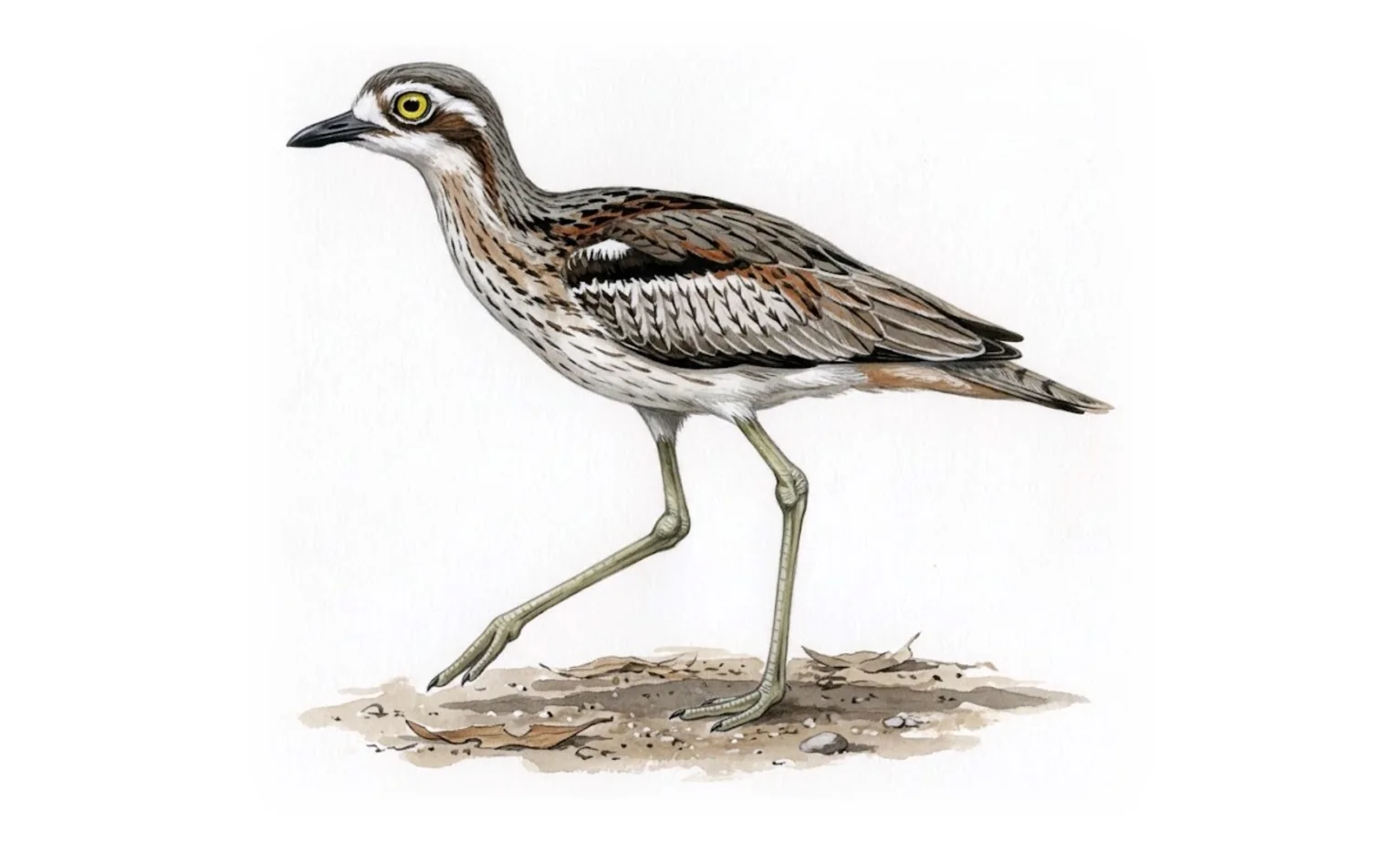
Cairns Brisbane

Eastern Queensland

Distribution

Widespread in eastern Queensland, from the tip of Cape York through the Wet Tropics and Brigalow Belt to the NSW border, inland to the Einasleigh Uplands and Carnarvon ranges; also the north-west Gulf country.

Habitat

Open eucalypt forest and woodland, paperbark swamps, riparian forest and rainforest edges; also timbered parks and suburbs, feeding in the canopy.

Breeding

Mainly Jun–Jan. Clutch 2. Deep, neat cup of bark strips and grass bound with cobweb, slung by the rim among outer leaves high in a eucalypt or paperbark.

BirdNerd study deck · QLD SeriesNominate albogularis on Cape York and in the Gulf; inopinatus (longer-winged) through eastern Qld to NE NSW.
Mystery bird plate CXII
Earlarge pale-yellow crescent ear-patch
Gapecreamy-yellow gape stripe below eye
Eyeblue-grey iris
Billblack, fairly stout, slightly curved
Bodydark olive-green; greyer below
  1. 1Ear large pale-yellow crescent ear-patch
  2. 2Gape creamy-yellow gape stripe below eye
  3. 3Eye blue-grey iris
  4. 4Bill black, fairly stout, slightly curved
  5. 5Body dark olive-green; greyer below
Adult — sexes alike No. CXII

Lewin's Honeyeater

Meliphaga lewinii

Meliphagidae · Honeyeaters

No. CXII19–22 cmLeast Concern

Description

  • Ear — large pale-yellow crescent ear-patch
  • Gape — creamy-yellow gape stripe below eye
  • Eye — blue-grey iris; brown in juveniles
  • Bill — black, fairly stout, slightly curved
  • Body — dark olive-green; paler, greyer below
Sexes alike: dark olive-green with a large pale-yellow crescent ear-patch, creamy-yellow gape stripe, black bill and blue-grey eye; pale yellow edges to flight feathers. Juvenile very like adult but has a brown, not blue-grey, eye.

Behaviour

Eats mostly fruit and berries, plus insects (some caught in flight) and nectar. Forages from the understorey to the canopy and on trunks. Usually solitary or in pairs, sometimes loose groups of up to ~10 at fruiting trees. Common and sedentary.
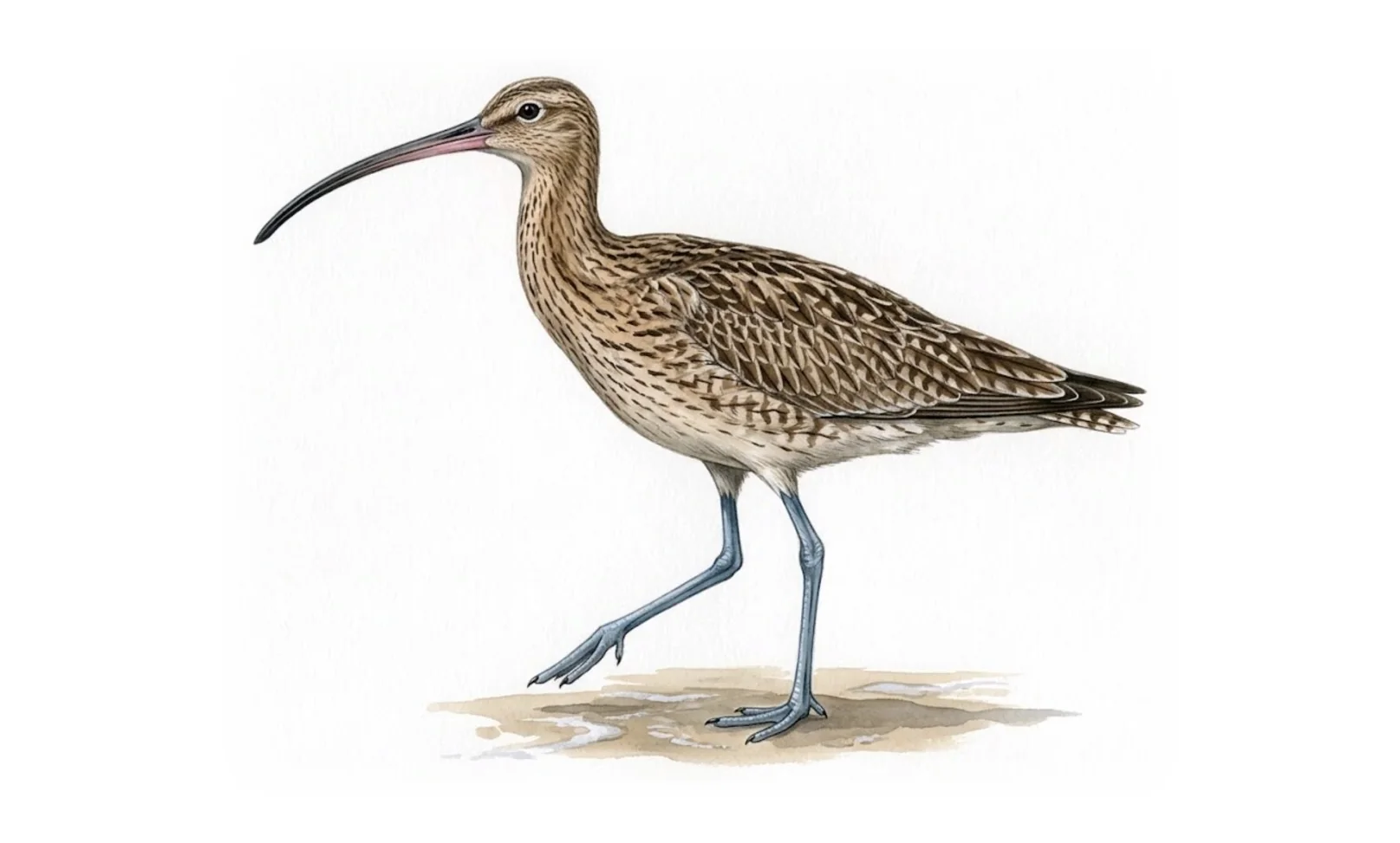
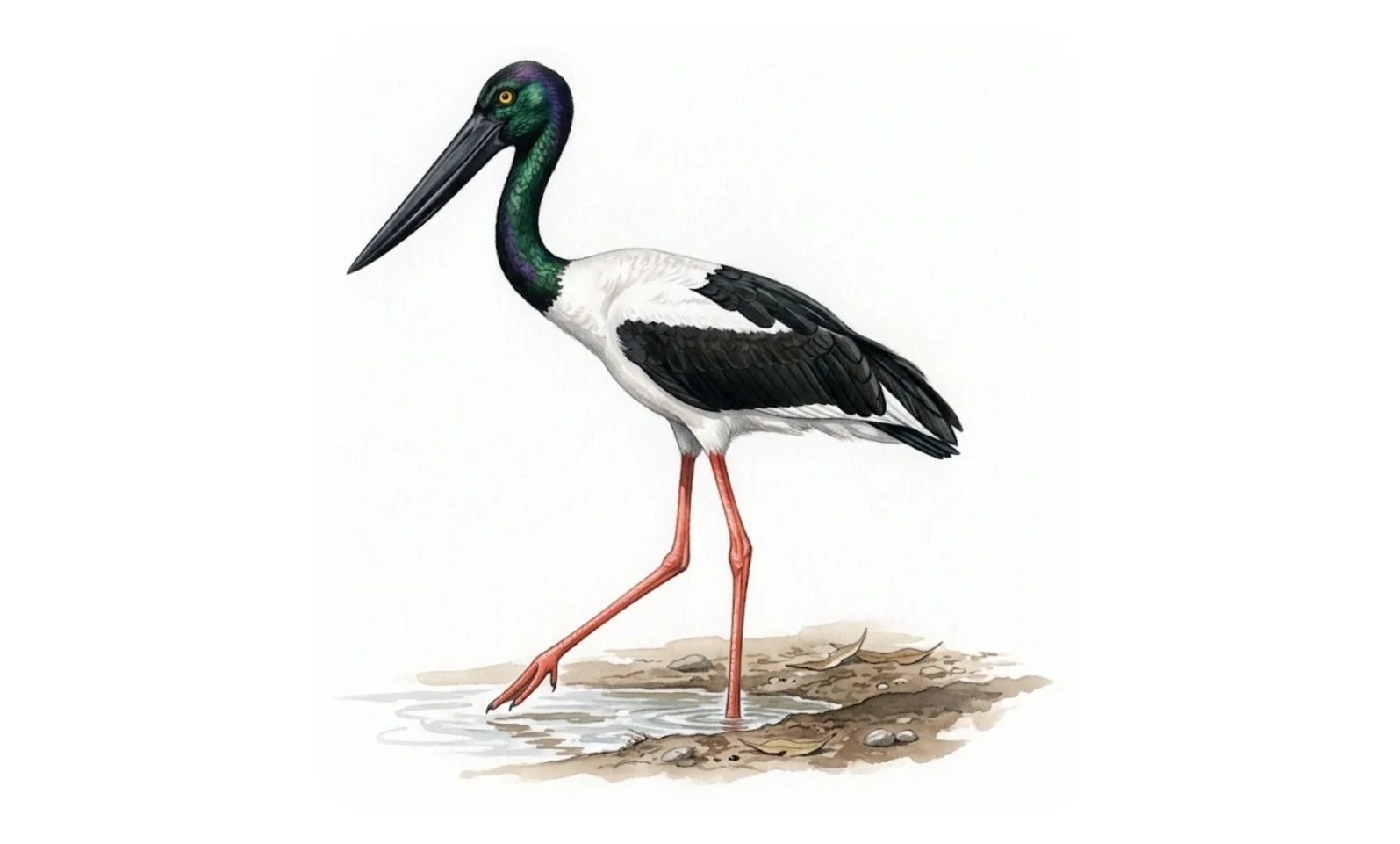
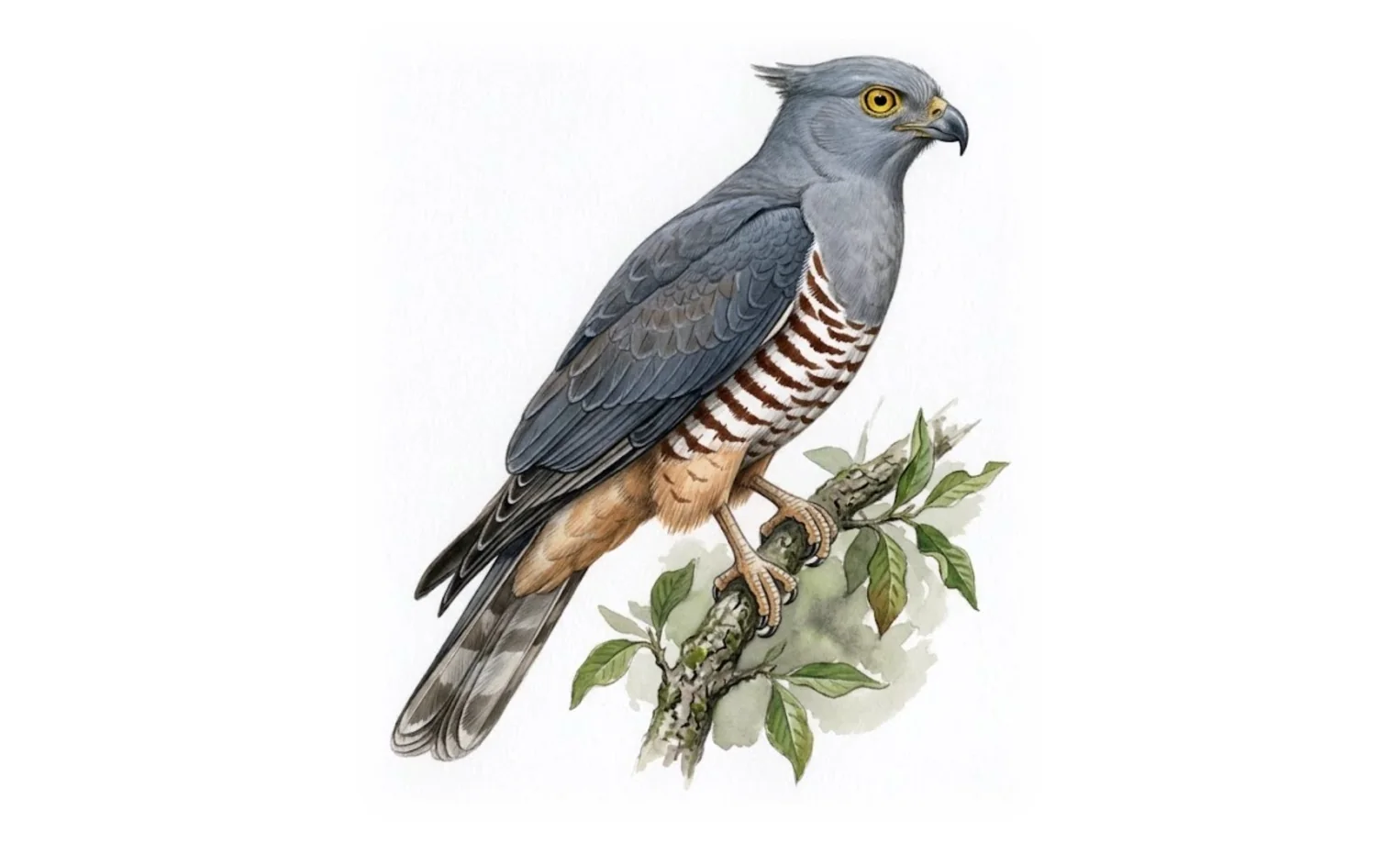
Cairns Brisbane

Eastern seaboard

Distribution

Eastern Qld from the McIlwraith Range (Cape York) through the Wet Tropics, Eungella and the central ranges to SEQ and the NSW border; inland to the Bunya Mtns, Blackdown and Carnarvon.

Habitat

Rainforest and wet sclerophyll forest and their edges, adjoining dry forest, vine scrub and riparian thickets; also orchards, parks and leafy gardens.

Breeding

Mainly Sep–Jan. Clutch 2–3. A large, bulky cup of plant material bound with spider web and lined with soft fibres, slung in a fork of a shrub, sapling or vine.

BirdNerd study deck · QLD SeriesNominate lewinii from SEQ to about Rockhampton; mab Rockhampton–Cooktown; amphochlora isolated on Cape York's McIlwraith Range.
Mystery bird plate CXIII
Faceyellow stripe below eye, edged black
Earsmall white plume behind the stripe
Billblack, slightly decurved
Wingolive-yellow flight-feather edges
Underpartspale grey-brown, faintly streaked
  1. 1Face yellow stripe below eye, edged black
  2. 2Ear small white plume behind the stripe
  3. 3Bill black, slightly decurved
  4. 4Wing olive-yellow flight-feather edges
  5. 5Underparts pale grey-brown, faintly streaked
Adult — sexes alike No. CXIII

Yellow-faced Honeyeater

Caligavis chrysops

Meliphagidae · Honeyeaters

No. CXIII15–18 cmLeast Concern

Description

  • Face — yellow stripe below eye, edged black
  • Ear — small white plume behind the stripe
  • Bill — black, slightly decurved
  • Wing — olive-yellow flight-feather edges
  • Underparts — pale grey-brown, faintly streaked
Sexes alike; male slightly larger. Grey-brown with faint streaks on crown and paler underparts; broad yellow stripe below eye bordered black above and below, ending in a small white plume; olive-yellow wing edges. Juvenile paler, with a plainer, unstreaked head.

Behaviour

Eats nectar, pollen, insects, fruit and seeds, foraging in flowers and foliage of trees, shrubs and mistletoe; rarely on the ground. Partly migratory: large flocks move north in autumn and south in spring; territorial when breeding. Common.

Cairns Brisbane

Eastern Queensland

Distribution

Eastern Qld from the Cooktown area and Atherton Tableland through the Wet Tropics uplands, Eungella and central ranges to SEQ, the Darling Downs and Granite Belt; sparser inland to Carnarvon NP.

Habitat

Open eucalypt forest and woodland, especially with a shrubby understorey; also forest edges, heath, riparian strips, mountain forest, parks and gardens.

Breeding

Jul–Mar. Clutch 2–3. Female builds a small, delicate woven cup of grass and moss, bound with web, low in a shrub, vine or sapling. Both parents feed the young.

BirdNerd study deck · QLD SeriesNominate chrysops in central and SE Qld; barroni in the Wet Tropics and Clarke Range (Eungella) of NE Qld; samueli in SA.
Mystery bird plate CXIV
Earsmall yellow spot behind the eye
Billlong, slender, decurved, black
Gapeblack (breeding ♂); yellow ♀
Wingolive-yellow panel on folded wing
Bodyplain grey-brown
  1. 1Ear small yellow spot behind the eye
  2. 2Bill long, slender, decurved, black
  3. 3Gape black (breeding ♂); yellow ♀
  4. 4Wing olive-yellow panel on folded wing
  5. 5Body plain grey-brown
Adult ♂ (♀ yellow gape) No. CXIV

Brown Honeyeater

Lichmera indistincta

Meliphagidae · Honeyeaters

No. CXIV12–16 cmLeast Concern

Description

  • Ear — small yellow spot behind the eye
  • Bill — long, slender, decurved, black
  • Gape — black in breeding ♂; yellow in ♀
  • Wing — olive-yellow panel on folded wing
  • Body — plain grey-brown; paler buff-grey below
Male: grey-brown with darker grey-brown crown, small yellow spot behind eye, olive-yellow wing panel, and a black gape when breeding. Female slightly smaller, olive-brown crown, gape always pale yellow. Juvenile like female, with a bright yellow swollen gape and faint eye-spot.

Behaviour

Mainly nectar from mistletoe, mangroves, eucalypts, paperbarks, banksias and grevilleas, plus insects gleaned or caught in flight. Usually single, in pairs or small groups; joins mixed honeyeater flocks. Locally nomadic, following flowering. Abundant.
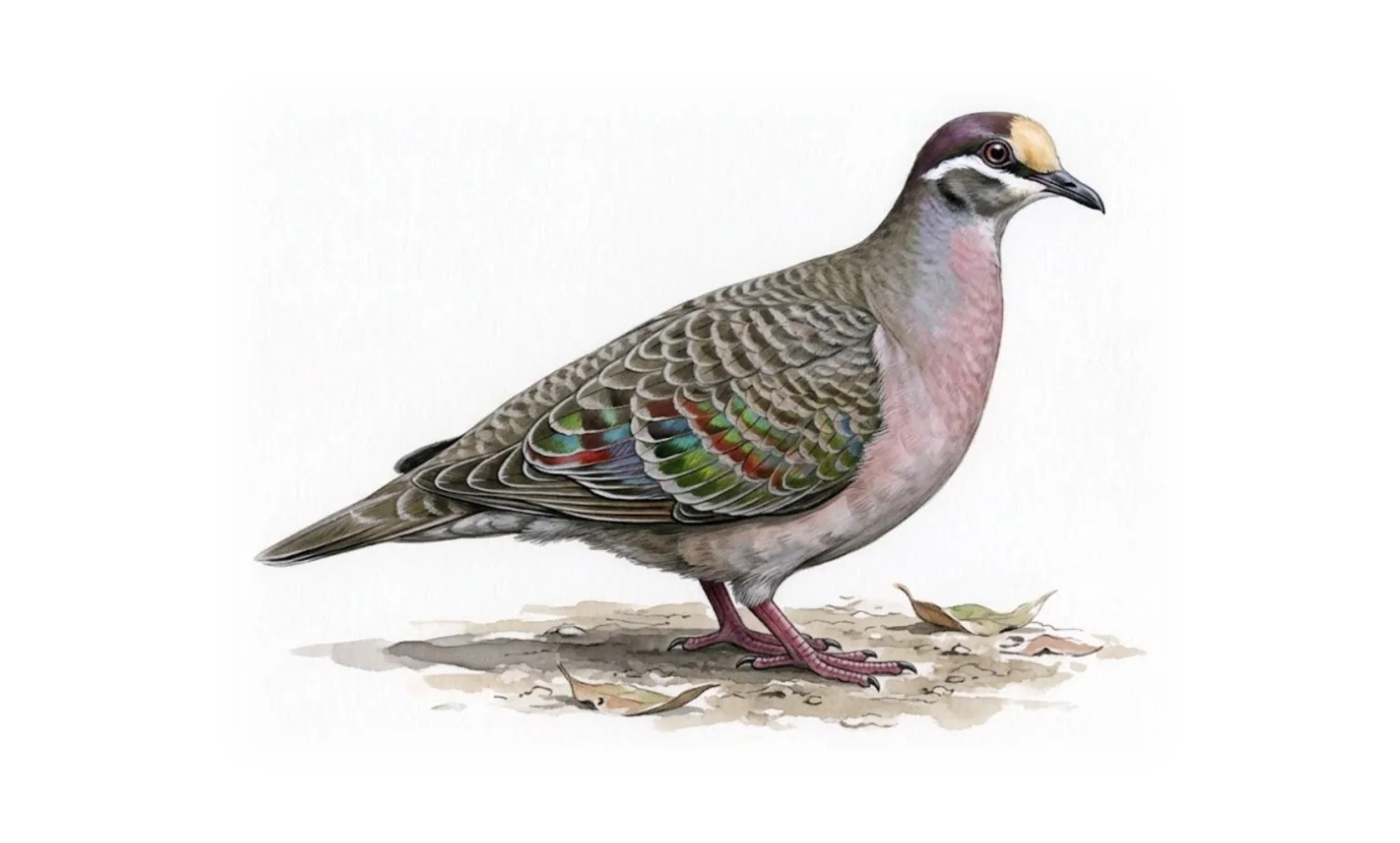
Cairns Brisbane

Statewide (suitable habitat)

Distribution

Throughout Queensland from Torres Strait and Cape York to the NSW border; abundant on the coast and across the tropics, and widespread inland along timbered watercourses into the Gulf and Channel Country.

Habitat

Almost any wooded habitat with flowers: mangroves, paperbark swamps, riverine and open woodland, rainforest edges, heath, and suburban parks and gardens.
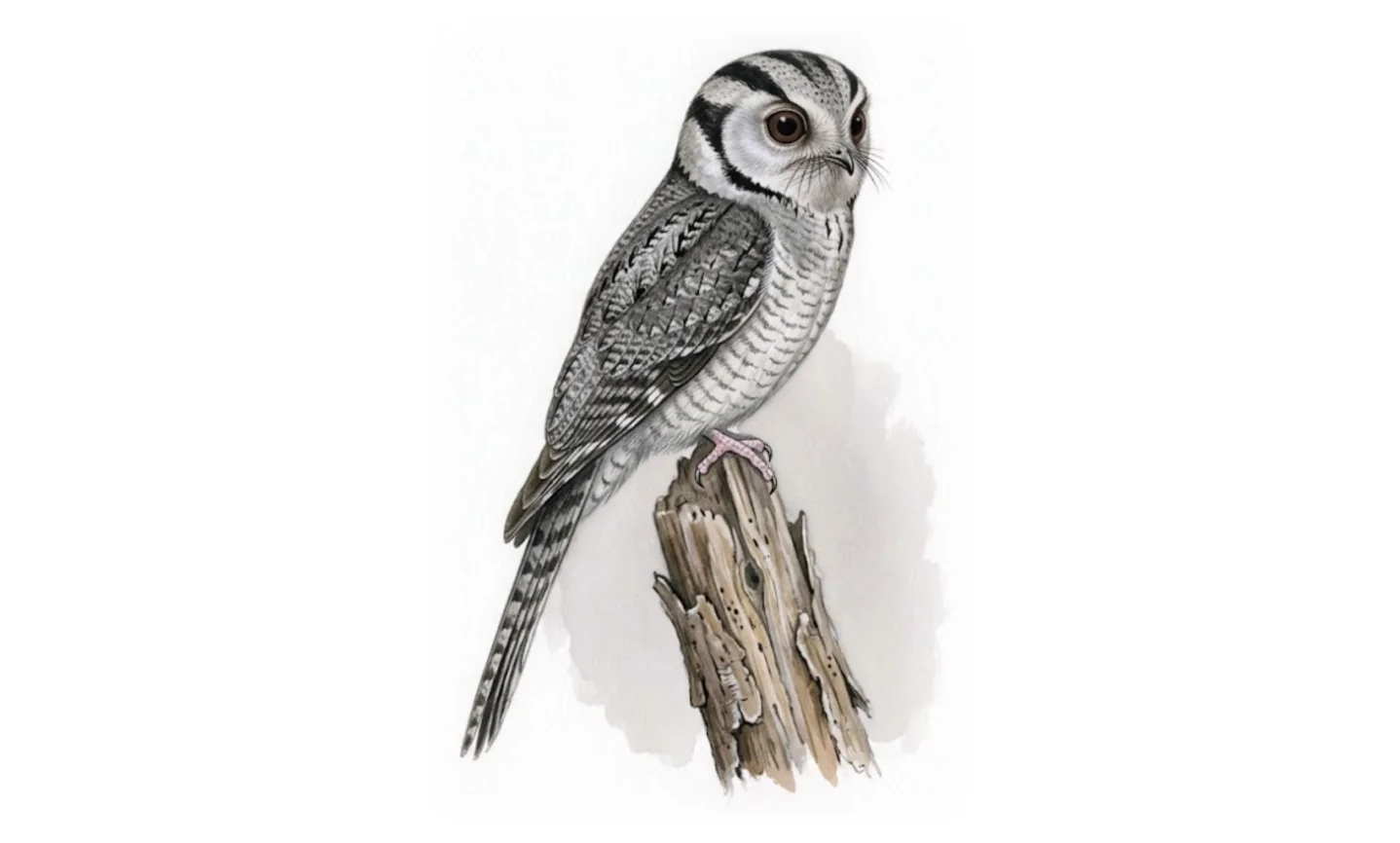
Breeding

Any month, mainly Jul–Jan in the east. Clutch 2–3. Female builds a small woven cup of grass and bark bound with web, in a low fork under 2 m, often near water.
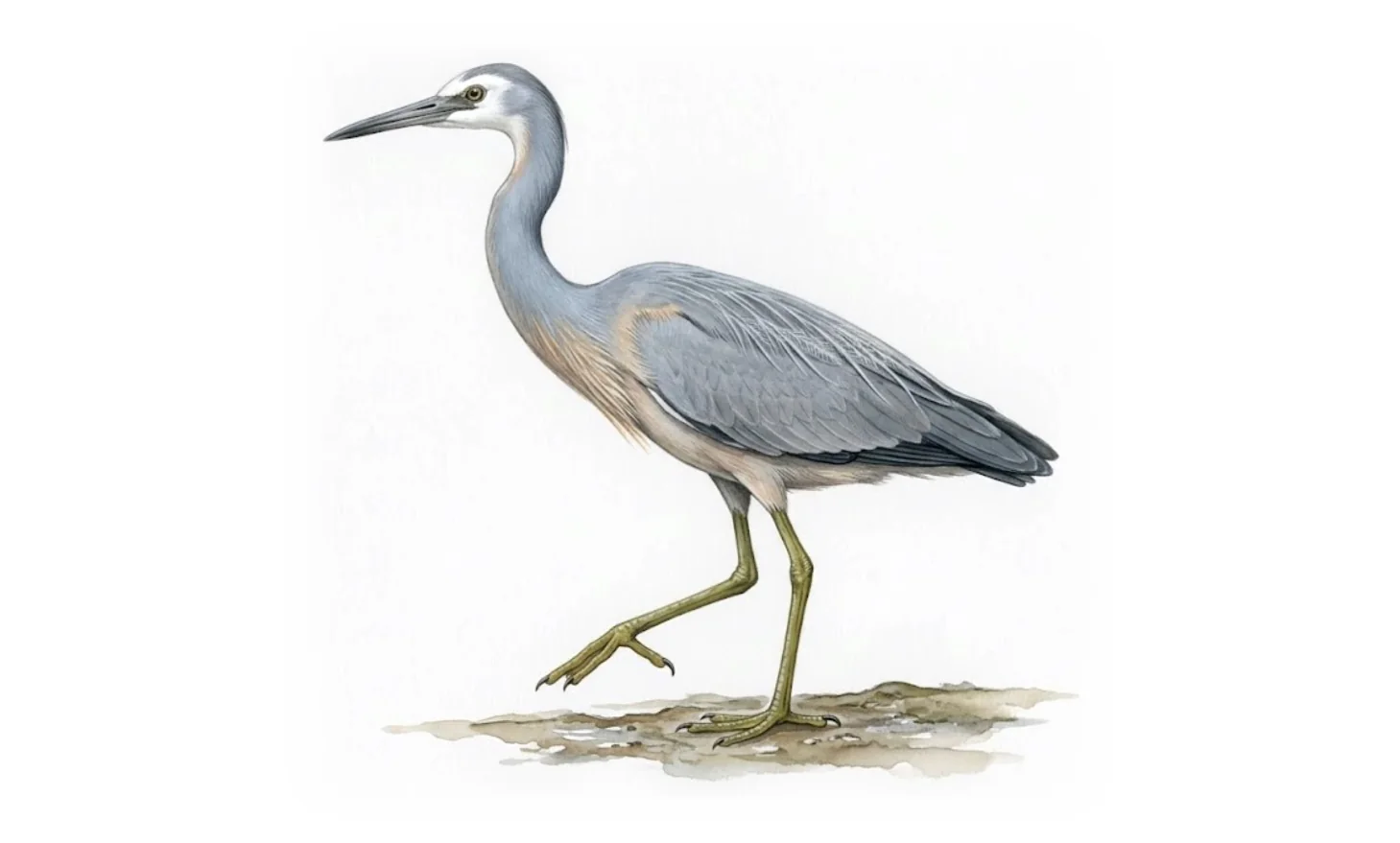
BirdNerd study deck · QLD SeriesIOC: ocularis in eastern Qld incl. Cape York; nominate indistincta reaches western Qld; others in NT, New Guinea and Indonesia.
Mystery bird plate CXV
Billpink, black-tipped
Cheekwhite bristly stripe below the eye
Throatcinnamon-buff throat and breast
Eyepale blue iris in adults
Underpartspale, boldly spotted dark brown
  1. 1Bill pink, black-tipped
  2. 2Cheek white bristly stripe below the eye
  3. 3Throat cinnamon-buff throat and breast
  4. 4Eye pale blue iris in adults
  5. 5Underparts pale, boldly spotted dark brown
Adult — sexes alike No. CXV

Spiny-cheeked Honeyeater

Acanthagenys rufogularis

Meliphagidae · Honeyeaters

No. CXV22–27 cmLeast Concern

Description

  • Bill — pink, black-tipped; long and straight
  • Cheek — white bristly stripe below the eye
  • Throat — cinnamon-buff throat and breast
  • Eye — pale blue iris in adults
  • Underparts — pale, boldly spotted dark brown
Sexes alike. Pink black-tipped bill; white bristly cheek stripe; cinnamon-buff throat and upper breast; streaked grey-brown upperparts; pale, dark-spotted belly; whitish rump and white tail tip; pale blue eye. Juvenile duller, with a brown eye and a yellowish cheek sash.

Behaviour

Eats fruit (incl. mistletoe berries), nectar and insects, also spiders and small reptiles. Forages in shrubs and the canopy, sometimes on the ground. Usually single or in pairs; flocks at food. Nomadic in the north, more resident south. Common.

Cairns Brisbane

Western & central-west inland

Distribution

Inland Qld west of the Great Divide: Mulga Lands, Channel Country, Mitchell Grass Downs and NW uplands, east through the Maranoa and Darling Downs to Toowoomba; rare strays to the coast; absent from Cape York.

Habitat

Arid and semi-arid shrubland and woodland — mulga, gidgee, mallee, belah and saltbush with flowering shrubs or mistletoe; also inland watercourses and gardens.

Breeding

Mainly Aug–Nov; recorded in most months. Clutch 2–3. Deep cup of grass and web slung between twigs 1–13 m up, lined with fur, wool or plant down.

BirdNerd study deck · QLD SeriesMonotypic (IOC); the only species in the genus Acanthagenys.
Mystery bird plate CXVI
Headwhite, boldly streaked black
Billshort, sharp, blue-grey
Throatwhite, with shaggy pointed feathers
Mantlegrey-brown, streaked darker
Underpartswhitish, faintly streaked
  1. 1Head white, boldly streaked black
  2. 2Bill short, sharp, blue-grey
  3. 3Throat white, with shaggy pointed feathers
  4. 4Mantle grey-brown, streaked darker
  5. 5Underparts whitish, faintly streaked
Adult — sexes alike No. CXVI

Striped Honeyeater

Plectorhyncha lanceolata

Meliphagidae · Honeyeaters

No. CXVI22–25 cmLeast Concern

Description

  • Head — white, boldly streaked black
  • Bill — short, sharp, blue-grey; dark tip
  • Throat — white, with shaggy pointed feathers
  • Mantle — grey-brown, streaked darker
  • Underparts — whitish, faintly streaked
Sexes alike (female may be a little browner above). White head, neck and throat boldly streaked black, with shaggy pointed throat feathers; streaked grey-brown back; whitish underparts with faint streaks; blue-grey bill and legs. Juvenile browner and duller, less streaked.

Behaviour

Mainly insects and spiders gleaned from foliage and bark or caught in flight; also nectar, seeds and fruit. Usually singly, in pairs or small groups; feeds peaceably with other honeyeaters but dive-bombs nest intruders. Fairly common.

Cairns Brisbane

South-east & central-east

Distribution

Southern and central Qld: Darling Downs, Brigalow Belt, Maranoa and Mulga Lands west to the Warrego and Winton districts, north to Charters Towers; also SEQ coastal lowlands incl. Moreton Bay.

Habitat

Drier open forest and woodland, especially casuarina and cypress-pine along rivers; also mulga, brigalow, coastal swamp-oak and mangrove fringes, and gardens.

Breeding

Aug–Jan, varying with conditions. Clutch about 3. Both sexes build a deep, thick-walled bag of grass, fibre and often emu feathers, hung from a drooping branch 1–6 m up.

BirdNerd study deck · QLD SeriesMonotypic; sole species of Plectorhyncha.
Mystery bird plate CXVII
Headsolid black head and neck
Facebare warty cream skin around eye
Breastblack, scalloped pale yellow
Wingbroad bright-yellow panels
Tailblack centre, yellow sides
  1. 1Head solid black head and neck
  2. 2Face bare warty cream skin around eye
  3. 3Breast black, scalloped pale yellow
  4. 4Wing broad bright-yellow panels
  5. 5Tail black centre, yellow sides
Adult — sexes alike; ♀ smaller No. CXVII

Regent Honeyeater

Anthochaera phrygia

Meliphagidae · Honeyeaters

No. CXVII20–24 cmEPBC Critically Endangered · QLD Critically Endangered

Description

  • Head — solid black head and neck
  • Face — bare warty cream skin around eye
  • Breast — black, scalloped pale yellow
  • Wing — broad bright-yellow panels
  • Tail — black centre, yellow sides
Sexes similar: black head, bare warty pale cream skin round the eye, black body scalloped pale yellow, broad yellow wing and tail panels. Female smaller, a little duller, with less facial skin. Juvenile mostly brown, with narrow pale wing edges and smooth grey-brown face skin.

Behaviour

Feeds mainly on nectar of box, ironbark and other eucalypts and mistletoes; also insects, lerp and fruit. Highly nomadic, tracking flowering. Now seen singly, in pairs or small groups; aggressive at blossom. Wild population about 250–300.

Cairns Brisbane

South-east & central-east

Distribution

Now a rare, irregular winter visitor to SE Qld; recent strays at Springfield Lakes (Ipswich) in 2019 and Highfields near Toowoomba in 2024. Once north to the Rockhampton area; vagrant to Mackay in 1963.

Habitat

Box-ironbark and other dry eucalypt woodland, spotted gum and swamp-mahogany forest, and river she-oak, especially with flowering eucalypts and heavy mistletoe.

Breeding

Mainly Aug–Jan; core breeding areas now in NSW and NE Victoria. Clutch 2–3. Female builds a bark cup bound with web in a fork or mistletoe clump, 1–20 m up.

BirdNerd study deck · QLD SeriesMonotypic. Formerly Xanthomyza phrygia; old name 'Warty-faced Honeyeater'.
Mystery bird plate CXVIII
Crowngrey crown, faint yellow forehead
Faceblack mask, yellow eye-skin
Neckyellow wash on sides of the throat
Billbright yellow, slightly curved
Rumpwhite rump below folded wingtips
  1. 1Crown grey crown, faint yellow forehead
  2. 2Face black mask, yellow eye-skin
  3. 3Neck yellow wash on sides of the throat
  4. 4Bill bright yellow, slightly curved
  5. 5Rump white rump below folded wingtips
Adult — sexes alike No. CXVIII

Yellow-throated Miner

Manorina flavigula

Meliphagidae · Honeyeaters

No. CXVIII22–28 cmLeast Concern

Description

  • Crown — grey crown, faint yellow forehead
  • Face — black mask; bare yellow skin by eye
  • Neck — yellow wash on sides of the throat
  • Bill — bright yellow, slightly curved
  • Rump — white rump below folded wingtips
Sexes alike. Grey with faint scalloping on the breast; grey crown, faint yellow forehead; black ear-coverts and mask; yellow bill, legs and bare skin by eye; yellow neck sides; white rump; white tail tips. Juvenile softer and plainer, unscalloped, with browner wings and tail.

Behaviour

Eats insects (most of the diet) and nectar, plus fruit, seeds and lerp, gleaned in the canopy, on bark and on the ground. Lives in noisy colonies of a dozen to 50; aggressive to smaller birds. Sedentary. Common to abundant inland.

Cairns Brisbane

Western & central-west inland

Distribution

Most of inland Qld: Channel Country, Mitchell Grass Downs, Mulga Lands, NW uplands, Gulf plains, Brigalow Belt and Einasleigh Uplands, reaching the dry coast near Townsville–Bowen; absent from Cape York.

Habitat

Open woodland and scrub — eucalypt, mulga, gidgee, brigalow and riverine timber — and cleared farmland with scattered trees, roadsides, homesteads and towns.

Breeding

Year-round, peaking Aug–Oct. Clutch 2–5, usually 3–4. Loose cup of twigs and grass lined with wool or fur, in a tree fork 3–6 m up; helpers feed young.

BirdNerd study deck · QLD SeriesNominate flavigula over most of Qld; wayensis in the far west and north-west (Mount Isa–Channel Country).
Mystery bird plate CXIX
Billshort, bright yellow
Eyeorange-red bare patch behind the eye
Loresblack lores and thin dark moustache
Plumageuniform olive-green
Legsbright orange-yellow legs and feet
  1. 1Bill short, bright yellow
  2. 2Eye orange-red bare patch behind the eye
  3. 3Lores black lores and thin dark moustache
  4. 4Plumage uniform olive-green
  5. 5Legs bright orange-yellow legs and feet
Adult — sexes alike No. CXIX

Bell Miner

Manorina melanophrys

Meliphagidae · Honeyeaters

No. CXIX17–20 cmLeast Concern

Description

  • Bill — short, bright yellow; slightly decurved
  • Eye — orange-red bare patch behind the eye
  • Lores — black lores and thin dark moustache
  • Plumage — uniform olive-green; wings darker grey-olive
  • Legs — bright orange-yellow legs and feet
Sexes alike; males slightly larger. Adult olive-green, a little darker on the wings, with yellow bill, orange-red bare skin behind the eye, black lores and narrow dark moustache, and orange-yellow legs. Juvenile duller and browner, with a paler bill and paler, smaller eye patch.

Behaviour

Feeds mainly on psyllids and their sugary lerps gleaned from eucalypt foliage, plus other insects, nectar and manna, usually 8 m or more up. Lives in sedentary colonies of 8–200 birds that aggressively exclude other small birds. Locally common.

Cairns Brisbane

South-east & central-east

Distribution

South-east Queensland only, from about Gympie and the Blackall Range south to the NSW border, coast to the Great Dividing Range, e.g. D'Aguilar Range, Scenic Rim and Lamington; patchy, in discrete colonies.

Habitat

Wet and dry eucalypt forest with a dense shrubby understorey, especially in gullies, along creeks and at rainforest edges; sometimes in leafy parks near water.

Breeding

Mainly Jun–Nov, but any month. Clutch 1–3 (usually 2). Female alone builds a thin cup in a dense shrub or sapling; helpers feed the young.

BirdNerd study deck · QLD SeriesMonotypic. Formerly called 'Bellbird'; not to be confused with the Crested Bellbird of inland Australia.
Mystery bird plate CXX
Crowncrimson crown, dark eye-mask
Throatclean white throat, sharply defined
Breastbrilliant crimson breast and belly
Eyepale cream iris in the dark mask
Rumpcrimson rump
  1. 1Crown crimson crown, dark eye-mask
  2. 2Throat clean white throat, sharply defined
  3. 3Breast brilliant crimson breast and belly
  4. 4Eye pale cream iris in the dark mask
  5. 5Rump crimson rump
Female ♀ detail
Female ♀
Adult ♂ (♀ brown, pink-washed) No. CXX

Crimson Chat

Epthianura tricolor

Meliphagidae · Honeyeaters

No. CXX11–13 cmLeast Concern

Description

  • Crown — crimson crown; dark mask through the eye
  • Throat — clean white throat, sharply defined
  • Breast — brilliant crimson breast and belly
  • Eye — pale cream iris in the dark mask
  • Rump — crimson rump; tail blackish, white-tipped
Male: crimson crown, breast and rump, white throat, dark brown mask and upperparts; duller and patchier outside breeding. Female: brown above, buff-white below with a pinkish-red wash on the breast, white throat and red rump. Juvenile like female but plainer and buffer.

Behaviour

Eats mainly insects and spiders taken on or near the ground, plus nectar and some seeds. In pairs or loose flocks, sometimes of hundreds, moving widely after rain; mostly a winter visitor to the north. Irregular and locally common.

Cairns Brisbane

Western & central-west inland

Distribution

Western and central Queensland: Channel Country, Mitchell-grass downs, Mulga Lands and the north-west; nomadic, following rain. In dry inland years it irrupts east to the Maranoa, Darling Downs and Brigalow Belt.

Habitat

Arid and semi-arid open country: saltbush and bluebush plains, open mulga and other acacia shrubland, spinifex and dunes, grassland and flowering shrubs after rain.

Breeding

Mainly Aug–Oct in the south; almost any month after rain in the north. Clutch 2–4, usually 3. Small cup of grass and twigs low in a shrub or tussock; loose colonies.

BirdNerd study deck · QLD SeriesMonotypic. Also called Tricoloured Chat or Saltbush Canary.
Mystery bird plate CXXI
Crestblack crest, often raised
Cheekbroad white patch on side of throat
Headblack head and breast
Mantledark olive-green back and wings
Taillong; white-tipped outer feathers
  1. 1Crest black crest, often raised
  2. 2Cheek broad white patch on side of throat
  3. 3Head black head and breast
  4. 4Mantle dark olive-green back and wings
  5. 5Tail long; white-tipped outer feathers
Adult — sexes alike No. CXXI

Eastern Whipbird

Psophodes olivaceus

Psophodidae · Whipbirds & wedgebills

No. CXXI25–30 cmLeast Concern

Description

  • Crest — black crest, often raised
  • Cheek — broad white patch on side of throat
  • Head — black head and breast; dark eye
  • Mantle — dark olive-green back and wings
  • Tail — long, graduated; white tips to outer feathers
Sexes alike; male slightly larger. Adult has black head, crest and breast, broad white cheek patch, dark olive-green upperparts, greyish-olive belly and long white-tipped tail. Juvenile dull olive-brown with a short crest, lacking the black throat and white cheek patch, which grows in as it matures.

Behaviour

Eats insects, spiders and other invertebrates gleaned from leaf litter and low vegetation, tossing leaves aside with the bill. Alone, in pairs or small family groups; sedentary and secretive but often curious. Common in suitable dense habitat.

Cairns Brisbane

Eastern seaboard

Distribution

Eastern Queensland from Cooktown south to the NSW border, in coastal ranges and lowlands and inland to the Bunya Mountains and Carnarvon area. Northern ssp. lateralis in the Wet Tropics; nominate in central-east and SE QLD.

Habitat

Dense, moist understorey: rainforest and its edges, wet eucalypt forest, vine scrub, lantana thickets and shrubby creek-lines; also leafy gardens beside bushland.

Breeding

Jul–Dec, often two broods. Clutch 2–3, pale blue eggs with black spots. Loose bowl of twigs lined with fine material, low in dense shrubs or vines under 3 m.

BirdNerd study deck · QLD Serieslateralis (Wet Tropics form): Cooktown–Paluma, NE QLD. Nominate olivaceus: central-east and SE QLD, south to Victoria.
Mystery bird plate CXXII
Crowngrey crown, broad white brows
Eyepale yellow eye in a dark eye-stripe
Billlong, black and strongly decurved
Throatwhite throat and breast
Taillong, blackish, broadly tipped white
  1. 1Crown grey crown, broad white brows
  2. 2Eye pale yellow eye in a dark eye-stripe
  3. 3Bill long, black and strongly decurved
  4. 4Throat white throat and breast
  5. 5Tail long, blackish, broadly tipped white
Adult — sexes alike No. CXXII

Grey-crowned Babbler

Pomatostomus temporalis

Pomatostomidae · Australasian babblers

No. CXXII25–29 cmLeast Concern

Description

  • Crown — pale grey crown; broad white brows
  • Eye — pale yellow eye in a dark eye-stripe
  • Bill — long, black and strongly decurved
  • Throat — white throat and breast; belly brown
  • Tail — long, blackish, broadly tipped white
Sexes alike. Adult: grey crown edged by broad white brows, dark brown eye-stripe, pale yellow eye, white throat and upper breast grading to brown belly, blackish white-tipped tail. Juvenile: dark brown eye, shorter, less curved bill; eye pales to yellow by about 3 years.

Behaviour

Forages mostly on the ground and on trunks, probing litter, bark and logs for insects, spiders and small reptiles, with some seeds and fruit. Sedentary family groups of 2–15 defend year-round territories. Common in QLD; declining in the south.

Cairns Brisbane

Statewide (suitable habitat)

Distribution

Widespread through most of Queensland, from Cape York and the Gulf to the NSW border and inland to the north-west; scarce or absent in the far south-west deserts. Common in Brigalow Belt and coastal woodlands.

Habitat

Open eucalypt and box woodland with sparse shrubs and fallen timber, brigalow, riverine woodland, paperbark and mangrove edges, roadside timber and rural towns.

Breeding

Mainly Jul–Feb, but any month. Clutch 2–3 (up to 6). Large domed stick nest with a hooded side entrance in a shrub or sapling; female incubates, helpers assist.

BirdNerd study deck · QLD Seriestemporalis (white breast): eastern QLD incl. Cape York. rubeculus (rufous breast): NW QLD; intergrade in north-central QLD.
Mystery bird plate CXXIII
Crownbrown crown, narrow white brow
Facedark brown eye-stripe below the brow
Billlong, slender, black and decurved
Throatwhite throat and upper breast
Taillong, dark brown
  1. 1Crown brown crown, narrow white brow
  2. 2Face dark brown eye-stripe below the brow
  3. 3Bill long, slender, black and decurved
  4. 4Throat white throat and upper breast
  5. 5Tail long, dark brown
Adult — sexes alike No. CXXIII

White-browed Babbler

Pomatostomus superciliosus

Pomatostomidae · Australasian babblers

No. CXXIII17–21 cmLeast Concern

Description

  • Crown — dark brown crown; narrow white brow
  • Face — dark brown eye-stripe below the brow
  • Bill — long, slender, black and decurved
  • Throat — white throat and upper breast
  • Tail — long, dark brown; narrow white tips
Sexes alike; males average larger. Adult: dark brown crown and upperparts, narrow white brow, dark brown eye-stripe, white throat and upper breast grading to grey-brown flanks and belly, long white-tipped tail. Juvenile: shorter, less curved bill, cream brow, yellow gape.

Behaviour

Feeds mostly on the ground, probing litter, bark and logs for insects, spiders and other invertebrates, with some seeds and fruit. Sedentary, highly social groups; inquisitive. Sensitive to shrub clearing and heavy grazing; locally common.

Cairns Brisbane

South-east & central-east

Distribution

Two separate areas: southern inland SE QLD west of the Divide (Granite Belt north to Toowoomba, Dalby and Chinchilla, west to Goondiwindi and Meandarra), and the Simpson Desert east to Birdsville.

Habitat

Dry eucalypt, cypress and acacia woodland with a dense shrub layer and fallen timber; in the far west, gidgee shrubland and shrubby watercourses.

Breeding

Mainly Jun–Nov, but any month. Clutch usually 2–3, up to 6. Domed stick nest with a hooded side entrance in a shrub; only the breeding female incubates.

No cards here. You've marked every card in this set as known. 🎉
Pick another set, or reset your progress at the bottom of the grid view.

Install on your iPhone: tap Share ⬆︎ then Add to Home Screen. It then works offline in the field.